
All exams/Healthcare
Free practice test · 300 original questionsFree practice · 300 questions
NCLEX-PN Practice Test with Rationales
This free NCLEX-PN practice test follows the 2026 NCSBN test plan across all Client Needs categories, with a verified clinical rationale on every answer.
- 85–150 items (CAT)
- 15 unscored pretest items
- 5-hour limit
- No signup to start
- Every answer includes a source note
- Updated October 7, 2026
Try one now
A real NCLEX-PN question
Pick an answer. You will see whether you are right, why, and the source it comes from. No signup.
- 20 free questions like this one
- An explanation and a source note on every answer
- The full bank is $29.99, once
A nurse is reviewing advance directives with a client who has designated a healthcare proxy. What does this document mean for the proxy?
The real test at a glance
How many questions are on the NCLEX-PN test, and what score passes?
The NCLEX-PN is computer-adaptive: it ends somewhere between 85 and 150 questions, as soon as it can tell whether you pass.
Adaptive: stops once it's sure you pass or fail
- 85–150questions, adaptive length
- 85%practice target (no official mark)
- 300practice questions here, 20 free
- Checked against2026 NCSBN NCLEX-PN Test Plan & Clinical Judgment Measurement Model
Questions written from the 2026 NCLEX-PN Test Plan (NCSBN) and verified against its clinical judgment framework. Internal QuizCram practice target. NCLEX uses computer-adaptive testing and an official logit passing standard, not a raw percentage.
See it on your device
What the real exam covers
The 8 areas of the NCLEX-PN and their weights
Share of scored questions per area, from the NCSBN blueprint (2026 test plan, April 2026 to March 2029). All 300 questions in this bank are filed under these areas.
- Coordinated care21% of the exam
- Safety and infection prevention and control13% of the exam
- Health promotion and maintenance9% of the exam
- Psychosocial integrity12% of the exam
- Basic care and comfort10% of the exam
- Pharmacological therapies13% of the exam
- Reduction of risk potential12% of the exam
- Physiological adaptation10% of the exam
Source: NCSBN 2026 NCLEX-PN Test Plan, distribution of content, checked October 14, 2026.
Critical Serum Electrolytes & Nursing Thresholds
Values outside these therapeutic windows indicate immediate physiological risk and must be reported immediately.
From the question bank
Try 3 more real questions
Tap an answer to check it. Every explanation cites the official source.
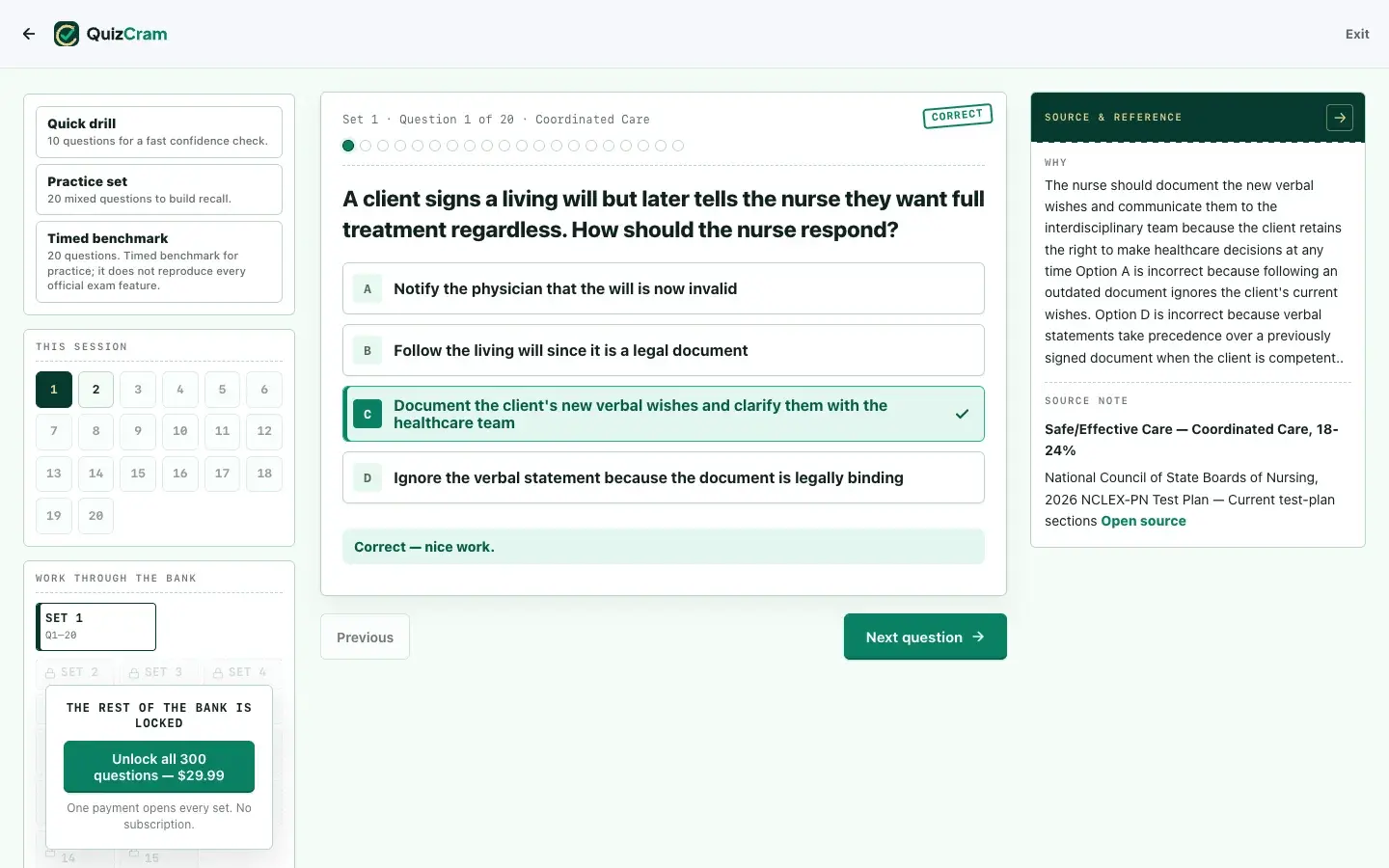
- Q1Coordinated Care
A client signs a living will but later tells the nurse they want full treatment regardless. How should the nurse respond?
The answer is C.
The nurse should document the new verbal wishes and communicate them to the interdisciplinary team because the client retains the right to make healthcare decisions at any time Option A is incorrect because following an outdated document ignores the client's current wishes. Option D is incorrect because verbal statements take precedence over a previously signed document when the client is competent..
Tap an answer to check it
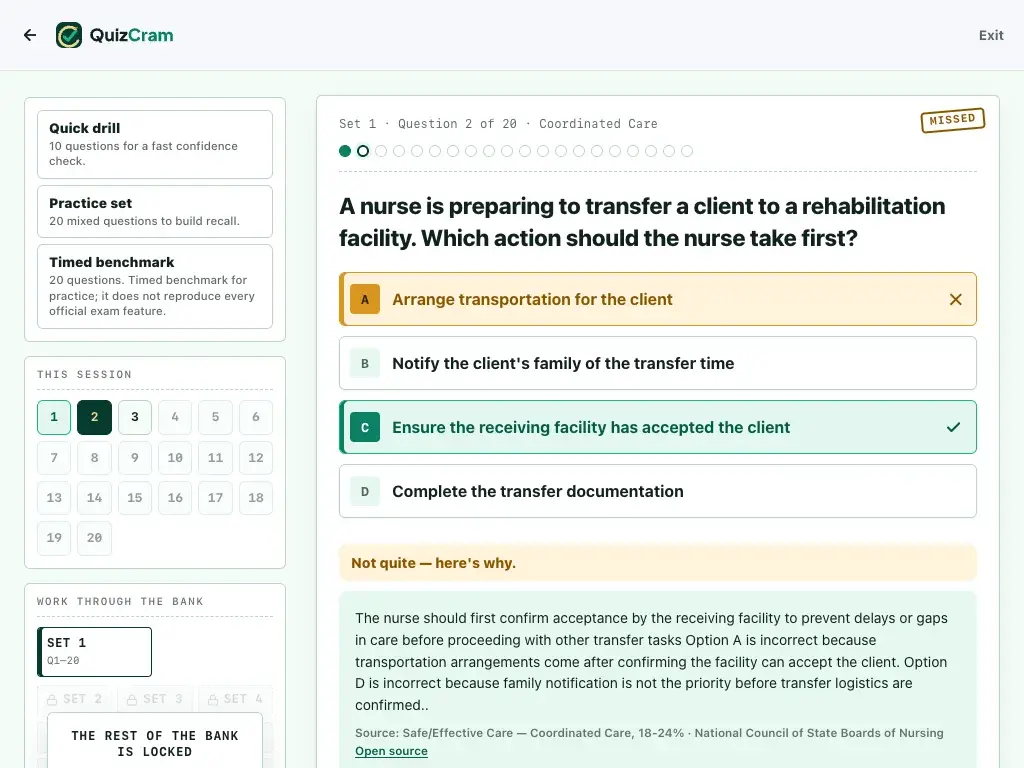
- Q2Coordinated Care
A nurse is preparing to transfer a client to a rehabilitation facility. Which action should the nurse take first?
The answer is C.
The nurse should first confirm acceptance by the receiving facility to prevent delays or gaps in care before proceeding with other transfer tasks Option A is incorrect because transportation arrangements come after confirming the facility can accept the client. Option D is incorrect because family notification is not the priority before transfer logistics are confirmed..
Tap an answer to check it
- Q3Coordinated Care
A client refuses a blood transfusion on religious grounds. The nurse notes that the physician has ordered the transfusion. What is the nurse's priority action?
The answer is B.
The nurse must document the refusal and notify the physician. The client has the right to refuse treatment, and the nurse advocates for informed decisions. Option A is incorrect because a physician order does not override a competent client's right to refuse. Option C is incorrect because persuading or coercing the client violates autonomy and informed consent. Option D is incorrect because an advocate cannot override a competent client's refusal.
Tap an answer to check it
Study plan
How to pass the NCLEX-PN
Learn each domain, drill until it’s automatic, then prove it in a timed mock exam.
- Step 1
Master the 4 Client Needs categories: Safe Care, Health Promotion, Psychosocial, Physiological
- Step 2
Practice prioritization and delegation — the #1 tested skill across all categories
- Step 3
Learn pharmacology essentials: drug classes, side effects, patient teaching
- Step 4
Drill clinical judgment: recognize cues, analyze cues, prioritize hypotheses, take action, evaluate outcomes
- Test day
Book the real test once you clear the pass mark comfortably, twice in a row.
Exam simulator
Sit a timed mock exam for the NCLEX-PN
- A real countdown. One question at a time, no feedback until you submit.
- Flag and review. Mark questions to come back to before you hand in.
- Score by topic. Your result against the target, every answer explained.
Questions are mixed by the weights NCSBN publishes, so the topics match how the exam is built.
The free mock exam runs 20 questions from the free set, once. Unlocking adds full-length runs of 85 questions from the whole bank. A practice mock exam, not an official replica.
- Free taster
- 20 q
- Full run
- 85 q
- Practice clock
- 85 min
- Target
- 85%
Free vs. full
Start free. Unlock when you’re ready.
Free
$0
No account, no card
- 20 original questions with source notes
- Instant scoring
- One free timed mock exam (20 questions)
- Free account adds saved progress + mistake review
Full bank
$29.99 one-time
No subscription · yours forever · 3-day money-back guarantee
- All 300 questions, every topic
- 85-question timed exam simulator; see the score note below
- Saved mistake review, ad-free
Internal QuizCram practice target. NCLEX uses computer-adaptive testing and an official logit passing standard, not a raw percentage.
What failing the NCLEX-PN exam costs
- Wait to retest
- 45 test-free days between exams
- Attempt limits
- Up to 8 times a year; some nursing regulatory bodies set stricter limits or longer waits
Source: NCLEX — results and retakes, NCSBN, checked September 30, 2026. The full bank is $29.99, once.
Free study kit
Everything free for the NCLEX-PN test


About these questions
How we check these questions
- Written from the source. Every question is our own wording of a fact in the 2026 NCSBN NCLEX-PN Test Plan & Clinical Judgment Measurement Model, never copied from a real exam.
- Checked against its section. Each answer names the section it comes from, and the answer is checked against that text. Anything we cannot confirm there is not published.
- Machine checks on the whole bank. Validators look for duplicates, missing explanations and missing sources.
- Re-checked on changes. When NCSBN revises the source, the bank is audited again. Last update: October 7, 2026.
Questions written from the 2026 NCLEX-PN Test Plan (NCSBN) and verified against its clinical judgment framework. Spot an error? Email [email protected] with the question; we check it against the source and fix confirmed errors. Editorial policy.
- Updated October 7, 2026
- v7 · 300 questions
- 20 free with answers
- Read the source
Tried the NCLEX-PN questions?
Good to know
NCLEX-PN FAQ
The Next Generation NCLEX-PN (NGN) delivers between 85 and 150 items using Computerized Adaptive Testing (CAT). This includes 15 unscored pretest items. The maximum test time is 5 hours.
NCSBN uses a logit passing standard (-0.18 logits on the current scale). The exam stops once the computer is 95% certain that your ability is either clearly above or clearly below the passing standard.
If the exam terminates at the minimum of 85 questions, it means the computer has reached 95% statistical certainty about your result. If you were answering challenging questions and performing above the passing standard, an 85-question cutoff typically indicates a pass.
Yes. Every NCLEX-PN candidate receives 3 clinical judgment case studies with 6 questions each (18 items total), testing the 6 cognitive steps: recognize cues, analyze cues, prioritize hypotheses, generate solutions, take action, and evaluate outcomes. QuizCram's practice questions are standard four-option multiple choice with rationales; they do not reproduce the case-study item types.
NCSBN requires a minimum 45-day waiting period between exam attempts, though individual state boards of nursing may set additional local retake policies.
Yes. Open the exam simulator and sit a timed mock exam of 20 questions built from the free questions, once, with no signup. Unlocking the exam adds full-length runs of 85 questions in 85 minutes (a practice clock), as many as you like, each a new draw from the whole bank.
It splits the questions across the exam's areas using the weights NCSBN publishes, then picks questions inside each area, favouring ones you missed before and never repeating one within a run. A retake is a new draw, so you will meet different questions. It is a practice mock exam, not an official replica of the real exam.
Taking another test?
More live exams
 HealthcareCNA CertificationTarget 80%40 free · 300 Qs$14.99 one time
 HealthcarePharmacy Technician (PTCE)Target 75%40 free · 300 Qs$19.99 one time
 HealthcareNHA CCMA Medical AssistantTarget 78%40 free · 300 Qs$19.99 one time
 HealthcareNHA CPT PhlebotomyTarget 78%40 free · 300 Qs$19.99 one time
 HealthcareNCLEX-RNTarget 85%20 free · 300 Qs$29.99 one time
 HealthcareNREMT EMTTarget 75%20 free · 300 Qs$19.99 one time
 HealthcareHESI A2Target 75%40 free · 300 Qs$24.99 one time
 HealthcareATI TEAS 7Target 75%40 free · 300 Qs$14.99 one time
 Driving & LicensesCalifornia DMV Permit83% to pass20 free · 300 Qs$8.99 one time
 Driving & LicensesTexas DMV Permit70% to pass20 free · 300 Qs$8.99 one time
 Driving & LicensesFlorida Class E Permit80% to pass20 free · 300 Qs$8.99 one time
- Driving & LicensesNew York DMV Permit70% to pass20 free · 300 Qs$8.99 one time
- Driving & LicensesPennsylvania DMV Permit83% to pass20 free · 300 Qs$8.99 one time
- Driving & LicensesOhio BMV Permit75% to pass20 free · 300 Qs$8.99 one time
- Driving & LicensesGeorgia DDS Permit75% to pass20 free · 300 Qs$8.99 one time
- Driving & LicensesNorth Carolina DMV Permit80% to pass20 free · 300 Qs$8.99 one time
- Driving & LicensesNew Jersey MVC Permit80% to pass20 free · 300 Qs$8.99 one time
- Driving & LicensesVirginia DMV Permit80% to pass20 free · 300 Qs$8.99 one time
- Driving & LicensesArizona MVD Permit80% to pass20 free · 300 Qs$8.99 one time
- Driving & LicensesWashington DOL Permit80% to pass20 free · 300 Qs$8.99 one time
- Driving & LicensesIllinois SOS PermitTarget 80%20 free · 300 Qs$8.99 one time
- Driving & LicensesIndiana BMV Permit80% to pass20 free · 300 Qs$8.99 one time
- Driving & LicensesTennessee DOS Permit80% to pass20 free · 300 Qs$8.99 one time
- Driving & LicensesMissouri DOR Permit80% to pass20 free · 300 Qs$8.99 one time
- Driving & LicensesKentucky DMV Permit80% to pass20 free · 300 Qs$8.99 one time
- Driving & LicensesMaryland MVA Permit88% to pass20 free · 300 Qs$8.99 one time
- Driving & LicensesMinnesota DVS Permit80% to pass20 free · 300 Qs$8.99 one time
- Driving & LicensesAlabama ALEA PermitTarget 80%20 free · 300 Qs$8.99 one time
- Driving & LicensesSouth Carolina SCDMV Permit80% to pass20 free · 300 Qs$8.99 one time
- Driving & LicensesColorado DMV PermitTarget 80%20 free · 300 Qs$8.99 one time
- Driving & LicensesOregon DMV Permit80% to pass20 free · 300 Qs$8.99 one time
- Driving & LicensesOklahoma Driver License75% to pass20 free · 300 Qs$8.99 one time
- Driving & LicensesMichigan Driver LicenseTarget 80%20 free · 300 Qs$8.99 one time
- Driving & LicensesNevada Driver License80% to pass20 free · 300 Qs$8.99 one time
- Driving & LicensesUtah Driver License80% to pass20 free · 300 Qs$8.99 one time
- Driving & LicensesMassachusetts RMV Permit72% to pass20 free · 300 Qs$8.99 one time
 Professional CertificationsReal Estate Salesperson70% to pass20 free · 300 Qs$24.99 one time
 Professional CertificationsCompTIA A+ Core 1Target 75%40 free · 300 Qs$19.99 one time
 TradesCA General Electrician70% to pass20 free · 300 Qs$24.99 one time
- TradesEPA 608Target 70%40 free · 300 Qs$19.99 one time
- Professional CertificationsFINRA Series 7Target 72%20 free · 300 Qs$19.99 one time
 Driving & LicensesCalifornia Motorcycle (Class M)80% to pass20 free · 300 Qs$8.99 one time
 Professional CertificationsServSafe Manager70% to pass40 free · 300 Qs$14.99 one time
 Driving & LicensesCDL General Knowledge80% to pass20 free · 300 Qs$8.99 one time
- Driving & LicensesAir Brakes80% to pass20 free · 100 Qs$8.99 one time
- Driving & LicensesCombination80% to pass20 free · 100 Qs$8.99 one time
- Driving & LicensesTanker80% to pass20 free · 80 Qs$6.99 one time
- Driving & LicensesPassenger80% to pass20 free · 80 Qs$6.99 one time
- Driving & LicensesSchool Bus80% to pass20 free · 80 Qs$6.99 one time
- Driving & LicensesHazmat80% to pass20 free · 150 Qs$8.99 one time
 Professional CertificationsASVABTarget 70%40 free · 300 Qs$14.99 one time
- Professional CertificationsGEDTarget 70%20 free · 300 Qs$14.99 one time
 Professional CertificationsCompTIA Network+ (N10-009)Target 80%20 free · 300 Qs$19.99 one time
 Professional CertificationsCompTIA Security+ (SY0-701)Target 83%20 free · 300 Qs$19.99 one time
 Professional CertificationsFood Handler CertificateTarget 75%20 free · 300 Qs$8.99 one time
 Driving & LicensesOntario G1 Knowledge TestTarget 80%20 free · 300 Qs$8.99 one time
Related Healthcare certifications
More Healthcare practice tests
Prepare for related national certifications and licensing exams with realistic practice questions, instant explanations, and verified study resources.