All exams/Trades
Free practice test · 300 original questionsFree practice · 300 questions
California General Electrician Practice Test (2026)
This free California General Electrician certification practice exam covers the state DLSE test: 100 questions, 70% to pass, with questions referenced directly to the National Electrical Code (NEC).
- 100 multiple-choice questions
- 70% to pass
- 4.5-hour limit
- supplied electronic references
- No signup to start
- Every answer includes a source note
- Updated November 6, 2026
Try one now
A real California General Electrician question
Pick an answer. You will see whether you are right, why, and the source it comes from. No signup.
- 20 free questions like this one
- An explanation and a source note on every answer
- The full bank is $24.99, once
A dwelling unit has a 240-volt, 12-kW electric range. Using the standard calculation method, what is the demand load for the range?
The real test at a glance
How many questions are on the California General Electrician test, and what score passes?
The California General Electrician test has 100 questions. You need 70 correct (70%) to pass, so you can miss 30 questions. The time limit is 270 minutes.
Need 70 of 100You can miss 30
- 100questions on the real test
- 70%needed to pass
- 300practice questions here, 20 free
- Checked againstCalifornia Electrician Certification Examination & NEC NFPA 70
Questions written from the CA DLSE General Electrician content outline and verified against NEC 2023. Published California General Electrician threshold; confirm the current candidate bulletin before test day.
See it on your device
What the real exam covers
The 10 areas of the CA General Electrician and their weights
Share of scored questions per area, from the California DLSE blueprint (General Electrician (California DLSE, 100 questions)). All 300 questions in this bank are filed under these areas.
- Safety6% of the exam
- Maintenance and repair6% of the exam
- Grounding and bonding9% of the exam
- Motors7% of the exam
- Overcurrent protection6% of the exam
- Conductor sizing, feeders and branch circuits9% of the exam
- Service sizing3% of the exam
- Box and conduit sizing7% of the exam
- Electrical theory and calculations5% of the exam
- Wiring methods, equipment and devices42% of the exam
Source: California DLSE Electrician Certification Unit, General Electrician content outline, checked October 14, 2026.
Ohm’s Law, Power Wheel & NEC Conductor Reference
Fundamental electrical formulas, power calculations, and National Electrical Code conductor sizing tested on the California General Electrician certification exam.
I = V / R (Current in Amps) · R = V / I (Resistance in Ohms). Core relation for DC and pure resistive AC circuits.
Joule’s Law: P = I² × R · P = V² / R. Power dissipated as heat increases with current squared.
Multiply Line-to-Line voltage by √3 (≈ 1.732) and Power Factor (cos θ) for balanced 208V and 480V three-phase systems.
(NEC 210.20(A)) Any load running continuously for 3+ hours requires overcurrent protection rated for 100% noncontinuous + 125% continuous load.
Standard Copper Branch Conductors & Box Fill (NEC 240.4(D) & Table 314.16(A))
From the question bank
Try 3 more real questions
Tap an answer to check it. Every explanation cites the official source.
- Q1Wiring methods
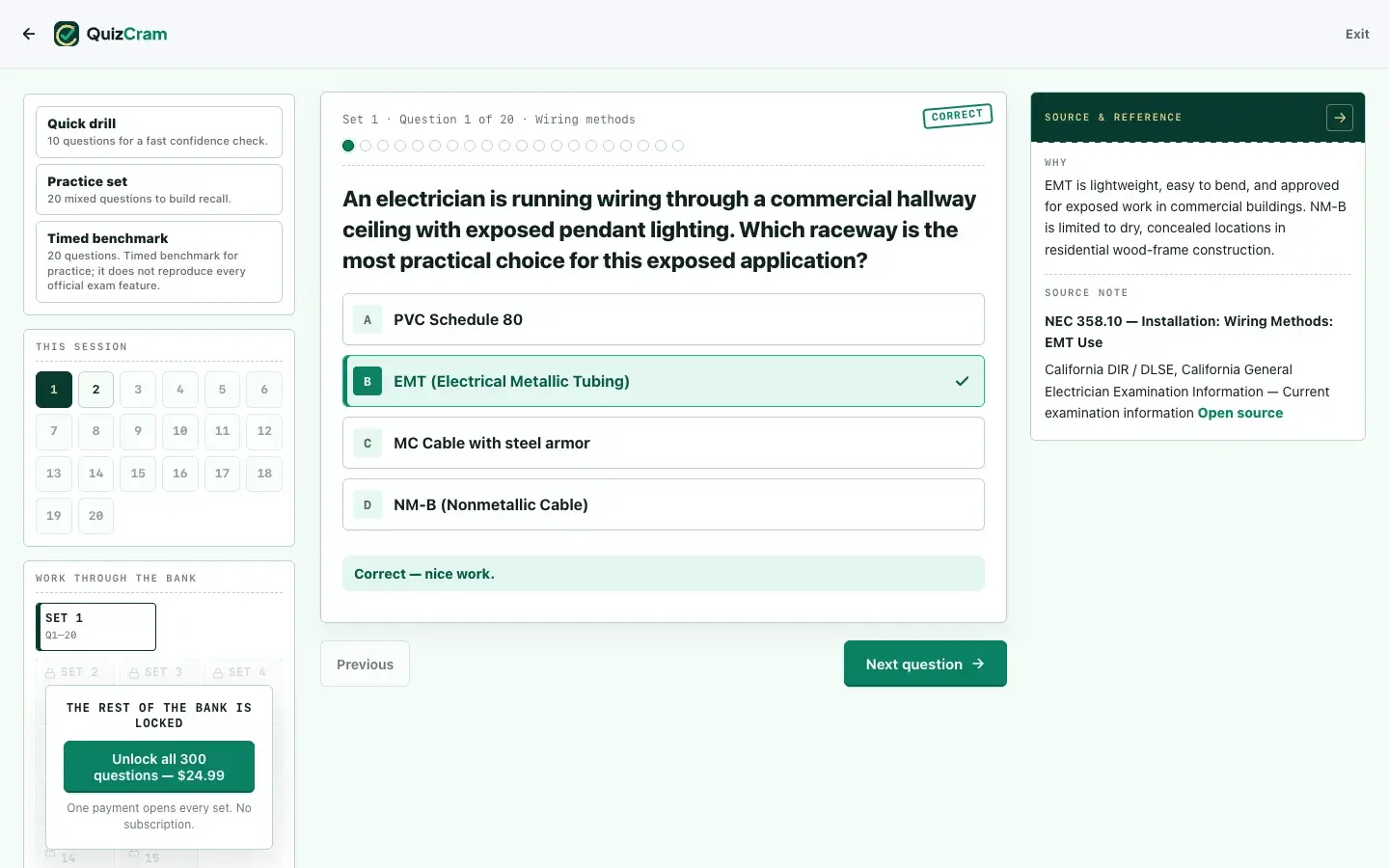
An electrician is running wiring through a commercial hallway ceiling with exposed pendant lighting. Which raceway is the most practical choice for this exposed application?
The answer is C.
EMT is lightweight, easy to bend, and approved for exposed work in commercial buildings. NM-B is limited to dry, concealed locations in residential wood-frame construction.
Tap an answer to check it
- Q2Grounding and bonding
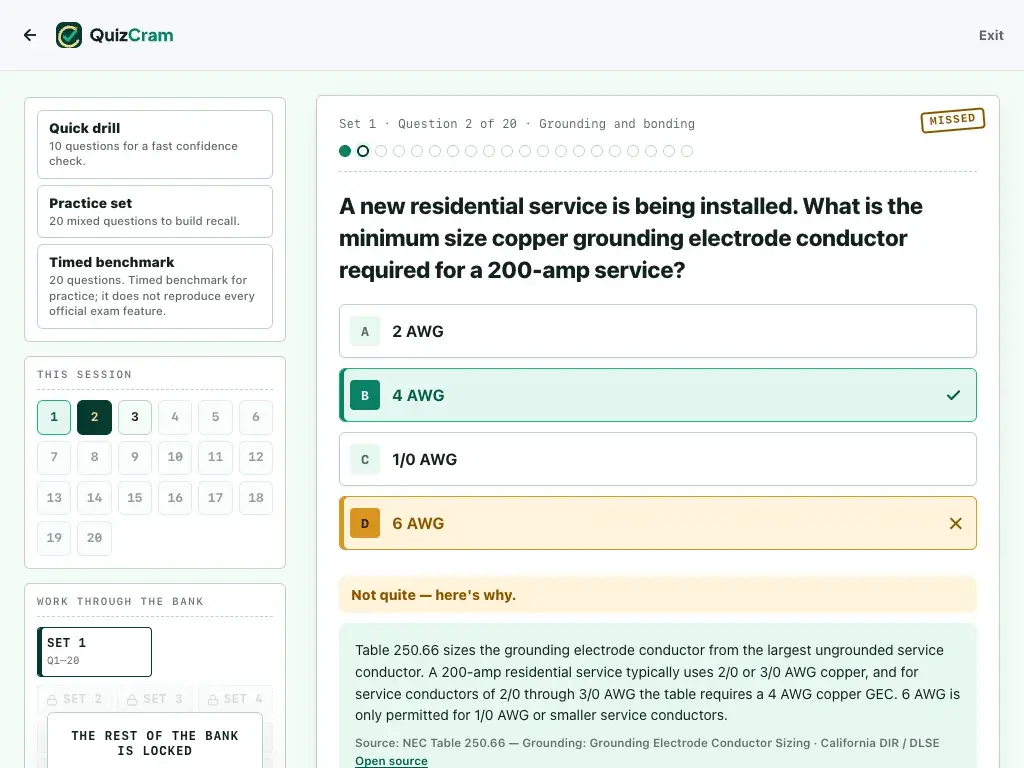
A new residential service is being installed. What is the minimum size copper grounding electrode conductor required for a 200-amp service?
The answer is C.
Table 250.66 sizes the grounding electrode conductor from the largest ungrounded service conductor. A 200-amp residential service typically uses 2/0 or 3/0 AWG copper, and for service conductors of 2/0 through 3/0 AWG the table requires a 4 AWG copper GEC. 6 AWG is only permitted for 1/0 AWG or smaller service conductors.
Tap an answer to check it
- Q3Boxes and conduit
During rough-in inspection, an inspector checks a box holding six 12 AWG insulated conductors, two 12 AWG pigtails that stay inside the box, internal cable clamps and one receptacle. What is the minimum box volume required?
The answer is C.
Under NEC 314.16(B), the six 12 AWG conductors count 6 × 2.25 = 13.5 in³, the internal clamps count once at the largest conductor (2.25 in³), and the receptacle's yoke counts twice (4.5 in³). A conductor no part of which leaves the box, such as a pigtail, is not counted. Total: 20.25 in³. Counting the pigtails gives the wrong 24.75 in³.
Tap an answer to check it
Study plan
How to pass the California General Electrician
Learn each domain, drill until it’s automatic, then prove it in a timed mock exam.
- Step 1
Installation is 66% — wiring methods, grounding, boxes/conduit, conductor sizing
- Step 2
System Requirements (22%): load calculations, service sizing, voltage drop formulas
- Step 3
NEC Articles 210-250, 300-314, 430, 440 are the most tested — know them cold
- Step 4
Safety (6%) and Maintenance (6%) are small but easy points — lockout/tagout, testing procedures
- Test day
Book the real test once you clear the pass mark comfortably, twice in a row.
Exam simulator
Sit a timed mock exam for the CA General Electrician
- A real countdown. One question at a time, no feedback until you submit.
- Flag and review. Mark questions to come back to before you hand in.
- Score by topic. Your result against the pass mark, every answer explained.
Questions are mixed by the weights California DLSE publishes, so the topics match how the exam is built.
The free mock exam runs 20 questions from the free set, once. Unlocking adds full-length runs of 100 questions from the whole bank. A practice mock exam, not an official replica.
- Free taster
- 20 q
- Full run
- 100 q
- Time limit
- 270 min
- Pass mark
- 70%
Free vs. full
Start free. Unlock when you’re ready.
Free
$0
No account, no card
- 20 original questions with source notes
- Instant scoring
- One free timed mock exam (20 questions)
- Free account adds saved progress + mistake review
Full bank
$24.99 one-time
No subscription · yours forever · 3-day money-back guarantee
- All 300 questions, every topic
- 100-question timed exam simulator; see the score note below
- Saved mistake review, ad-free
Published California General Electrician threshold; confirm the current candidate bulletin before test day.
Free study kit
Everything free for the California General Electrician test
- 20 free questionsEvery answer explained, with its source
- Topic breakdownDrill questions by official blueprint domain
- Printable cheat sheetEvery number on the test on one page
- Electrical box fill calculatorConductors, devices, clamps and grounds counted the NEC 314.16 way, with the smallest box that fits.
- Voltage drop calculatorVoltage drop for copper or aluminum, single or three phase, with the 3% and 5% guideline checks.
- Timed practiceTake the 20 free questions as a quiz
California General Electrician Exam 2026: Format, Open-Book Rules, and the NEC Tables You Must Know
Electrician Exam Calculations: 12 Worked NEC 2023 Problems — Ampacity, Derating, Box and Conduit Fill, Voltage Drop, Motors and Dwelling Loads
How to Navigate the NEC in Under a Minute: The Chapter Map, the Numbering Logic, and the 40 Most-Tested Sections on the Electrician Exam
About these questions
How we check these questions
- Written from the source. Every question is our own wording of a fact in the California Electrician Certification Examination & NEC NFPA 70, never copied from a real exam.
- Checked against its section. Each answer names the section it comes from, and the answer is checked against that text. Anything we cannot confirm there is not published.
- Machine checks on the whole bank. Validators look for duplicates, missing explanations and missing sources.
- Re-checked on changes. When California DLSE revises the source, the bank is audited again. Last update: November 6, 2026.
Questions written from the CA DLSE General Electrician content outline and verified against NEC 2023. Spot an error? Email [email protected] with the question; we check it against the source and fix confirmed errors. Editorial policy.
- Updated November 6, 2026
- v7 · 300 questions
- 20 free with answers
- Read the source
Tried the California General Electrician questions?
Good to know
California General Electrician FAQ
The exam consists of 100 multiple-choice questions with a 4.5-hour time limit administered by PSI on behalf of the California DLSE/DIR. You need 70% (70/100 correct) to pass.
Yes. The California General Electrician exam is an open-book test based on the 2023 National Electrical Code (NEC). PSI provides an electronic reference copy of the code on the computer workstation.
Wiring methods (NEC Chapter 3), equipment for general use (NEC Chapter 4), branch circuits and feeders (NEC Articles 210 and 215), and grounding and bonding (NEC Article 250) account for the majority of the exam questions.
If you do not pass, you must wait 60 days before you can retake the examination and submit a retest fee to PSI/DIR.
Yes. Open the exam simulator and sit a timed mock exam of 20 questions built from the free questions, once, with no signup. Unlocking the exam adds full-length runs of 100 questions in 270 minutes (the published time limit), as many as you like, each a new draw from the whole bank.
It splits the questions across the exam's areas using the weights California DLSE publishes, then picks questions inside each area, favouring ones you missed before and never repeating one within a run. A retake is a new draw, so you will meet different questions. It is a practice mock exam, not an official replica of the real exam.
Taking another test?
More live exams
- TradesEPA 608Target 70%40 free · 300 Qs$19.99 one time
 Driving & LicensesCalifornia DMV Permit83% to pass20 free · 300 Qs$8.99 one time
 Driving & LicensesTexas DMV Permit70% to pass20 free · 300 Qs$8.99 one time
 Driving & LicensesFlorida Class E Permit80% to pass20 free · 300 Qs$8.99 one time
- Driving & LicensesNew York DMV Permit70% to pass20 free · 300 Qs$8.99 one time
- Driving & LicensesPennsylvania DMV Permit83% to pass20 free · 300 Qs$8.99 one time
- Driving & LicensesOhio BMV Permit75% to pass20 free · 300 Qs$8.99 one time
- Driving & LicensesGeorgia DDS Permit75% to pass20 free · 300 Qs$8.99 one time
- Driving & LicensesNorth Carolina DMV Permit80% to pass20 free · 300 Qs$8.99 one time
- Driving & LicensesNew Jersey MVC Permit80% to pass20 free · 300 Qs$8.99 one time
- Driving & LicensesVirginia DMV Permit80% to pass20 free · 300 Qs$8.99 one time
- Driving & LicensesArizona MVD Permit80% to pass20 free · 300 Qs$8.99 one time
- Driving & LicensesWashington DOL Permit80% to pass20 free · 300 Qs$8.99 one time
- Driving & LicensesIllinois SOS PermitTarget 80%20 free · 300 Qs$8.99 one time
- Driving & LicensesIndiana BMV Permit80% to pass20 free · 300 Qs$8.99 one time
- Driving & LicensesTennessee DOS Permit80% to pass20 free · 300 Qs$8.99 one time
- Driving & LicensesMissouri DOR Permit80% to pass20 free · 300 Qs$8.99 one time
- Driving & LicensesKentucky DMV Permit80% to pass20 free · 300 Qs$8.99 one time
- Driving & LicensesMaryland MVA Permit88% to pass20 free · 300 Qs$8.99 one time
- Driving & LicensesMinnesota DVS Permit80% to pass20 free · 300 Qs$8.99 one time
- Driving & LicensesAlabama ALEA PermitTarget 80%20 free · 300 Qs$8.99 one time
- Driving & LicensesSouth Carolina SCDMV Permit80% to pass20 free · 300 Qs$8.99 one time
- Driving & LicensesColorado DMV PermitTarget 80%20 free · 300 Qs$8.99 one time
- Driving & LicensesOregon DMV Permit80% to pass20 free · 300 Qs$8.99 one time
- Driving & LicensesOklahoma Driver License75% to pass20 free · 300 Qs$8.99 one time
- Driving & LicensesMichigan Driver LicenseTarget 80%20 free · 300 Qs$8.99 one time
- Driving & LicensesNevada Driver License80% to pass20 free · 300 Qs$8.99 one time
- Driving & LicensesUtah Driver License80% to pass20 free · 300 Qs$8.99 one time
- Driving & LicensesMassachusetts RMV Permit72% to pass20 free · 300 Qs$8.99 one time
 Professional CertificationsReal Estate Salesperson70% to pass20 free · 300 Qs$24.99 one time
 Professional CertificationsCompTIA A+ Core 1Target 75%40 free · 300 Qs$19.99 one time
 HealthcareNCLEX-PNTarget 85%20 free · 300 Qs$29.99 one time
 HealthcareCNA CertificationTarget 80%40 free · 300 Qs$14.99 one time
- Professional CertificationsFINRA Series 7Target 72%20 free · 300 Qs$19.99 one time
 Driving & LicensesCalifornia Motorcycle (Class M)80% to pass20 free · 300 Qs$8.99 one time
 HealthcarePharmacy Technician (PTCE)Target 75%40 free · 300 Qs$19.99 one time
 HealthcareNHA CCMA Medical AssistantTarget 78%40 free · 300 Qs$19.99 one time
 HealthcareNHA CPT PhlebotomyTarget 78%40 free · 300 Qs$19.99 one time
 Professional CertificationsServSafe Manager70% to pass40 free · 300 Qs$14.99 one time
 HealthcareNCLEX-RNTarget 85%20 free · 300 Qs$29.99 one time
 HealthcareNREMT EMTTarget 75%20 free · 300 Qs$19.99 one time
 HealthcareHESI A2Target 75%40 free · 300 Qs$24.99 one time
 Driving & LicensesCDL General Knowledge80% to pass20 free · 300 Qs$8.99 one time
- Driving & LicensesAir Brakes80% to pass20 free · 100 Qs$8.99 one time
- Driving & LicensesCombination80% to pass20 free · 100 Qs$8.99 one time
- Driving & LicensesTanker80% to pass20 free · 80 Qs$6.99 one time
- Driving & LicensesPassenger80% to pass20 free · 80 Qs$6.99 one time
- Driving & LicensesSchool Bus80% to pass20 free · 80 Qs$6.99 one time
- Driving & LicensesHazmat80% to pass20 free · 150 Qs$8.99 one time
 Professional CertificationsASVABTarget 70%40 free · 300 Qs$14.99 one time
- Professional CertificationsGEDTarget 70%20 free · 300 Qs$14.99 one time
 Professional CertificationsCompTIA Network+ (N10-009)Target 80%20 free · 300 Qs$19.99 one time
 Professional CertificationsCompTIA Security+ (SY0-701)Target 83%20 free · 300 Qs$19.99 one time
 Professional CertificationsFood Handler CertificateTarget 75%20 free · 300 Qs$8.99 one time
 HealthcareATI TEAS 7Target 75%40 free · 300 Qs$14.99 one time
 Driving & LicensesOntario G1 Knowledge TestTarget 80%20 free · 300 Qs$8.99 one time
Related Trades certifications
More Trades practice tests
Prepare for related national certifications and licensing exams with realistic practice questions, instant explanations, and verified study resources.