EPA Section 608 Technician Certification/Cheat sheet
EPA Section 608 Technician Certification cheat sheet: key rules and summary
100 multiple-choice questions across Core, Type I, Type II, and Type III (25 questions each, 70% per section to pass).
- 20 numbers
- 4 sections
- 4 rules people get wrong
Memorise these first
- 30% per yearIndustrial process refrigeration (IPR) systems with 50+ lbs of refrigerant
- 0 in HgVery high-pressure appliances (R-13, R-503, R-744/CO2)
- CFC (R-11, R-12)Chlorofluorocarbon: Chlorine, Fluorine, Carbon — highest Ozone Depletion Potential (ODP)
Leak rate trigger thresholds (50+ lbs)
- 30% per year
- Industrial process refrigeration (IPR) systems with 50+ lbs of refrigerant40 CFR § 82.156 — Leak Repair Requirements
- 20% per year
- Commercial refrigeration equipment (supermarket racks, cold storage)40 CFR § 82.156 — Leak Repair Requirements
- 10% per year
- Comfort cooling appliances (residential/commercial central AC and chillers)40 CFR § 82.156 — Leak Repair Requirements
- 30 days
- Standard timeline to repair leaks exceeding the threshold and perform initial verification test40 CFR § 82.156 — Leak Repair Requirements
- 10 days
- Follow-up verification test timeline after leak repair completion40 CFR § 82.156 — Leak Repair Requirements
- 1 year
- Maximum time allowed to retrofit or retire an appliance that cannot be repaired within 30 days40 CFR § 82.156 — Leak Repair Requirements
Required evacuation levels (inches of Hg)
- 0 in Hg
- Very high-pressure appliances (R-13, R-503, R-744/CO2)40 CFR § 82.156 — Required Evacuation Levels
- 0 in Hg (before 1993) / 10 in Hg (after)
- High-pressure appliance with <200 lbs of refrigerant (R-22, R-410A)40 CFR § 82.156 — Required Evacuation Levels
- 4 in Hg (before 1993) / 15 in Hg (after)
- High-pressure appliance with 200+ lbs of refrigerant40 CFR § 82.156 — Required Evacuation Levels
- 25 in Hg (before 1993) / 25 mm Hg abs (after)
- Low-pressure appliances (R-11, R-123 chillers)40 CFR § 82.156 — Required Evacuation Levels
- 4 inches of vacuum
- Type I small appliances when compressor is NOT operating (90% recovery with operating compressor)Type I Small Appliances Recovery
Refrigerant chemistry & ozone depletion
- CFC (R-11, R-12)
- Chlorofluorocarbon: Chlorine, Fluorine, Carbon — highest Ozone Depletion Potential (ODP)Ozone Depletion Chemistry
- HCFC (R-22, R-123)
- Hydrochlorofluorocarbon: Hydrogen, Chlorine, Fluorine, Carbon — medium ODPOzone Depletion Chemistry
- HFC (R-134a, R-410A)
- Hydrofluorocarbon: Zero ODP, but high Global Warming Potential (GWP)Ozone Depletion Chemistry
- HFO (R-1234yf)
- Hydrofluoroolefin: Zero ODP and ultra-low GWP (A2L mildly flammable)Ozone Depletion Chemistry
- Chlorine atom
- One chlorine atom can destroy up to 100,000 ozone (O3) molecules in the stratosphereStratospheric Ozone Depletion
Safety, cylinders & recovery rules
- 80% maximum
- Maximum liquid fill capacity of a refillable refrigerant recovery cylinderRefrigerant Cylinder Safety
- Gray with yellow top
- Approved color scheme for refillable refrigerant recovery cylindersRefrigerant Cylinder Safety
- 5 years
- Hydrostatic test interval for refillable recovery cylindersDOT Cylinder Regulations
- 3 years
- Record retention period for disposal of mid-sized appliances (5 to 50 lbs of refrigerant)Recordkeeping Requirements
Second read
Rules people get wrong
- Never use oxygen or compressed air to pressurize a refrigeration system for leak checking. Oxygen mixed with compressor oil or refrigerants will violently explode. Always use dry nitrogen.
- Never heat a refrigerant cylinder with an open flame or torch. Heating causes pressure relief valves to burst or cylinder walls to rupture.
- R-410A is a near-azeotropic HFC blend that operates at approximately 60% higher pressure than R-22 and requires manifolds and gauges rated for 800 psi.
- Venting prohibition: Section 608 of the Clean Air Act prohibits knowingly venting any ozone-depleting substance or substitute refrigerant during service, maintenance, or disposal.
Take it with you
Save it as one poster
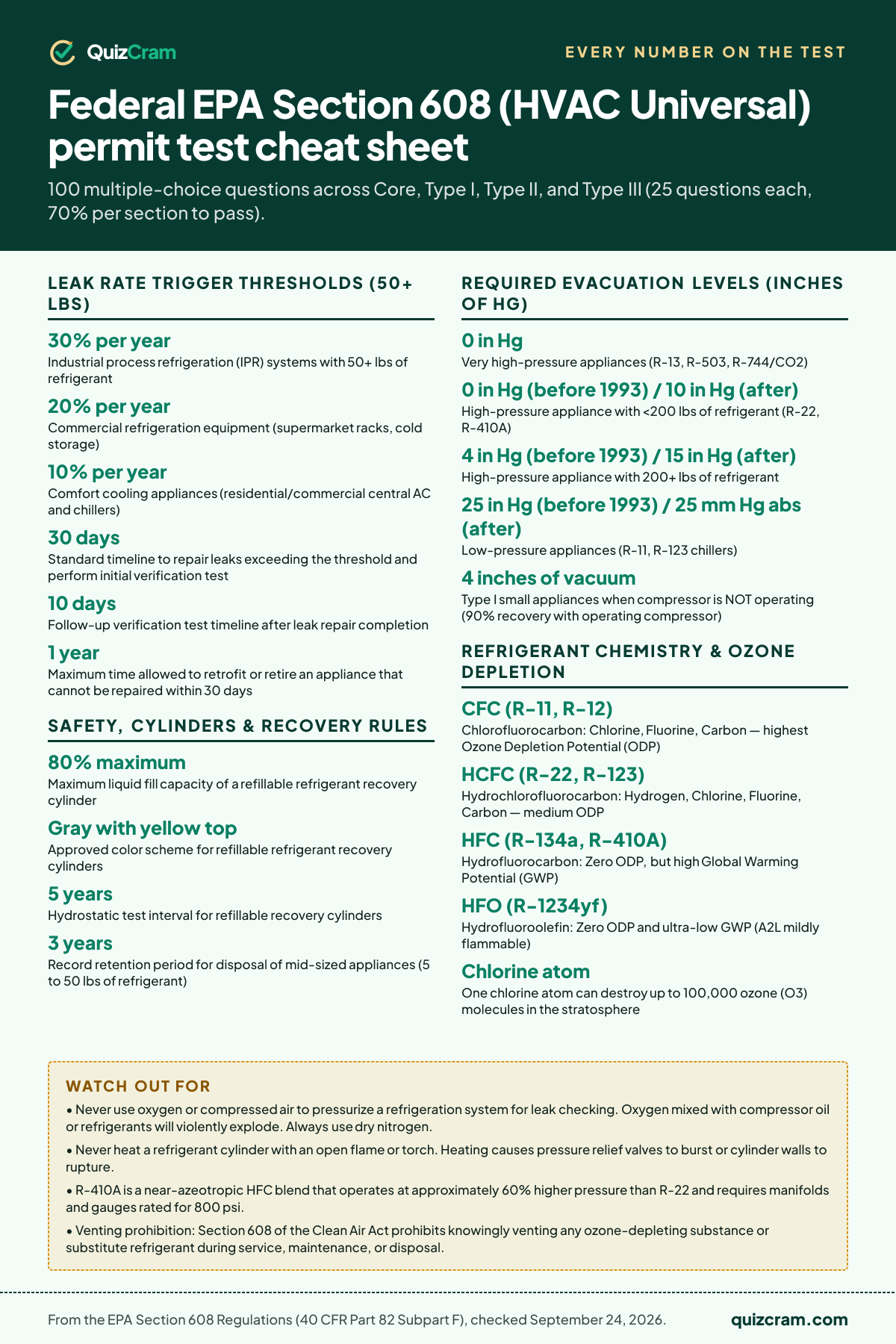
Knowing the numbers is half of it. Can you apply them?
The real test asks these as scenarios. Take the 20 free Federal EPA Section 608 (HVAC Universal) questions — each answer explains the rule and cites the handbook section. If you want the full bank and timed practice tests, it’s a one-time $19.99.