Washington DOL Permit/Cheat sheet
Washington DMV cheat sheet: every number on the permit test
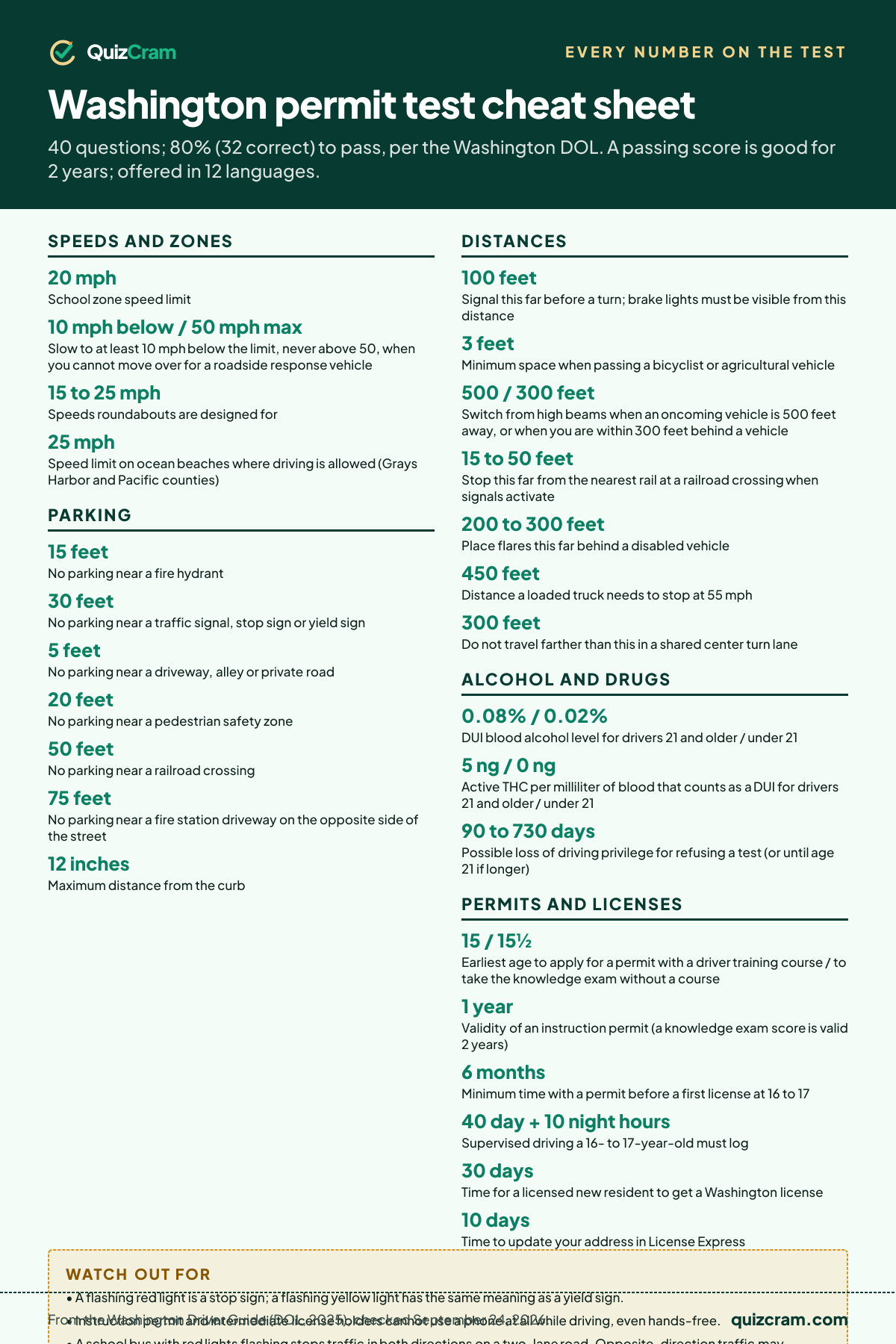
40 questions; 80% (32 correct) to pass, per the Washington DOL. A passing score is good for 2 years; offered in 12 languages.
- 27 numbers
- 5 sections
- 5 rules people get wrong
Memorise these first
- 20 mphSchool zone speed limit
- 100 feetSignal this far before a turn; brake lights must be visible from this distance
- 15 feetNo parking near a fire hydrant
Speed Limits
Essential- 20 mph
- School zone speed limit
- 10 mph below / 50 mph max
- Slow to at least 10 mph below the limit, never above 50, when you cannot move over for a roadside response vehicle
- 15 to 25 mph
- Speeds roundabouts are designed for
BAC & Alcohol
Zero Tolerance- 0.08% / 0.02%
- DUI blood alcohol level for drivers 21 and older / under 21
- 5 ng / 0 ng
- Active THC per milliliter of blood that counts as a DUI for drivers 21 and older / under 21
- 90 to 730 days
- Possible loss of driving privilege for refusing a test (or until age 21 if longer)
Fines & Penalties
Enforced- 100 feet
- Signal this far before a turn; brake lights must be visible from this distance
- 3 feet
- Minimum space when passing a bicyclist or agricultural vehicle
- 500 / 300 feet
- Switch from high beams when an oncoming vehicle is 500 feet away, or when you are within 300 feet behind a vehicle
Speeds and zones
- 20 mph
- School zone speed limit4.17 Zones (school zone)
- 10 mph below / 50 mph max
- Slow to at least 10 mph below the limit, never above 50, when you cannot move over for a roadside response vehicle4.17 Zones (emergency zone)
- 15 to 25 mph
- Speeds roundabouts are designed for4.15 Other intersections (roundabouts)
- 25 mph
- Speed limit on ocean beaches where driving is allowed (Grays Harbor and Pacific counties)4.20 Maritime (beaches)
Distances
- 100 feet
- Signal this far before a turn; brake lights must be visible from this distance4.14 Turning; 2.5 Vehicle maintenance
- 3 feet
- Minimum space when passing a bicyclist or agricultural vehicle4.6 Sharing with bicyclists; 4.8
- 500 / 300 feet
- Switch from high beams when an oncoming vehicle is 500 feet away, or when you are within 300 feet behind a vehicle2.5 Vehicle maintenance (headlights)
- 15 to 50 feet
- Stop this far from the nearest rail at a railroad crossing when signals activate4.7 Sharing the road with trains
- 200 to 300 feet
- Place flares this far behind a disabled vehicle5.7 Vehicle failures
- 450 feet
- Distance a loaded truck needs to stop at 55 mph4.4 Sharing with large vehicles
- 300 feet
- Do not travel farther than this in a shared center turn lane4.16 Road markings (lanes)
Parking
- 15 feet
- No parking near a fire hydrant4.18 Parking (general parking rules)
- 30 feet
- No parking near a traffic signal, stop sign or yield sign4.18 Parking (general parking rules)
- 5 feet
- No parking near a driveway, alley or private road4.18 Parking (general parking rules)
- 20 feet
- No parking near a pedestrian safety zone4.18 Parking (general parking rules)
- 50 feet
- No parking near a railroad crossing4.18 Parking (general parking rules)
- 75 feet
- No parking near a fire station driveway on the opposite side of the street4.18 Parking (general parking rules)
- 12 inches
- Maximum distance from the curb4.18 Parking (general parking rules)
Alcohol and drugs
- 0.08% / 0.02%
- DUI blood alcohol level for drivers 21 and older / under 211.15 Maintaining your license (driving under the influence)
- 5 ng / 0 ng
- Active THC per milliliter of blood that counts as a DUI for drivers 21 and older / under 211.15 Maintaining your license (THC concentration)
- 90 to 730 days
- Possible loss of driving privilege for refusing a test (or until age 21 if longer)1.15 Maintaining your license (driving under the influence)
Permits and licenses
- 15 / 15½
- Earliest age to apply for a permit with a driver training course / to take the knowledge exam without a course1.8 Getting a personal driver license (instruction permit)
- 1 year
- Validity of an instruction permit (a knowledge exam score is valid 2 years)1.8 Getting a personal driver license (instruction permit)
- 6 months
- Minimum time with a permit before a first license at 16 to 171.8 Getting a personal driver license (ages 16 to 17)
- 40 day + 10 night hours
- Supervised driving a 16- to 17-year-old must log1.8 Getting a personal driver license (ages 16 to 17)
- 30 days
- Time for a licensed new resident to get a Washington license1.5 New residents
- 10 days
- Time to update your address in License Express1.16 Additional services
Second read
Rules people get wrong
- A flashing red light is a stop sign; a flashing yellow light has the same meaning as a yield sign.
- Instruction permit and intermediate license holders cannot use a phone at all while driving, even hands-free.
- A school bus with red lights flashing stops traffic in both directions on a two-lane road. Opposite-direction traffic may continue only if there are three or more lanes separated by a median or barrier.
- When a traffic signal is out, treat the intersection as a four-way stop and yield to traffic on your right.
- Every intersection is legally a crosswalk, whether or not it is marked.
Take it with you
Save it as one poster
Knowing the numbers is half of it. Can you apply them?
The real test asks these as scenarios. Take the 20 free Washington questions — each answer explains the rule and cites the handbook section. If you want the full bank and timed practice tests, it’s a one-time $8.99.