All exams/Healthcare
Free practice test · 300 original questionsFree practice · 300 questions
NREMT EMT Practice Test
This free NREMT EMT practice test covers the five cognitive domains tested on the national registry exam: Airway/Respiration, Cardiology, Trauma, Medical, and EMS Operations.
- Computerized adaptive test
- item count and difficulty vary by candidate
- fixed passing standard
- No signup to start
- Every answer includes a source note
- Updated October 15, 2026
Try one now
A real NREMT EMT question
Pick an answer. You will see whether you are right, why, and the source it comes from. No signup.
- 20 free questions like this one
- An explanation and a source note on every answer
- The full bank is $19.99, once
You are managing the airway of an unresponsive patient who is vomiting. After suctioning the oropharynx, what is your NEXT intervention?
The real test at a glance
How many questions are on the NREMT EMT test, and what score passes?
Adaptive: length varies by candidate
- Adaptivequestions, adaptive length
- 75%practice target (no official mark)
- 300practice questions here, 20 free
- Checked againstNREMT EMT Candidate Information Bulletin & National EMS Education Standards
Questions written from the NREMT EMT Candidate Handbook and the National EMS Education Standards; not official NREMT items. Internal QuizCram practice target. NREMT uses a computerized adaptive test with a fixed entry-level competency standard and publishes no percentage passing score.
From learners on QuizCram
How learners do on these NREMT EMT questions
60
practice answers on this exam
87% right · 13% wrong
75%
practice target
Aim above it in practice before you book.
Learners have answered 60 NREMT EMT practice questions on QuizCram, and 87% of those answers were correct. Counted anonymously from finished practice sets; totals before 30 Oct 2026 come from site analytics. Practice results, not official pass rates.
See it on your device
Topic coverage
Topics covered in this bank
300 original questions, split by the topics the official source covers
Glasgow Coma Scale (GCS 15-Point Breakdown)
Scored 3 to 15. An adult with GCS ≤ 8 requires airway intervention (“GCS 8, intubate”).
- 4 Spontaneous
- 3 To sound / verbal command
- 2 To pain stimulus
- 1 No response
- 5 Oriented & converses
- 4 Confused conversation
- 3 Inappropriate words
- 2 Incomprehensible sounds
- 1 No response
- 6 Obeys commands
- 5 Localizes painful stimulus
- 4 Flexion / withdrawal from pain
- 3 Decorticate (abnormal flexion)
- 2 Decerebrate (abnormal extension)
- 1 No response (flaccid)
From the question bank
Try 3 more real questions
Tap an answer to check it. Every explanation cites the official source.
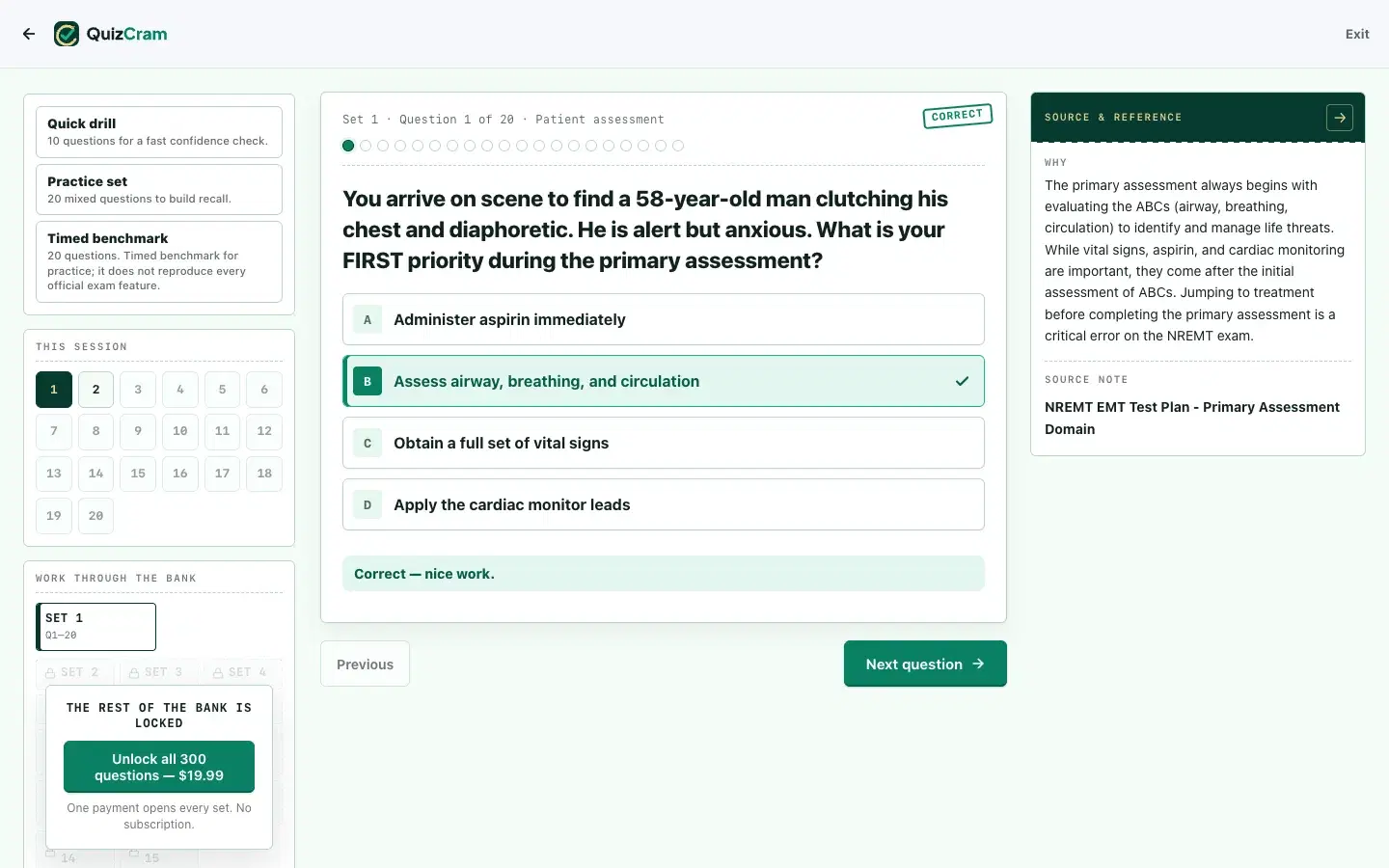
- Q1Patient assessment
You arrive on scene to find a 58-year-old man clutching his chest and diaphoretic. He is alert but anxious. What is your FIRST priority during the primary assessment?
The answer is B.
The primary assessment always begins with evaluating the ABCs (airway, breathing, circulation) to identify and manage life threats. While vital signs, aspirin, and cardiac monitoring are important, they come after the initial assessment of ABCs. Jumping to treatment before completing the primary assessment is a critical error on the NREMT exam.
Tap an answer to check it
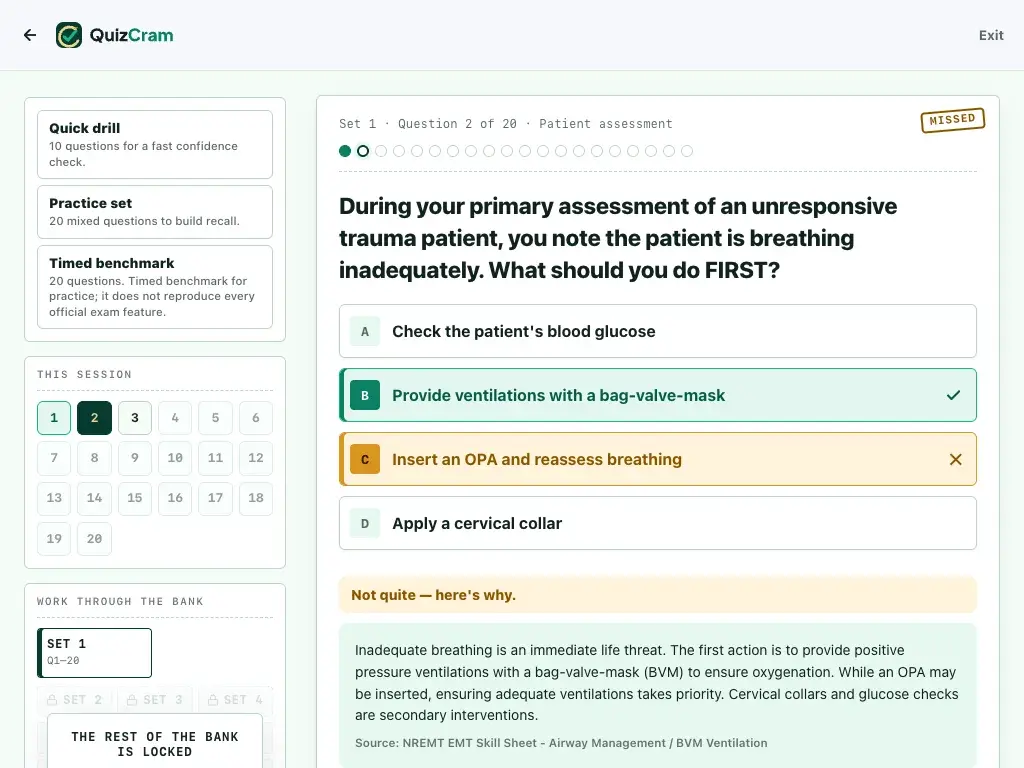
- Q2Patient assessment
During your primary assessment of an unresponsive trauma patient, you note the patient is breathing inadequately. What should you do FIRST?
The answer is D.
Inadequate breathing is an immediate life threat. The first action is to provide positive pressure ventilations with a bag-valve-mask (BVM) to ensure oxygenation. While an OPA may be inserted, ensuring adequate ventilations takes priority. Cervical collars and glucose checks are secondary interventions.
Tap an answer to check it
- Q3Patient assessment
A 72-year-old woman presents with slurred speech and left-sided weakness that began 45 minutes ago. Her blood glucose is 110 mg/dL. What is your MOST appropriate action?
The answer is C.
This patient's presentation of slurred speech, unilateral weakness, and normal glucose is highly suspicious for a stroke. Stroke patients require rapid transport to a stroke center where CT imaging and potential thrombolytic therapy within a 4.5-hour window can be initiated. Delaying transport for a detailed on-scene assessment wastes critical time.
Tap an answer to check it
Study plan
How to pass the NREMT EMT
Learn each domain, drill until it’s automatic, then prove it in a timed mock exam.
- Step 1
Work airway, breathing, and ventilation first — it gates every other intervention
- Step 2
Drill scene size-up, primary assessment, and transport decisions until they are automatic
- Step 3
Separate medical from trauma pathways: assessment order changes with the mechanism
- Step 4
Know EMS operations, patient movement, and your scope of practice as an EMT
- Test day
Book the real test once you clear the pass mark comfortably, twice in a row.
Exam simulator
Sit a timed mock exam for the NREMT EMT
- A real countdown. One question at a time, no feedback until you submit.
- Flag and review. Mark questions to come back to before you hand in.
- Score by topic. Your result against the target, every answer explained.
Topics are mixed across the whole bank, and a retake is a new draw.
The free mock exam runs 20 questions from the free set, once. Unlocking adds full-length runs of 70 questions from the whole bank. A practice mock exam, not an official replica.
- Free taster
- 20 q
- Full run
- 70 q
- Practice clock
- 70 min
- Target
- 75%
Free vs. full
Start free. Unlock when you’re ready.
Free
$0
No account, no card
- 20 original questions with source notes
- Instant scoring
- One free timed mock exam (20 questions)
- Free account adds saved progress + mistake review
Full bank
$19.99 one-time
No subscription · yours forever · 3-day money-back guarantee
- All 300 questions, every topic
- 70-question timed exam simulator; see the score note below
- Saved mistake review, ad-free
Internal QuizCram practice target. NREMT uses a computerized adaptive test with a fixed entry-level competency standard and publishes no percentage passing score.
What failing the NREMT EMT exam costs
- Wait to retest
- 15 days from your last exam date
- Attempt limits
- 6 chances; after 3 failures you must complete remedial education before the fourth attempt
Source: NREMT EMT handbook — the cognitive exam, National Registry of EMTs, checked September 30, 2026. The full bank is $19.99, once.
Free study kit
Everything free for the NREMT EMT test
About these questions
How we check these questions
- Written from the source. Every question is our own wording of a fact in the NREMT EMT Candidate Information Bulletin & National EMS Education Standards, never copied from a real exam.
- Checked against its section. Each answer names the section it comes from, and the answer is checked against that text. Anything we cannot confirm there is not published.
- Machine checks on the whole bank. Validators look for duplicates, missing explanations and missing sources.
- Re-checked on changes. When Healthcare revises the source, the bank is audited again. Last update: October 15, 2026.
Questions written from the NREMT EMT Candidate Handbook and the National EMS Education Standards; not official NREMT items. Spot an error? Email [email protected] with the question; we check it against the source and fix confirmed errors. Editorial policy.
- Updated October 15, 2026
- v4 · 300 questions
- 20 free with answers
- Read the source
Tried the NREMT EMT questions?
Good to know
NREMT EMT FAQ
The National Registry states the exam is a computerized adaptive test, so the number and difficulty of items vary for each session while the passing standard stays the same for every candidate. It does not publish an item-count range in the candidate handbook.
There is no published percentage. The exam decides whether you have reached entry-level competency, so QuizCram's percentage is a study target only.
No. This bank covers the cognitive exam only. Psychomotor skills are evaluated separately by your state or training program.
Yes. Open the exam simulator and sit a timed mock exam of 20 questions built from the free questions, once, with no signup. Unlocking the exam adds full-length runs of 70 questions in 70 minutes (a practice clock), as many as you like, each a new draw from the whole bank.
The exam's agency publishes no topic weights, so it mixes topics in proportion to the question bank, favouring questions you missed before and never repeating one within a run. A retake is a new draw, so you will meet different questions. It is a practice mock exam, not an official replica of the real exam.
Taking another test?
More live exams
 HealthcareNCLEX-PNTarget 85%20 free · 300 Qs$29.99 one time
 HealthcareCNA CertificationTarget 80%40 free · 300 Qs$14.99 one time
 HealthcarePharmacy Technician (PTCE)Target 75%40 free · 300 Qs$19.99 one time
 HealthcareNHA CCMA Medical AssistantTarget 78%40 free · 300 Qs$19.99 one time
 HealthcareNHA CPT PhlebotomyTarget 78%40 free · 300 Qs$19.99 one time
 HealthcareNCLEX-RNTarget 85%20 free · 300 Qs$29.99 one time
 HealthcareHESI A2Target 75%40 free · 300 Qs$24.99 one time
 HealthcareATI TEAS 7Target 75%40 free · 300 Qs$14.99 one time
 Driving & LicensesCalifornia DMV Permit83% to pass20 free · 300 Qs$8.99 one time
 Driving & LicensesTexas DMV Permit70% to pass20 free · 300 Qs$8.99 one time
 Driving & LicensesFlorida Class E Permit80% to pass20 free · 300 Qs$8.99 one time
- Driving & LicensesNew York DMV Permit70% to pass20 free · 300 Qs$8.99 one time
- Driving & LicensesPennsylvania DMV Permit83% to pass20 free · 300 Qs$8.99 one time
- Driving & LicensesOhio BMV Permit75% to pass20 free · 300 Qs$8.99 one time
- Driving & LicensesGeorgia DDS Permit75% to pass20 free · 300 Qs$8.99 one time
- Driving & LicensesNorth Carolina DMV Permit80% to pass20 free · 300 Qs$8.99 one time
- Driving & LicensesNew Jersey MVC Permit80% to pass20 free · 300 Qs$8.99 one time
- Driving & LicensesVirginia DMV Permit80% to pass20 free · 300 Qs$8.99 one time
- Driving & LicensesArizona MVD Permit80% to pass20 free · 300 Qs$8.99 one time
- Driving & LicensesWashington DOL Permit80% to pass20 free · 300 Qs$8.99 one time
- Driving & LicensesIllinois SOS PermitTarget 80%20 free · 300 Qs$8.99 one time
- Driving & LicensesIndiana BMV Permit80% to pass20 free · 300 Qs$8.99 one time
- Driving & LicensesTennessee DOS Permit80% to pass20 free · 300 Qs$8.99 one time
- Driving & LicensesMissouri DOR Permit80% to pass20 free · 300 Qs$8.99 one time
- Driving & LicensesKentucky DMV Permit80% to pass20 free · 300 Qs$8.99 one time
- Driving & LicensesMaryland MVA Permit88% to pass20 free · 300 Qs$8.99 one time
- Driving & LicensesMinnesota DVS Permit80% to pass20 free · 300 Qs$8.99 one time
- Driving & LicensesAlabama ALEA PermitTarget 80%20 free · 300 Qs$8.99 one time
- Driving & LicensesSouth Carolina SCDMV Permit80% to pass20 free · 300 Qs$8.99 one time
- Driving & LicensesColorado DMV PermitTarget 80%20 free · 300 Qs$8.99 one time
- Driving & LicensesOregon DMV Permit80% to pass20 free · 300 Qs$8.99 one time
- Driving & LicensesOklahoma Driver License75% to pass20 free · 300 Qs$8.99 one time
- Driving & LicensesMichigan Driver LicenseTarget 80%20 free · 300 Qs$8.99 one time
- Driving & LicensesNevada Driver License80% to pass20 free · 300 Qs$8.99 one time
- Driving & LicensesUtah Driver License80% to pass20 free · 300 Qs$8.99 one time
- Driving & LicensesMassachusetts RMV Permit72% to pass20 free · 300 Qs$8.99 one time
 Professional CertificationsReal Estate Salesperson70% to pass20 free · 300 Qs$24.99 one time
 Professional CertificationsCompTIA A+ Core 1Target 75%40 free · 300 Qs$19.99 one time
 TradesCA General Electrician70% to pass20 free · 300 Qs$24.99 one time
- TradesEPA 608Target 70%40 free · 300 Qs$19.99 one time
- Professional CertificationsFINRA Series 7Target 72%20 free · 300 Qs$19.99 one time
 Driving & LicensesCalifornia Motorcycle (Class M)80% to pass20 free · 300 Qs$8.99 one time
 Professional CertificationsServSafe Manager70% to pass40 free · 300 Qs$14.99 one time
 Driving & LicensesCDL General Knowledge80% to pass20 free · 300 Qs$8.99 one time
- Driving & LicensesAir Brakes80% to pass20 free · 100 Qs$8.99 one time
- Driving & LicensesCombination80% to pass20 free · 100 Qs$8.99 one time
- Driving & LicensesTanker80% to pass20 free · 80 Qs$6.99 one time
- Driving & LicensesPassenger80% to pass20 free · 80 Qs$6.99 one time
- Driving & LicensesSchool Bus80% to pass20 free · 80 Qs$6.99 one time
- Driving & LicensesHazmat80% to pass20 free · 150 Qs$8.99 one time
 Professional CertificationsASVABTarget 70%40 free · 300 Qs$14.99 one time
- Professional CertificationsGEDTarget 70%20 free · 300 Qs$14.99 one time
 Professional CertificationsCompTIA Network+ (N10-009)Target 80%20 free · 300 Qs$19.99 one time
 Professional CertificationsCompTIA Security+ (SY0-701)Target 83%20 free · 300 Qs$19.99 one time
 Professional CertificationsFood Handler CertificateTarget 75%20 free · 300 Qs$8.99 one time
 Driving & LicensesOntario G1 Knowledge TestTarget 80%20 free · 300 Qs$8.99 one time
Related Healthcare certifications
More Healthcare practice tests
Prepare for related national certifications and licensing exams with realistic practice questions, instant explanations, and verified study resources.