NCLEX-RN/Cheat sheet
NCLEX-RN cheat sheet: key rules and summary
85–150 computer-adaptive questions (including 15 unscored pretest items); 5-hour limit; passing evaluated on logit standard.
Arterial blood gases (ABGs) & ROME rule
Essential- 7.35–7.45
- Arterial pH (<7.35 acidosis, >7.45 alkalosis; normal 7.40)
- 35–45
- PaCO2 (mmHg) · Respiratory component (opposite direction to pH)
- 22–26
- HCO3- (mEq/L) · Metabolic component (same direction as pH)
Cardiac markers, hemodynamics & renal minimums
High-Yield- <0.04
- Troponin I (ng/mL) · Gold standard for MI; rises 3–4 hrs, peaks 14–18 hrs
- <100
- BNP (pg/mL) · >400 confirms acute congestive heart failure / volume overload
- 2–6 mmHg
- Central Venous Pressure (CVP) · >6 hypervolemia, <2 hypovolemia/shock
Emergency triage, shock & Parkland burn formula
Critical- Red (1)
- Immediate: life-threatening airway/breathing/circulation crisis (tension pneumothorax)
- Yellow (2)
- Delayed: serious systemic injury stable for 1–2 hours (major compound fracture)
- Green (3)
- Minimal: walking wounded, minor abrasions/sprains directed away from acute zones
Arterial Blood Gas (ABG) ROME Decision Flow
Respiratory Opposite · Metabolic Equal — The core algorithm tested on NCLEX-RN to identify primary acid-base imbalance.
Arterial blood gases (ABGs) & ROME rule
- 7.35–7.45
- Arterial pH (<7.35 acidosis, >7.45 alkalosis; normal 7.40)Physiological Adaptation — ABG Interpretation
- 35–45
- PaCO2 (mmHg) · Respiratory component (opposite direction to pH)Physiological Adaptation
- 22–26
- HCO3- (mEq/L) · Metabolic component (same direction as pH)Physiological Adaptation
- 80–100
- PaO2 (mmHg) on room air (<80 mmHg indicates hypoxemia)Physiological Adaptation
- ROME
- Respiratory Opposite (pH ↑ PaCO2 ↓), Metabolic Equal (pH ↑ HCO3 ↑)Clinical Judgment Measurement Model
- Allen Test
- Confirm collateral ulnar arterial circulation prior to radial artery punctureReduction of Risk Potential
Cardiac markers, hemodynamics & renal minimums
- <0.04
- Troponin I (ng/mL) · Gold standard for MI; rises 3–4 hrs, peaks 14–18 hrsPhysiological Adaptation
- <100
- BNP (pg/mL) · >400 confirms acute congestive heart failure / volume overloadPhysiological Adaptation
- 2–6 mmHg
- Central Venous Pressure (CVP) · >6 hypervolemia, <2 hypovolemia/shockReduction of Risk Potential
- ≥30 mL/hr
- Minimum adult urine output (or ≥0.5 mL/kg/hr; report <30 mL/hr for 2 hrs)Basic Care and Comfort
- 10–20 mEq
- Max safe IV potassium hourly infusion rate on electronic pump (never IV push)Pharmacological Therapies
- 0.5–2.0
- Digoxin (ng/mL) · Hold for apical pulse <60 bpm; monitor for hypokalemiaPharmacological Therapies
Emergency triage, shock & Parkland burn formula
- Red (1)
- Immediate: life-threatening airway/breathing/circulation crisis (tension pneumothorax)Safe and Effective Care — Disaster Management
- Yellow (2)
- Delayed: serious systemic injury stable for 1–2 hours (major compound fracture)Disaster Triage
- Green (3)
- Minimal: walking wounded, minor abrasions/sprains directed away from acute zonesDisaster Triage
- Black (0)
- Expectant: deceased or unsurvivable injuries (apneic after repositioning, brain trauma)Disaster Triage
- 4 mL×kg×%
- Parkland Formula: LR for burns (50% infused first 8 hrs, 50% over next 16 hrs)Reduction of Risk Potential
- 9% Rule
- Adult burn: Head 9%, Each Arm 9%, Chest/Abdomen 18%, Back 18%, Each Leg 18%, Perineum 1%Physiological Adaptation
Chest tubes, blood transfusion & clinical gotchas
- ≤4 hours
- Blood transfusion limit: start within 30 min of issue, run with 0.9% NS onlyReduction of Risk Potential
- Reaction
- Transfusion reaction: stop immediately, disconnect at hub, run NS via new lineReduction of Risk Potential
- Water seal
- Continuous bubbling in water seal = air leak; gentle tidaling is normalPhysiological Adaptation
- 3 sides
- Chest tube pullout: tape sterile occlusive dressing on 3 sidesSafety and Infection Control
- Sterile water
- Chest tube disconnect: submerge distal tube end 1–2 inches in sterile waterPhysiological Adaptation
Rules People Get Wrong on Test Day
Questions on these specific handbook rules produce the highest error rates. Review these crucial distinctions carefully before test day.
Clinical judgment prioritization
Prioritize acute conditions over chronic conditions, unstable clients over stable clients, unexpected findings over expected disease findings, and actual physiological issues over potential risks.
Chest tube water seal vs suction chamber
Gentle bubbling in the suction control chamber is normal and expected; continuous bubbling in the water seal chamber indicates an active air leak in the patient or closed system.
Blood product administration
Blood products must be infused exclusively with 0.9% Normal Saline. Dextrose causes hemolysis, and Lactated Ringer's contains calcium which causes clotting in IV tubing.
Disaster triage resource distribution
In mass casualty incidents (MCI), resources are triaged to save the greatest number of viable lives. Clients with catastrophic nonsurvivable trauma receive black tags and palliative comfort rather than resource-heavy resuscitation.
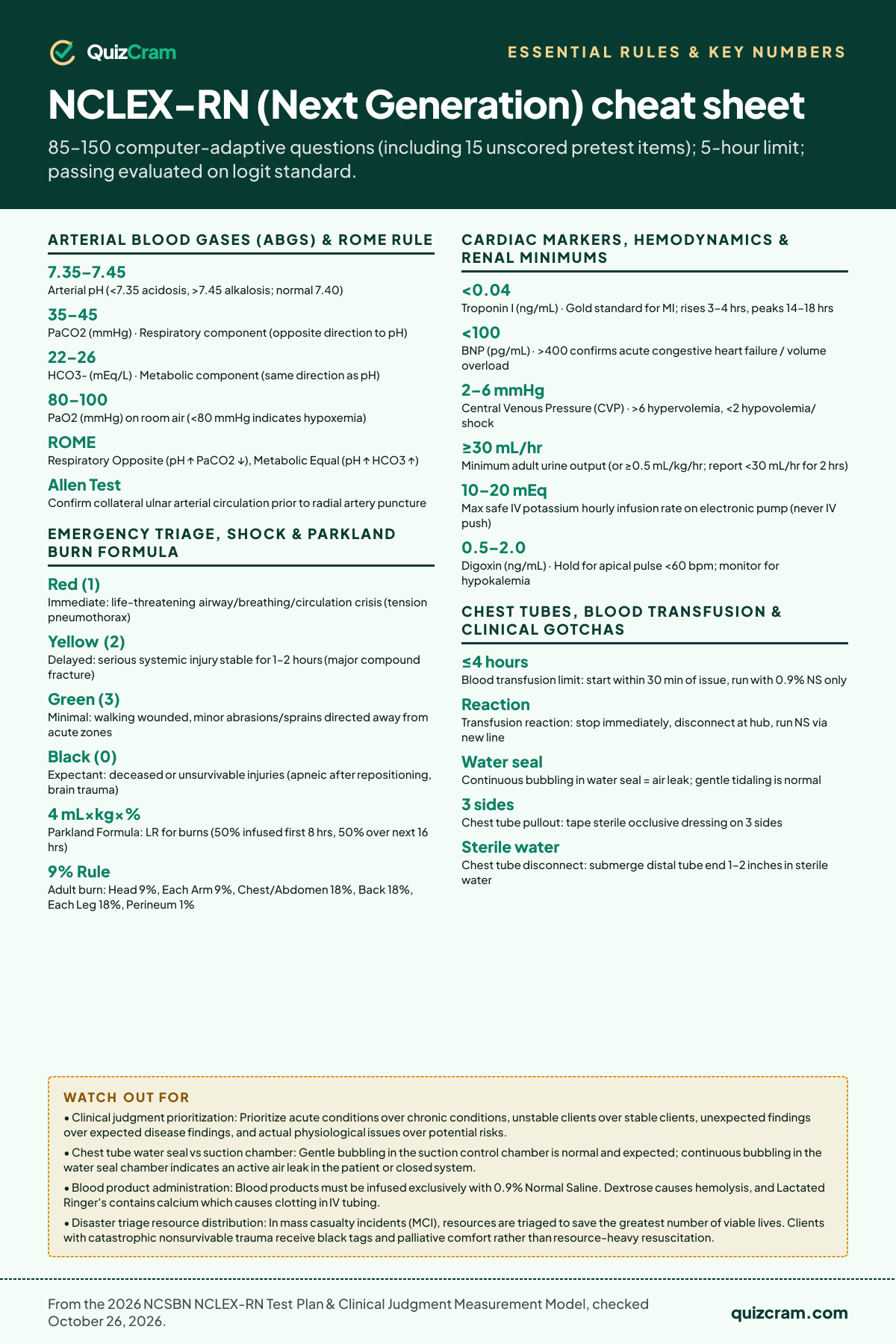
Save It as One Printable Poster
Keep the complete NCLEX-RN cheat sheet on your wall or phone. High-resolution canvas formatted for standard 8.5″ × 11″ portrait print.
Formatted for standard US Letter paper or binder study inserts without text clipping.
Every statutory limit, formula, and penalty verified against official testing sources.
Crisp 2:3 vertical canvas, perfect for saving to camera roll or reviewing before the test.
Knowing the rules and numbers is half of it. Can you apply them?
The real test asks these as scenarios. Take the 20 free NCLEX-RN questions — each answer explains the rule and cites the official source. If you want the full bank and timed practice tests, it’s a one-time $29.99.