NCLEX-PN/Cheat sheet
NCLEX-PN cheat sheet: key rules and summary
85–150 computer-adaptive questions (including 15 unscored pretest items); 5-hour limit; passing evaluated on logit standard.
Hematology, coagulation & vital parameters
Essential- 12–18
- Hemoglobin (g/dL: Female 12–16, Male 14–18; report <8 for transfusion threshold)
- 37%–52%
- Hematocrit (Female 37%–47%, Male 42%–52%; approximately 3x hemoglobin value)
- 4.5k–11k
- White blood cells (/µL) · Neutropenic precautions when ANC <1,000
Hematology, coagulation & vital parameters
High-Yield- 12–18
- Hemoglobin (g/dL: Female 12–16, Male 14–18; report <8 for transfusion threshold)
- 37%–52%
- Hematocrit (Female 37%–47%, Male 42%–52%; approximately 3x hemoglobin value)
- 4.5k–11k
- White blood cells (/µL) · Neutropenic precautions when ANC <1,000
LPN/LVN scope of practice & delegation traps
Critical- No EAT
- Never delegate Evaluation, Assessment (initial), or Teaching (initial) to LPN or UAP
- LPN Scope
- Data collection, routine oral/IM/SC meds, dressing changes, reinforcing education
- UAP Scope
- Vital signs on stable clients, ambulation, hygiene, intake/output, bed making
Critical Serum Electrolytes & Nursing Thresholds
Values outside these therapeutic windows indicate immediate physiological risk and must be reported immediately.
Critical serum electrolytes & lab values
- 3.5–5.0
- Potassium (mEq/L) · <3.5 arrhythmia/digoxin toxicity risk; >5.0 peaked T wavesPhysiological Integrity — Basic Care
- 135–145
- Sodium (mEq/L) · <120 seizure risk, cerebral edema; >160 severe dehydrationPhysiological Integrity — Basic Care
- 8.5–10.5
- Calcium (mg/dL) · <8.5 hypocalcemia: positive Chvostek and Trousseau signs, tetanyPhysiological Integrity — Basic Care
- 1.5–2.5
- Magnesium (mEq/L) · <1.5 hyperreflexia, torsades; >2.5 suppresses DTRsPhysiological Integrity — Basic Care
- 70–100
- Fasting glucose (mg/dL) · <70 hypoglycemia (diaphoresis, tremors; Rule of 15)Physiological Integrity — Basic Care
- 0.6–1.2
- Serum creatinine (mg/dL) · BUN 10–20; elevated indicates renal impairmentPhysiological Integrity — Basic Care
Hematology, coagulation & vital parameters
- 12–18
- Hemoglobin (g/dL: Female 12–16, Male 14–18; report <8 for transfusion threshold)Reduction of Risk Potential
- 37%–52%
- Hematocrit (Female 37%–47%, Male 42%–52%; approximately 3x hemoglobin value)Reduction of Risk Potential
- 4.5k–11k
- White blood cells (/µL) · Neutropenic precautions when ANC <1,000Safety & Infection Control
- 150k–400k
- Platelets (/µL) · Bleeding precautions <50,000; hemorrhage risk <20,000Reduction of Risk Potential
- 2.0–3.0
- Therapeutic INR for Warfarin (Coumadin) · Antidote: Vitamin KPharmacological Therapies
- 60–80s
- Therapeutic aPTT for Heparin (1.5–2.5x normal 30–40s) · Antidote: Protamine SulfatePharmacological Therapies
Therapeutic drug levels & nursing alerts
- 0.5–2.0
- Digoxin (ng/mL) · Toxicity: visual halos, nausea; hold for apical pulse <60Pharmacological Therapies
- 0.6–1.2
- Lithium (mEq/L) · Toxicity >1.5: coarse tremors, ataxia; maintain adequate sodiumPharmacological Therapies
- 10–20
- Phenytoin / Dilantin (µg/mL) · Expected side effect: gingival hyperplasiaPharmacological Therapies
- 10–20
- Vancomycin trough (µg/mL) · Ototoxicity/nephrotoxicity risk; infuse over ≥60 minPharmacological Therapies
- Narcan
- Naloxone: opioid antagonist for acute respiratory depression; repeat as neededPharmacological Therapies
LPN/LVN scope of practice & delegation traps
- No EAT
- Never delegate Evaluation, Assessment (initial), or Teaching (initial) to LPN or UAPSafe and Effective Care — Management of Care
- LPN Scope
- Data collection, routine oral/IM/SC meds, dressing changes, reinforcing educationManagement of Care — Delegation
- UAP Scope
- Vital signs on stable clients, ambulation, hygiene, intake/output, bed makingManagement of Care — Delegation
- Contact
- MRSA, C. diff, VRE (gloves + gown; soap & water for C. diff, not alcohol)Safety and Infection Control
- Airborne
- TB, measles, varicella/shingles (N95 respirator, negative pressure private room)Safety and Infection Control
Rules People Get Wrong on Test Day
Questions on these specific handbook rules produce the highest error rates. Review these crucial distinctions carefully before test day.
Delegation boundary
The RN cannot delegate any task involving initial assessment, clinical judgment, nursing diagnosis, care plan formulation, or initial patient discharge teaching to an LPN/LVN. LPNs collect data and reinforce established teaching.
C. difficile hand hygiene
Alcohol-based sanitizers do NOT destroy Clostridioides difficile spores. Providers must wash hands with antimicrobial soap and warm running water.
Intravenous potassium danger
Never administer potassium chloride IV push, bolus, or intramuscularly — doing so causes lethal ventricular arrhythmias. Potassium must be diluted and infused via electronic infusion pump.
Digoxin-potassium interaction
Hypokalemia (K+ < 3.5 mEq/L) drastically enhances cardiac sensitivity to digoxin, inducing fatal toxicity even when the serum digoxin level is within the therapeutic range (0.5–2.0 ng/mL).
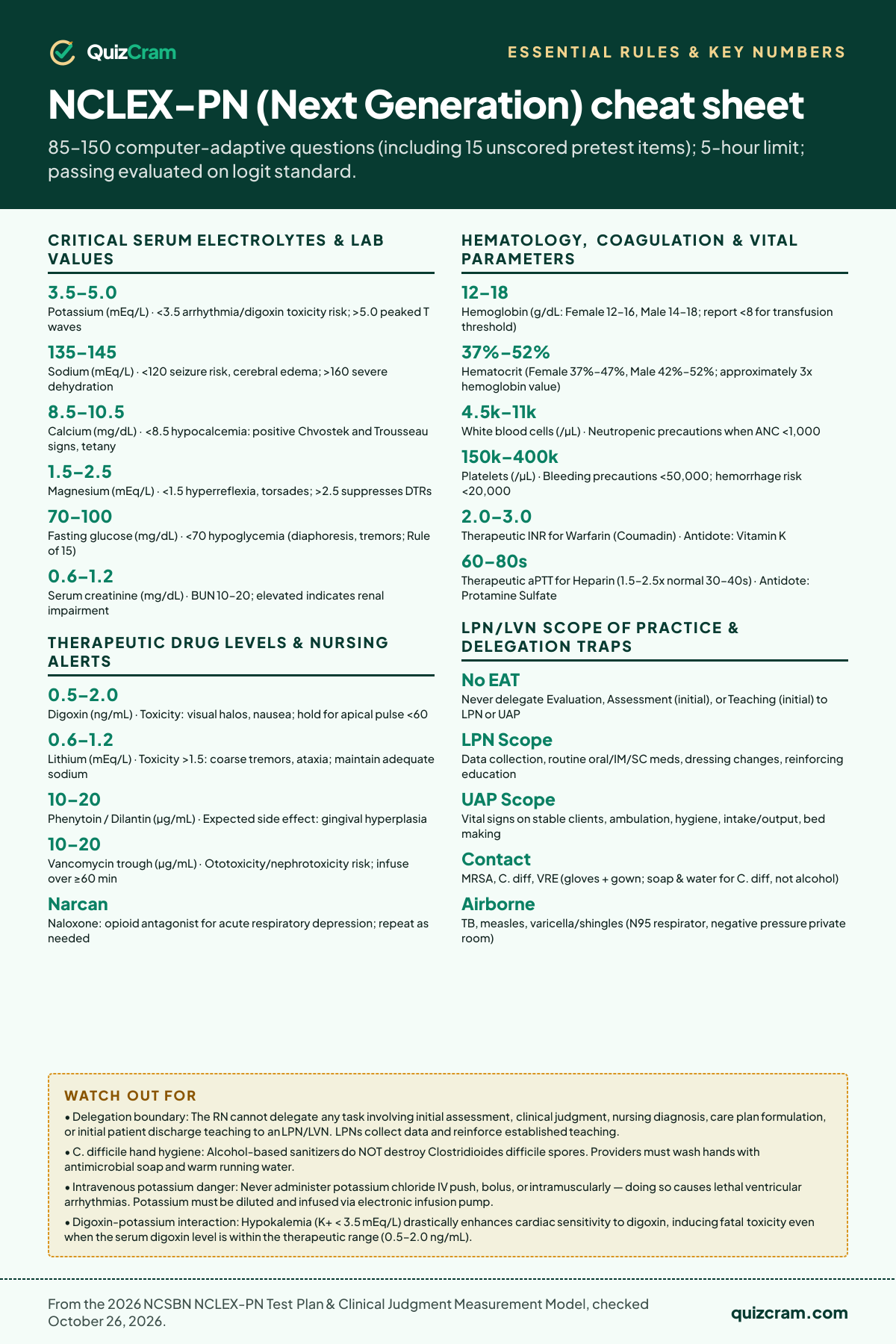
Save It as One Printable Poster
Keep the complete NCLEX-PN cheat sheet on your wall or phone. High-resolution canvas formatted for standard 8.5″ × 11″ portrait print.
Formatted for standard US Letter paper or binder study inserts without text clipping.
Every statutory limit, formula, and penalty verified against official testing sources.
Crisp 2:3 vertical canvas, perfect for saving to camera roll or reviewing before the test.
Knowing the rules and numbers is half of it. Can you apply them?
The real test asks these as scenarios. Take the 20 free NCLEX-PN questions — each answer explains the rule and cites the official source. If you want the full bank and timed practice tests, it’s a one-time $29.99.