NREMT EMT/Cheat sheet
NREMT EMT cheat sheet: key rules and summary
70–120 computer-adaptive questions; 2-hour time limit; entry-level competency standard; NREMT.
Glasgow Coma Scale (GCS) & Rule of Nines
Essential- Eye 4–1
- 4 Spontaneous, 3 To speech, 2 To pain, 1 None (Glasgow Coma Scale)
- Verbal 5–1
- 5 Oriented, 4 Confused, 3 Inappropriate words, 2 Sounds, 1 None
- Motor 6–1
- 6 Obeys commands, 5 Localizes pain, 4 Withdraws, 3 Flexion, 2 Extension, 1 None
EMT scope emergency medications
High-Yield- Oxygen
- Indicated for hypoxia (SpO2 <94%), dyspnea, shock, altered mental status, suspected CO
- 15–24 g
- Oral Glucose buccal dose for hypoglycemia (<60 mg/dL; patient must be conscious)
- 324 mg
- Aspirin chewable dose (four 81 mg baby tablets) for suspected cardiac chest pain
EMT scope emergency medications
Critical- Oxygen
- Indicated for hypoxia (SpO2 <94%), dyspnea, shock, altered mental status, suspected CO
- 15–24 g
- Oral Glucose buccal dose for hypoglycemia (<60 mg/dL; patient must be conscious)
- 324 mg
- Aspirin chewable dose (four 81 mg baby tablets) for suspected cardiac chest pain
Glasgow Coma Scale (GCS 15-Point Breakdown)
Scored 3 to 15. An adult with GCS ≤ 8 requires airway intervention (“GCS 8, intubate”).
- 4 Spontaneous
- 3 To sound / verbal command
- 2 To pain stimulus
- 1 No response
- 5 Oriented & converses
- 4 Confused conversation
- 3 Inappropriate words
- 2 Incomprehensible sounds
- 1 No response
- 6 Obeys commands
- 5 Localizes painful stimulus
- 4 Flexion / withdrawal from pain
- 3 Decorticate (abnormal flexion)
- 2 Decerebrate (abnormal extension)
- 1 No response (flaccid)
Glasgow Coma Scale (GCS) & Rule of Nines
- Eye 4–1
- 4 Spontaneous, 3 To speech, 2 To pain, 1 None (Glasgow Coma Scale)Patient Assessment — Neurological Status
- Verbal 5–1
- 5 Oriented, 4 Confused, 3 Inappropriate words, 2 Sounds, 1 NonePatient Assessment — Neurological Status
- Motor 6–1
- 6 Obeys commands, 5 Localizes pain, 4 Withdraws, 3 Flexion, 2 Extension, 1 NonePatient Assessment — Neurological Status
- GCS ≤ 8
- Severe brain injury ('GCS 8, intubate'); 9–12 moderate; 13–15 mild brain injuryTrauma — Head and Spine
- Adult Burns
- Rule of 9s: Head 9%, Chest 9%, Abdomen 9%, Upper/Lower Back 18%, Arms 9% each, Legs 18% eachTrauma — Burns
- Infant Burns
- Pediatric Rule of 9s: Infant head 18%, each leg 14% (larger head, smaller legs)Special Patient Populations — Pediatrics
Vital signs, ventilation rates & oxygen delivery
- 12–20
- Normal adult respiratory rate (breaths/min; <10 or >28 mandates positive pressure ventilation)Airway, Respiration & Ventilation
- 5–6 sec
- Adult rescue breathing rate with a pulse: 1 breath every 5–6 sec (10–12 breaths/min)Airway, Respiration & Ventilation
- 2–3 sec
- Pediatric / infant rescue breathing rate with a pulse: 1 breath every 2–3 sec (20–30/min)Special Patient Populations — Pediatrics
- 30:2 / 15:2
- CPR ratio: 30:2 for all adult CPR; 15:2 for 2-rescuer infant/child CPRCardiology & Resuscitation
- 10–15 L
- Non-Rebreather Mask (NRB) delivering up to 90% FiO2 (pre-fill reservoir 2/3 full)Airway, Respiration & Ventilation
- 1–6 L
- Nasal Cannula delivering 24%–44% FiO2 (~4% FiO2 increase per 1 L/min flow)Airway, Respiration & Ventilation
- 15 L
- Bag-Valve Mask (BVM) connected to oxygen reservoir delivering ~100% FiO2Airway, Respiration & Ventilation
EMT scope emergency medications
- Oxygen
- Indicated for hypoxia (SpO2 <94%), dyspnea, shock, altered mental status, suspected COPharmacology & Medication Administration
- 15–24 g
- Oral Glucose buccal dose for hypoglycemia (<60 mg/dL; patient must be conscious)Medical Emergencies — Endocrine
- 324 mg
- Aspirin chewable dose (four 81 mg baby tablets) for suspected cardiac chest painCardiology & Resuscitation
- 0.3 mg IM
- Epinephrine 1:1,000 auto-injector IM for severe anaphylaxis (0.15 mg pediatric)Medical Emergencies — Immunology
- 2–4 mg IN
- Naloxone (Narcan) intranasal opioid antagonist for respiratory depressionMedical Emergencies — Toxicology
- 0.4 mg SL
- Nitroglycerin sublingual dose for chest pain (contraindicated: BP <100 or ED drugs in 48h)Cardiology & Resuscitation
Patient assessment & trauma signs
- Assessment
- Scene Size-up → General Impression → AVPU → Airway → Breathing → Circulation → TransportPatient Assessment
- C-A-B
- Catastrophic life-threatening hemorrhage takes priority: tourniquet before airwayTrauma — Bleeding and Shock
- Cushing
- Cushing Triad (ICP): severe hypertension with widening pulse pressure, bradycardia, irregular respirationsTrauma — Head Injuries
- Beck
- Beck Triad (tamponade): JVD, muffled heart sounds, hypotension with narrowing pulse pressureTrauma — Thoracic Trauma
- Flail chest
- 2+ ribs fractured in 2+ places; paradoxical motion treated with positive pressureTrauma — Thoracic Trauma
- 15 seconds
- Max suction duration for adult (10s child, 5s infant); apply suction only on withdrawalAirway, Respiration & Ventilation
Rules People Get Wrong on Test Day
Questions on these specific handbook rules produce the highest error rates. Review these crucial distinctions carefully before test day.
Catastrophic hemorrhage priority
In the presence of arterial or life-threatening external bleeding, immediately transition from ABC to C-A-B / MARCH. Apply a tourniquet high and tight before managing the airway.
Nitroglycerin contraindications
Never administer nitroglycerin if systolic blood pressure is below 100 mmHg or if the patient took phosphodiesterase inhibitors (sildenafil/Viagra, tadalafil/Cialis, vardenafil) within the past 24–48 hours — can cause fatal refractory hypotension.
Suctioning duration limits
Maximum suction time is 15 seconds for an adult, 10 seconds for a child, and 5 seconds for an infant. Always apply suction only on the way out while withdrawing the catheter.
Hyperventilation risks
Ventilating too rapidly or with excessive tidal volume increases intrathoracic pressure, impeding venous return to the right heart, precipitously dropping cardiac output, and causing gastric insufflation/aspiration.
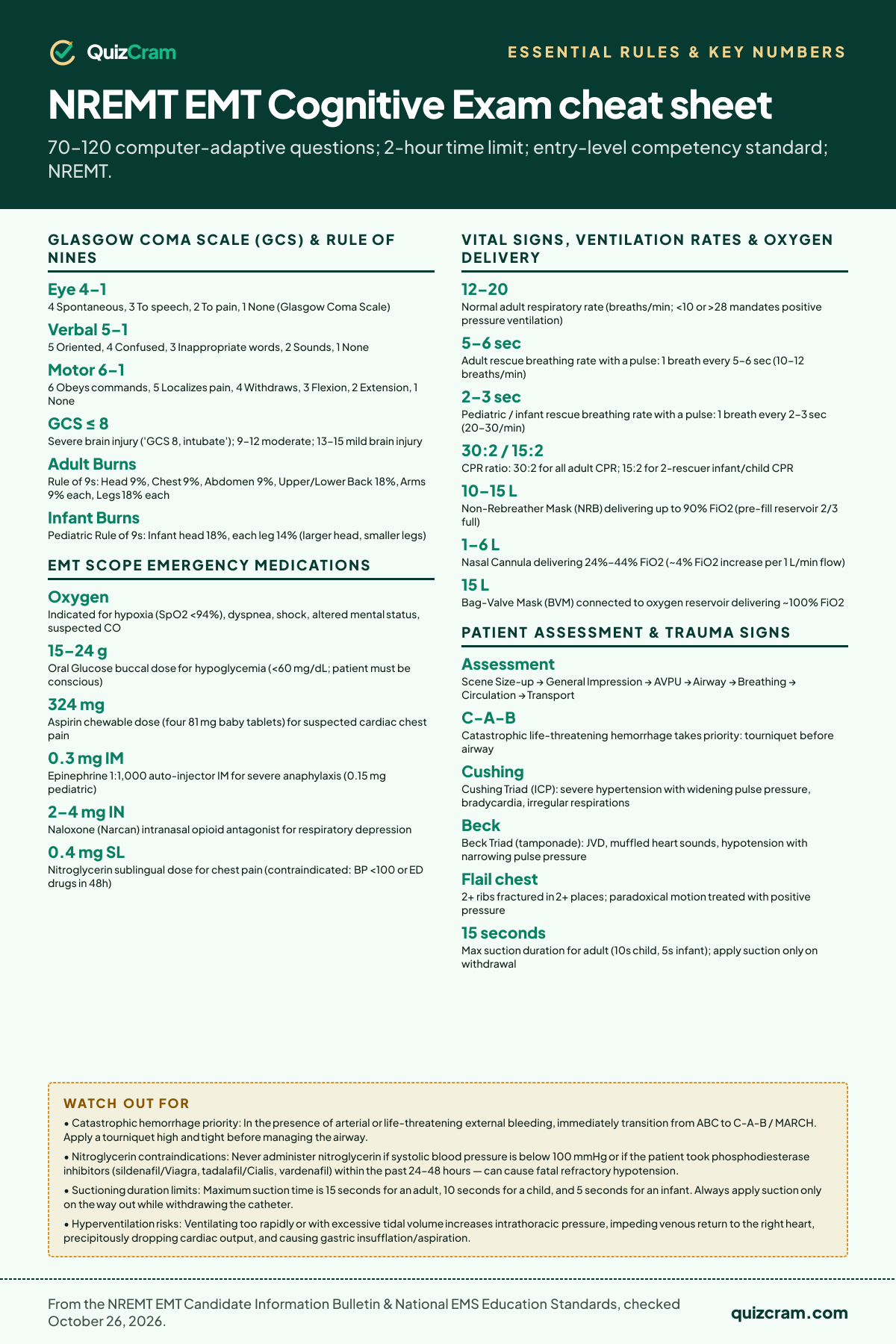
Save It as One Printable Poster
Keep the complete NREMT EMT cheat sheet on your wall or phone. High-resolution canvas formatted for standard 8.5″ × 11″ portrait print.
Formatted for standard US Letter paper or binder study inserts without text clipping.
Every statutory limit, formula, and penalty verified against official testing sources.
Crisp 2:3 vertical canvas, perfect for saving to camera roll or reviewing before the test.
Knowing the rules and numbers is half of it. Can you apply them?
The real test asks these as scenarios. Take the 20 free NREMT EMT questions — each answer explains the rule and cites the official source. If you want the full bank and timed practice tests, it’s a one-time $19.99.