All exams/Healthcare
Free practice test · 300 original questionsFree practice · 300 questions
Pharmacy Technician Certification Exam (PTCE) Practice Test
This free PTCB practice test follows the official PTCE blueprint: medications, federal requirements, patient safety and quality assurance, and order entry and processing.
- 90 items (80 scored + 10 unscored)
- 110-minute limit
- 1,400 scaled score
- No signup to start
- Every answer includes a source note
- Updated November 6, 2026
Try one now
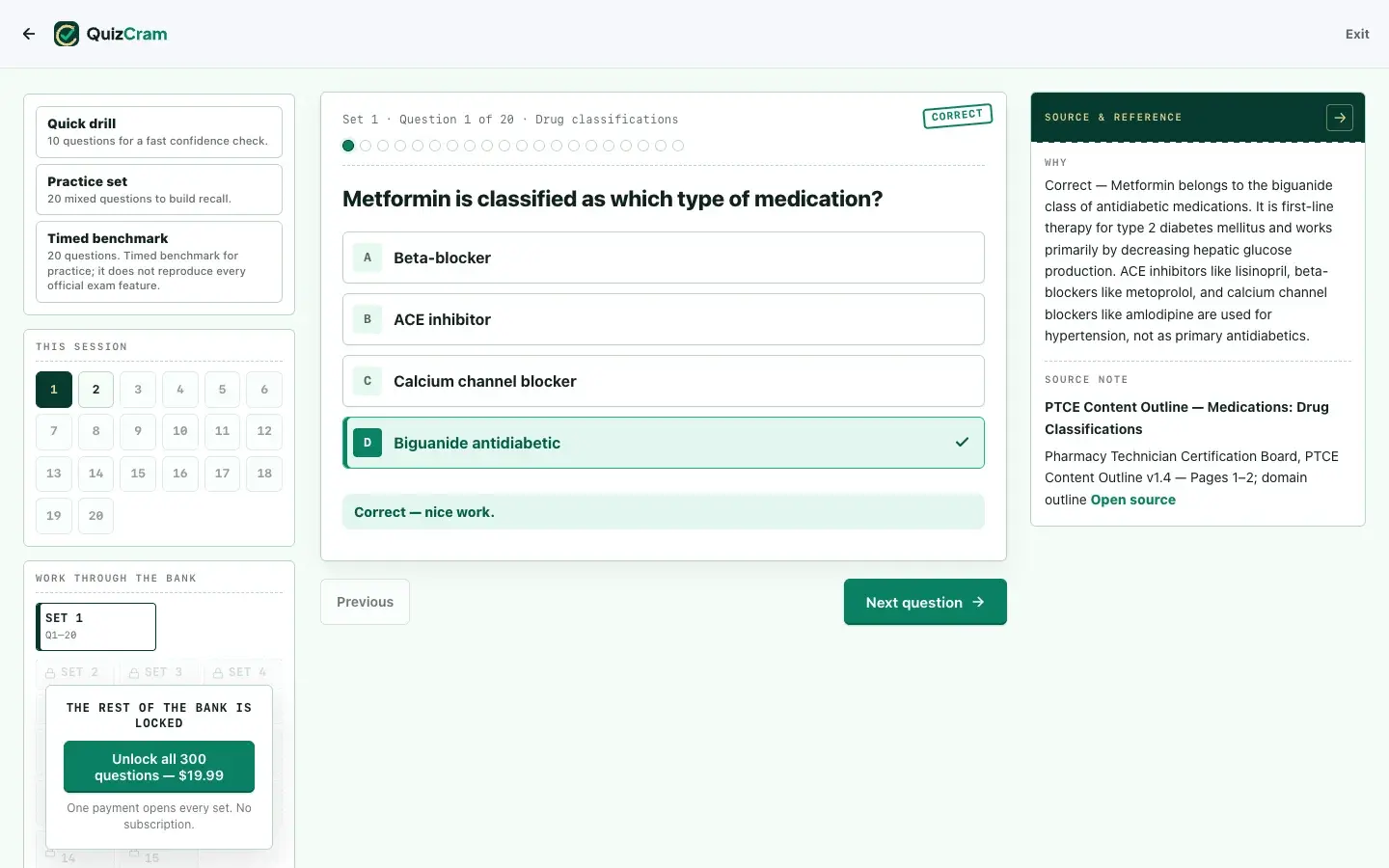
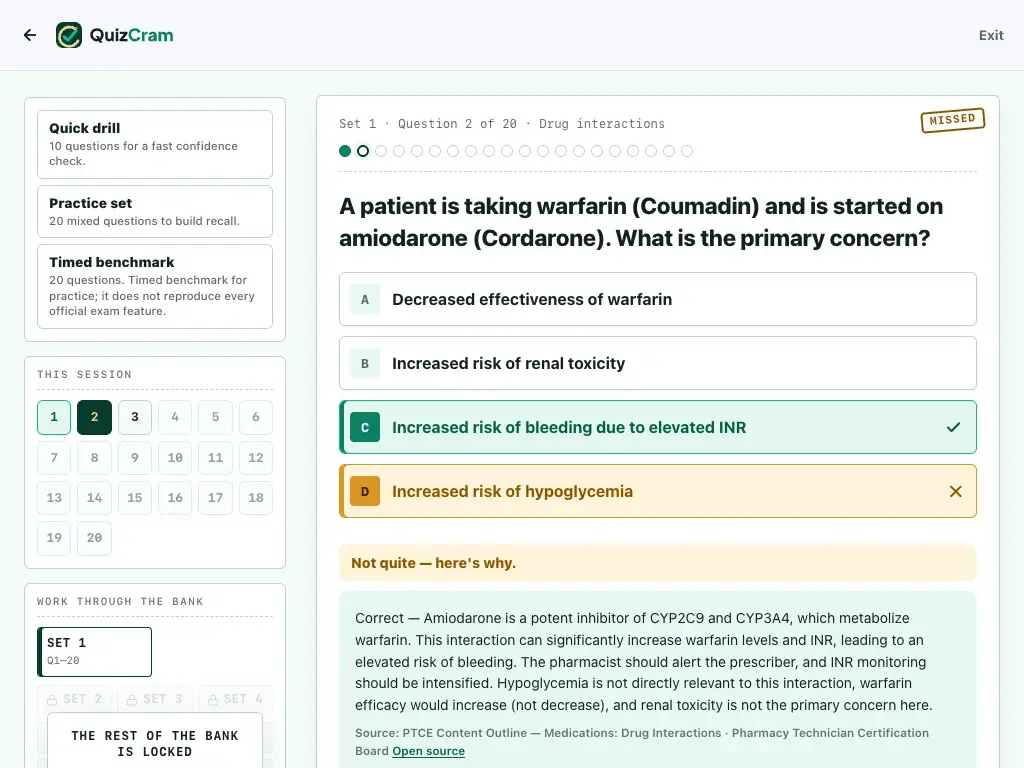
A real Pharmacy Technician Certification Exam (PTCE) question
Pick an answer. You will see whether you are right, why, and the source it comes from. No signup.
- 40 free questions like this one
- An explanation and a source note on every answer
- The full bank is $19.99, once
A patient is taking warfarin (Coumadin) and is started on amiodarone (Cordarone). What is the primary concern?
The real test at a glance
How many questions are on the Pharmacy Technician Certification Exam (PTCE) test, and what score passes?
The Pharmacy Technician Certification Exam (PTCE) has 90 questions, scored on a scale of 1000 to 1600. A scaled score of 1400 or higher passes.
Scaled score · 1400 to pass · up to 90 items
- 90questions, scaled score
- 1400scaled score to pass, on a 1000–1600 scale
- 300practice questions here, 40 free
- Checked againstPTCB Certified Pharmacy Technician (CPhT) Candidate Handbook
Original questions mapped to the current PTCB PTCE Content Outline; not official or recalled questions. Internal practice target. PTCB reports a 1,400 scaled passing score; a practice percentage cannot be converted into an official scaled score.
From learners on QuizCram
How learners do on these Pharmacy Technician Certification Exam (PTCE) questions
112
practice answers on this exam
70% right · 30% wrong
75%
practice target
Aim above it in practice before you book.
Learners have answered 112 Pharmacy Technician Certification Exam (PTCE) practice questions on QuizCram, and 70% of those answers were correct. Counted anonymously from finished practice sets; totals before 30 Oct 2026 come from site analytics. Practice results, not official pass rates.
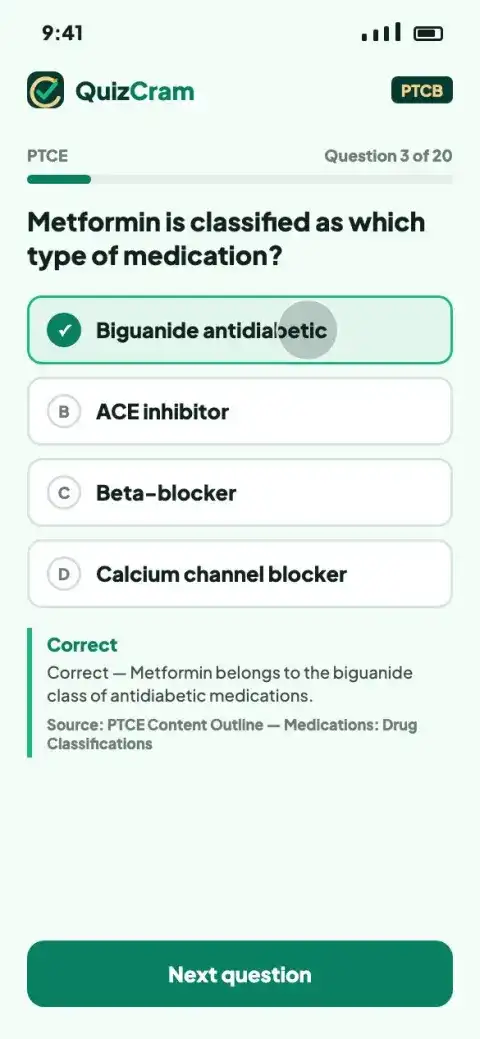
See it on your device
What the real exam covers
The 4 areas of the Pharmacy Technician (PTCE) and their weights
Share of scored questions per area, from the PTCB blueprint (PTCE content outline effective 6 January 2026). All 300 questions in this bank are filed under these areas.
- Medications35% of the exam
- Federal requirements19% of the exam
- Patient safety and quality assurance24% of the exam
- Order entry and processing23% of the exam
Source: PTCB Pharmacy Technician Certification Examination (PTCE) Content Outline, effective January 6, 2026, checked October 14, 2026.
From the question bank
Try 3 more real questions
Tap an answer to check it. Every explanation cites the official source.
- Q1Drug classifications
Metformin is classified as which type of medication?
The answer is B.
Metformin belongs to the biguanide class of antidiabetic medications. It is first-line therapy for type 2 diabetes mellitus and works primarily by decreasing hepatic glucose production. ACE inhibitors like lisinopril, beta-blockers like metoprolol, and calcium channel blockers like amlodipine are used for hypertension, not as primary antidiabetics.
Tap an answer to check it
- Q2Dosage forms
Which of the following dosage forms is designed to dissolve under the tongue without chewing or swallowing?
The answer is C.
Sublingual tablets (such as nitroglycerin) are placed under the tongue where they dissolve rapidly for direct absorption through the oral mucosa into the bloodstream, bypassing first-pass metabolism. Enteric-coated tablets resist stomach acid and dissolve in the intestine. Extended-release capsules release drug slowly over time. Chewable tablets are meant to be chewed before swallowing.
Tap an answer to check it
- Q3Drug classifications
Sertraline (Zoloft) belongs to which therapeutic class of medications?
The answer is D.
Sertraline is an SSRI, a first-line treatment for depression, anxiety disorders, and OCD. SSRIs selectively block the reuptake of serotonin in the brain. Benzodiazepines like alprazolam enhance GABA activity. MAOIs like phenelzine inhibit monoamine oxidase. TCAs like amitriptyline block norepinephrine and serotonin reuptake non-selectively and have more anticholinergic side effects than SSRIs.
Tap an answer to check it
Study plan
How to pass the Pharmacy Technician Certification Exam (PTCE)
Learn each domain, drill until it’s automatic, then prove it in a timed mock exam.
- Step 1
Start with a representative 20-question diagnostic across the current PTCE domains
- Step 2
Use domain results to target medications, federal requirements, patient safety, and order entry
- Step 3
Review every miss with its outline mapping and source note
- Step 4
Treat the QuizCram bank as practice material, not a prediction of the official exam
- Test day
Book the real test once you clear the pass mark comfortably, twice in a row.
Exam simulator
Sit a timed mock exam for the Pharmacy Technician (PTCE)
- A real countdown. One question at a time, no feedback until you submit.
- Flag and review. Mark questions to come back to before you hand in.
- Score by topic. Your result against the target, every answer explained.
Questions are mixed by the weights PTCB publishes, so the topics match how the exam is built.
The free mock exam runs 40 questions from the free set, once. Unlocking adds full-length runs of 50 questions from the whole bank. A practice mock exam, not an official replica.
- Free taster
- 40 q
- Full run
- 50 q
- Practice clock
- 50 min
- Target
- 75%
Free vs. full
Start free. Unlock when you’re ready.
Free
$0
No account, no card
- 40 original questions with source notes
- Instant scoring
- One free timed mock exam (40 questions)
- Free account adds saved progress + mistake review
Full bank
$19.99 one-time
No subscription · yours forever · 3-day money-back guarantee
- All 300 questions, every topic
- 50-question timed exam simulator; see the score note below
- Saved mistake review, ad-free
Internal practice target. PTCB reports a 1,400 scaled passing score; a practice percentage cannot be converted into an official scaled score.
Fail the real exam and you pay its fee again to retake it.
What failing the Pharmacy Technician Certification Exam (PTCE) exam costs
- Wait to retest
- None for the second and third attempts; 6 months before the fourth. You must wait for your official score report before reapplying
- Attempt limits
- Unlimited, but after four attempts you must show PTCB an approved preparation activity before more (for example a formal review course or six months of tutoring)
- Retest fee
- You apply and pay for each attempt
Source: PTCB — retake policy (v1.2, March 2025), PTCB, checked September 30, 2026. The full bank is $19.99, once.
Free study kit
Everything free for the Pharmacy Technician Certification Exam (PTCE) test
About these questions
How we check these questions
- Written from the source. Every question is our own wording of a fact in the PTCB Certified Pharmacy Technician (CPhT) Candidate Handbook, never copied from a real exam.
- Checked against its section. Each answer names the section it comes from, and the answer is checked against that text. Anything we cannot confirm there is not published.
- Machine checks on the whole bank. Validators look for duplicates, missing explanations and missing sources.
- Re-checked on changes. When PTCB revises the source, the bank is audited again. Last update: November 6, 2026.
Original questions mapped to the current PTCB PTCE Content Outline; not official or recalled questions. Spot an error? Email [email protected] with the question; we check it against the source and fix confirmed errors. Editorial policy.
- Updated November 6, 2026
- v5 · 300 questions
- 40 free with answers
- Read the source
Tried the Pharmacy Technician Certification Exam (PTCE) questions?
Good to know
Pharmacy Technician Certification Exam (PTCE) FAQ
The Pharmacy Technician Certification Exam (PTCE) contains 90 multiple-choice questions: 80 scored questions and 10 unscored pretest items, with an exam duration of 1 hour and 50 minutes (110 minutes).
PTCB reports scores on a scaled score range from 1,000 to 1,600. The passing score is 1,400. This is a scaled score determined by psychometric equating across exam forms.
The PTCE covers four knowledge domains: Medications (40%), Federal Requirements (12.5%), Patient Safety and Quality Assurance (26.25%), and Order Entry and Processing (21.25%).
Candidates who fail must wait 60 days before their second and third attempts. If a candidate fails on their third attempt, they must wait 6 months before applying for a fourth attempt.
PTCB Certified Pharmacy Technicians (CPhT) must recertify every 2 years by completing 20 hours of pharmacy-related Continuing Education (CE), including 1 hour of pharmacy law and 1 hour of patient safety.
Yes. Open the exam simulator and sit a timed mock exam of 40 questions built from the free questions, once, with no signup. Unlocking the exam adds full-length runs of 50 questions in 50 minutes (a practice clock), as many as you like, each a new draw from the whole bank.
It splits the questions across the exam's areas using the weights PTCB publishes, then picks questions inside each area, favouring ones you missed before and never repeating one within a run. A retake is a new draw, so you will meet different questions. It is a practice mock exam, not an official replica of the real exam.
Taking another test?
More live exams
 HealthcareNCLEX-PNTarget 85%20 free · 300 Qs$29.99 one time
 HealthcareCNA CertificationTarget 80%40 free · 300 Qs$14.99 one time
 HealthcareNHA CCMA Medical AssistantTarget 78%40 free · 300 Qs$19.99 one time
 HealthcareNHA CPT PhlebotomyTarget 78%40 free · 300 Qs$19.99 one time
 HealthcareNCLEX-RNTarget 85%20 free · 300 Qs$29.99 one time
 HealthcareNREMT EMTTarget 75%20 free · 300 Qs$19.99 one time
 HealthcareHESI A2Target 75%40 free · 300 Qs$24.99 one time
 HealthcareATI TEAS 7Target 75%40 free · 300 Qs$14.99 one time
 Driving & LicensesCalifornia DMV Permit83% to pass20 free · 300 Qs$8.99 one time
 Driving & LicensesTexas DMV Permit70% to pass20 free · 300 Qs$8.99 one time
 Driving & LicensesFlorida Class E Permit80% to pass20 free · 300 Qs$8.99 one time
- Driving & LicensesNew York DMV Permit70% to pass20 free · 300 Qs$8.99 one time
- Driving & LicensesPennsylvania DMV Permit83% to pass20 free · 300 Qs$8.99 one time
- Driving & LicensesOhio BMV Permit75% to pass20 free · 300 Qs$8.99 one time
- Driving & LicensesGeorgia DDS Permit75% to pass20 free · 300 Qs$8.99 one time
- Driving & LicensesNorth Carolina DMV Permit80% to pass20 free · 300 Qs$8.99 one time
- Driving & LicensesNew Jersey MVC Permit80% to pass20 free · 300 Qs$8.99 one time
- Driving & LicensesVirginia DMV Permit80% to pass20 free · 300 Qs$8.99 one time
- Driving & LicensesArizona MVD Permit80% to pass20 free · 300 Qs$8.99 one time
- Driving & LicensesWashington DOL Permit80% to pass20 free · 300 Qs$8.99 one time
- Driving & LicensesIllinois SOS PermitTarget 80%20 free · 300 Qs$8.99 one time
- Driving & LicensesIndiana BMV Permit80% to pass20 free · 300 Qs$8.99 one time
- Driving & LicensesTennessee DOS Permit80% to pass20 free · 300 Qs$8.99 one time
- Driving & LicensesMissouri DOR Permit80% to pass20 free · 300 Qs$8.99 one time
- Driving & LicensesKentucky DMV Permit80% to pass20 free · 300 Qs$8.99 one time
- Driving & LicensesMaryland MVA Permit88% to pass20 free · 300 Qs$8.99 one time
- Driving & LicensesMinnesota DVS Permit80% to pass20 free · 300 Qs$8.99 one time
- Driving & LicensesAlabama ALEA PermitTarget 80%20 free · 300 Qs$8.99 one time
- Driving & LicensesSouth Carolina SCDMV Permit80% to pass20 free · 300 Qs$8.99 one time
- Driving & LicensesColorado DMV PermitTarget 80%20 free · 300 Qs$8.99 one time
- Driving & LicensesOregon DMV Permit80% to pass20 free · 300 Qs$8.99 one time
- Driving & LicensesOklahoma Driver License75% to pass20 free · 300 Qs$8.99 one time
- Driving & LicensesMichigan Driver LicenseTarget 80%20 free · 300 Qs$8.99 one time
- Driving & LicensesNevada Driver License80% to pass20 free · 300 Qs$8.99 one time
- Driving & LicensesUtah Driver License80% to pass20 free · 300 Qs$8.99 one time
- Driving & LicensesMassachusetts RMV Permit72% to pass20 free · 300 Qs$8.99 one time
 Professional CertificationsReal Estate Salesperson70% to pass20 free · 300 Qs$24.99 one time
 Professional CertificationsCompTIA A+ Core 1Target 75%40 free · 300 Qs$19.99 one time
 TradesCA General Electrician70% to pass20 free · 300 Qs$24.99 one time
- TradesEPA 608Target 70%40 free · 300 Qs$19.99 one time
- Professional CertificationsFINRA Series 7Target 72%20 free · 300 Qs$19.99 one time
 Driving & LicensesCalifornia Motorcycle (Class M)80% to pass20 free · 300 Qs$8.99 one time
 Professional CertificationsServSafe Manager70% to pass40 free · 300 Qs$14.99 one time
 Driving & LicensesCDL General Knowledge80% to pass20 free · 300 Qs$8.99 one time
- Driving & LicensesAir Brakes80% to pass20 free · 100 Qs$8.99 one time
- Driving & LicensesCombination80% to pass20 free · 100 Qs$8.99 one time
- Driving & LicensesTanker80% to pass20 free · 80 Qs$6.99 one time
- Driving & LicensesPassenger80% to pass20 free · 80 Qs$6.99 one time
- Driving & LicensesSchool Bus80% to pass20 free · 80 Qs$6.99 one time
- Driving & LicensesHazmat80% to pass20 free · 150 Qs$8.99 one time
 Professional CertificationsASVABTarget 70%40 free · 300 Qs$14.99 one time
- Professional CertificationsGEDTarget 70%20 free · 300 Qs$14.99 one time
 Professional CertificationsCompTIA Network+ (N10-009)Target 80%20 free · 300 Qs$19.99 one time
 Professional CertificationsCompTIA Security+ (SY0-701)Target 83%20 free · 300 Qs$19.99 one time
 Professional CertificationsFood Handler CertificateTarget 75%20 free · 300 Qs$8.99 one time
 Driving & LicensesOntario G1 Knowledge TestTarget 80%20 free · 300 Qs$8.99 one time
Related Healthcare certifications
More Healthcare practice tests
Prepare for related national certifications and licensing exams with realistic practice questions, instant explanations, and verified study resources.