
All exams/Healthcare
Free practice test · 300 original questionsFree practice · 300 questions
ATI TEAS 7 Practice Test
This free ATI TEAS Version 7 practice test covers all four scored domains — Science (Anatomy & Physiology), Mathematics, Reading, and English — with thorough answer rationales mapped to the official ATI content blueprint.
- 170 items (150 scored + 20 pretest)
- 209-minute limit
- no universal passing score
- No signup to start
- Every answer includes a source note
- Updated November 6, 2026
Try one now
A real ATI TEAS 7 question
Pick an answer. You will see whether you are right, why, and the source it comes from. No signup.
- 40 free questions like this one
- An explanation and a source note on every answer
- The full bank is $14.99, once
A nurse reads a patient's chart noting a blood glucose level of 250 mg/dL and a urinalysis showing glucose in the urine. Based on this combined information, what conclusion is best supported?
The real test at a glance
How many questions are on the ATI TEAS 7 test, and what score passes?
170 items · your program sets the pass mark
- Variesquestions, set by the exam owner
- 75%practice target (no official mark)
- 300practice questions here, 40 free
- Checked againstATI TEAS Version 7 Content Outline, test questions by content area
Questions written from the published ATI TEAS Version 7 content areas; not official ATI items. Internal QuizCram practice target. ATI publishes no universal passing score for the TEAS — each program sets its own required score.
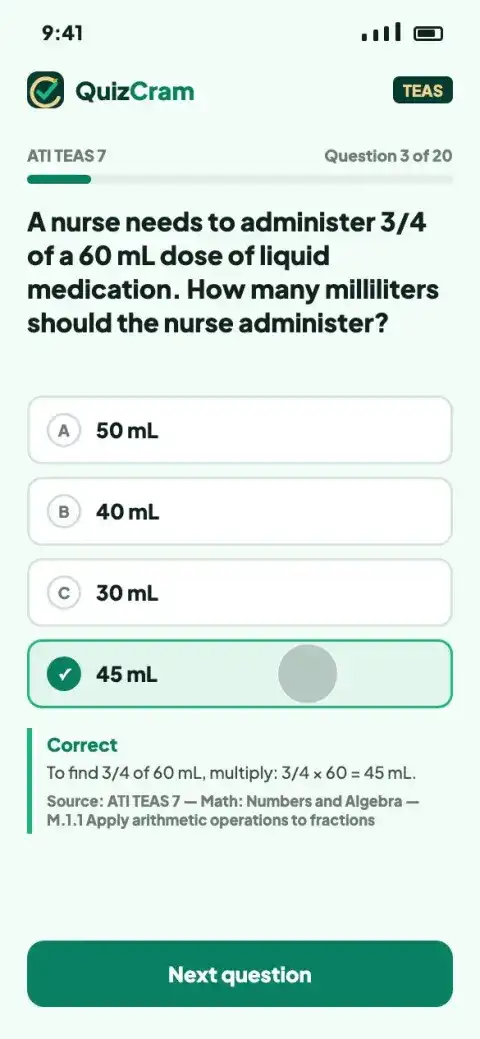
See it on your device
What the real exam covers
The 11 areas of the ATI TEAS 7 and their weights
Share of scored questions per area, from the ATI blueprint (ATI TEAS version 7 (150 scored questions)). All 300 questions in this bank are filed under these areas.
- Reading: key ideas and details10% of the exam
- Reading: craft and structure6% of the exam
- Reading: integration of knowledge and ideas10% of the exam
- Math: number and algebra12% of the exam
- Math: measurement and data11% of the exam
- Science: human anatomy and physiology12% of the exam
- Science: biology and chemistry11% of the exam
- Science: scientific reasoning6% of the exam
- English: conventions of standard English8% of the exam
- English: knowledge of language7% of the exam
- English: vocabulary acquisition7% of the exam
Source: ATI TEAS Version 7 Content Outline, test questions by content area, checked October 14, 2026.
From the question bank
Try 3 more real questions
Tap an answer to check it. Every explanation cites the official source.
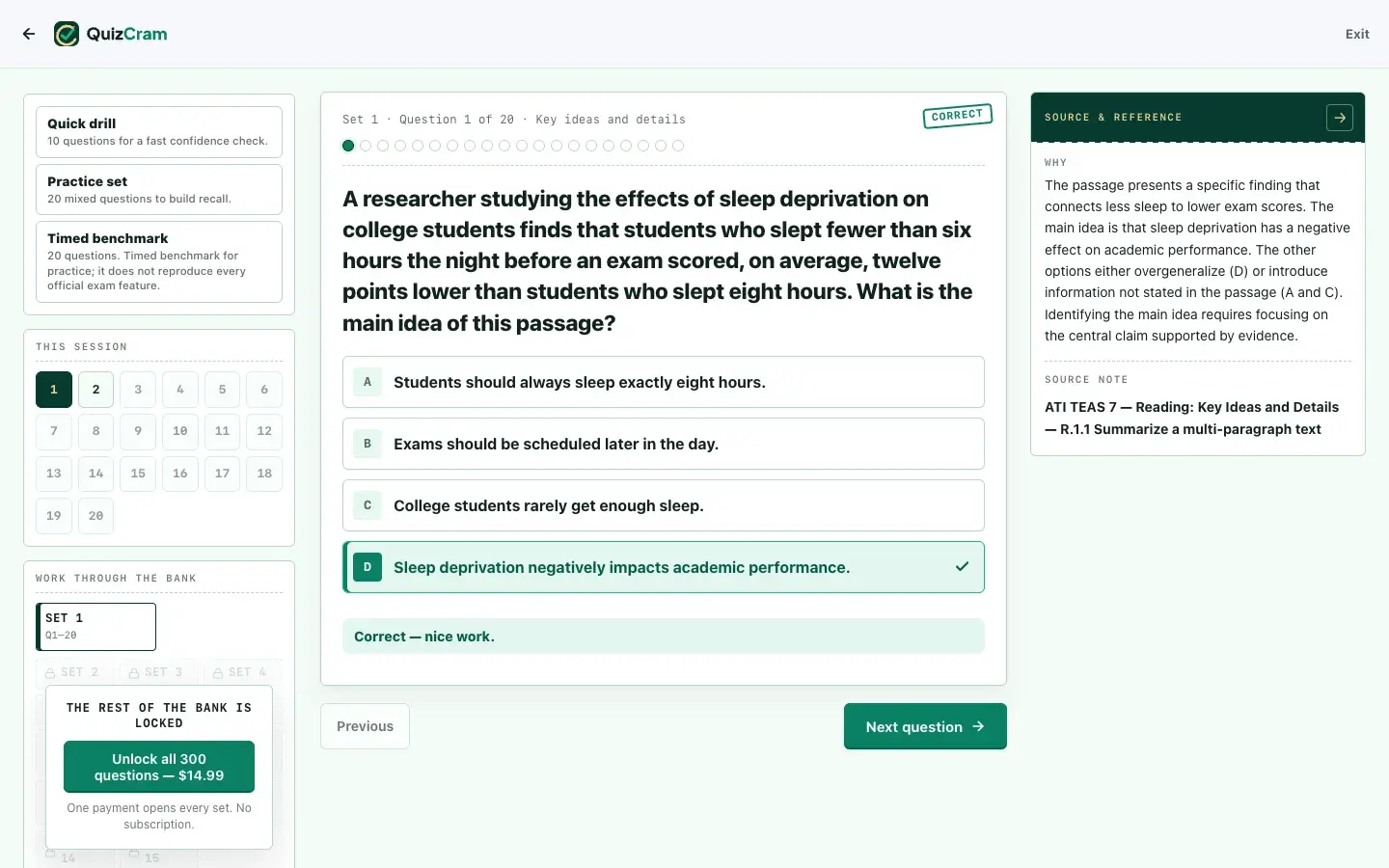
- Q1Key ideas and details
A researcher studying the effects of sleep deprivation on college students finds that students who slept fewer than six hours the night before an exam scored, on average, twelve points lower than students who slept eight hours. What is the main idea of this passage?
The answer is B.
The finding links fewer than six hours of sleep to scores twelve points lower, so the central claim is that sleep deprivation hurts academic performance. Nothing in the passage discusses exam timing, so rescheduling exams is an unsupported recommendation. The study compares six and eight hours but never says exactly eight is required for everyone. How often college students get enough sleep is never measured, so that option adds information the passage lacks.
Tap an answer to check it
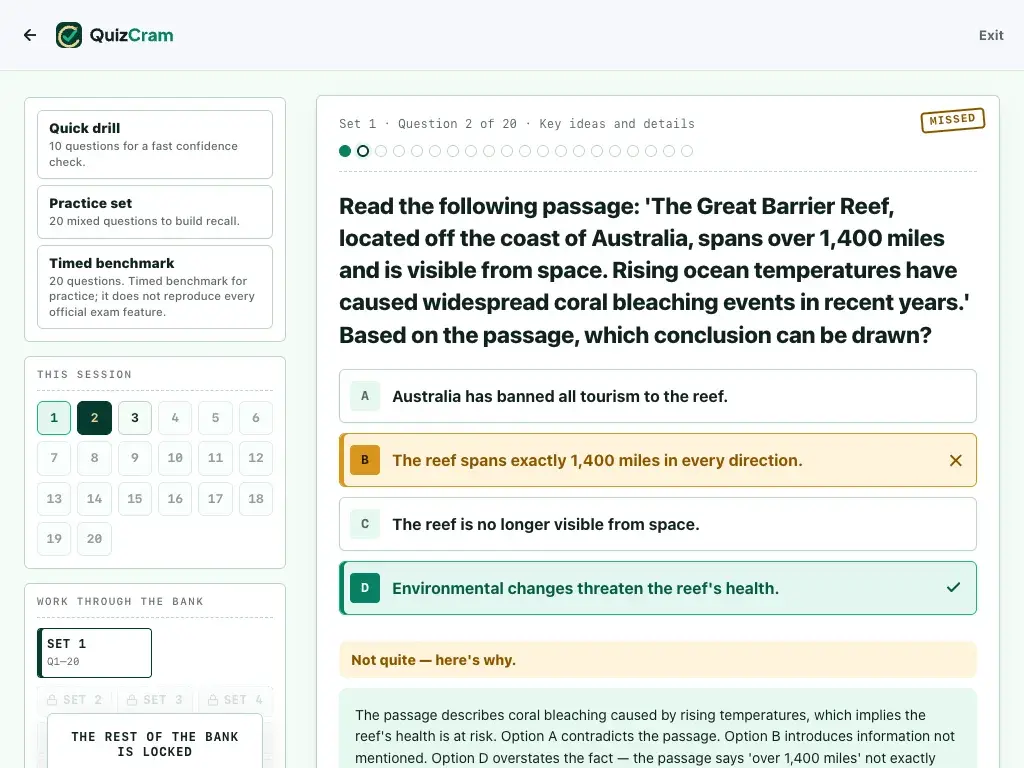
- Q2Key ideas and details
Read the following passage: 'The Great Barrier Reef, located off the coast of Australia, spans over 1,400 miles and is visible from space. Rising ocean temperatures have caused widespread coral bleaching events in recent years.' Based on the passage, which conclusion can be drawn?
The answer is B.
Rising ocean temperatures causing widespread bleaching is evidence that environmental change threatens the reef's health. The passage says the reef spans over 1,400 miles, not exactly 1,400 miles in every direction. It states the reef is visible from space, the opposite of the claim that it no longer is. Tourism is never mentioned, so a tourism ban cannot be concluded.
Tap an answer to check it
- Q3Craft and structure
In a health article, the author writes: 'Vaccines are one of the greatest achievements in public health, having eradicated smallpox and nearly eliminated polio.' The phrase 'one of the greatest achievements' signals that the author:
The answer is B.
Calling vaccines 'one of the greatest achievements' ranks them against other accomplishments, which is a value judgment, so the author is giving a subjective evaluation. The claim is widely accepted rather than a controversial hypothesis. No quotation marks or attribution suggest the words come from a textbook. Although smallpox eradication is factual, the ranking phrase itself carries judgment, so it is not a neutral statement of fact.
Tap an answer to check it
Study plan
How to pass the ATI TEAS 7
Learn each domain, drill until it’s automatic, then prove it in a timed mock exam.
- Step 1
Each section is separately timed and unused time does not carry over — pace per section
- Step 2
Science is the largest section at 50 items; A&P carries the most weight within it
- Step 3
Math is calculator-permitted on TEAS 7 but rewards fluency with ratios and conversions
- Step 4
English and language usage is the shortest section — bank time there for Science
- Test day
Book the real test once you clear the pass mark comfortably, twice in a row.
Exam simulator
Sit a timed mock exam for the ATI TEAS 7
- A real countdown. One question at a time, no feedback until you submit.
- Flag and review. Mark questions to come back to before you hand in.
- Score by topic. Your result against the target, every answer explained.
Questions are mixed by the weights ATI publishes, so the topics match how the exam is built.
The free mock exam runs 40 questions from the free set, once. Unlocking adds full-length runs of 50 questions from the whole bank. A practice mock exam, not an official replica.
- Free taster
- 40 q
- Full run
- 50 q
- Practice clock
- 50 min
- Target
- 75%
Free vs. full
Start free. Unlock when you’re ready.
Free
$0
No account, no card
- 40 original questions with source notes
- Instant scoring
- One free timed mock exam (40 questions)
- Free account adds saved progress + mistake review
Full bank
$14.99 one-time
No subscription · yours forever · 3-day money-back guarantee
- All 300 questions, every topic
- 50-question timed exam simulator; see the score note below
- Saved mistake review, ad-free
Internal QuizCram practice target. ATI publishes no universal passing score for the TEAS — each program sets its own required score.
What failing the ATI TEAS 7 exam costs
- Wait to retest
- ATI requires no waiting period; your school may set one
- Attempt limits
- ATI sets no limit; your school sets the number of attempts and deadlines. Each completed, scored exam counts as an attempt, even if you do not submit the results
Source: ATI — how many times can I take the TEAS, ATI (limits set by your school), checked September 30, 2026. The full bank is $14.99, once.
Free study kit
Everything free for the ATI TEAS 7 test

About these questions
How we check these questions
- Written from the source. Every question is our own wording of a fact in the ATI TEAS Version 7 Content Outline, test questions by content area, never copied from a real exam.
- Checked against its section. Each answer names the section it comes from, and the answer is checked against that text. Anything we cannot confirm there is not published.
- Machine checks on the whole bank. Validators look for duplicates, missing explanations and missing sources.
- Re-checked on changes. When ATI revises the source, the bank is audited again. Last update: November 6, 2026.
Questions written from the published ATI TEAS Version 7 content areas; not official ATI items. Spot an error? Email [email protected] with the question; we check it against the source and fix confirmed errors. Editorial policy.
- Updated November 6, 2026
- v3 · 300 questions
- 40 free with answers
- Read the source
Tried the ATI TEAS 7 questions?
Good to know
ATI TEAS 7 FAQ
170 questions across four separately timed sections in 209 minutes of testing time, plus a 10-minute break. Reading is 45 items in 55 minutes, Math 38 in 57, Science 50 in 60, and English 37 in 37.
There is no official passing score. Each nursing or allied health program sets its own required score, so check the requirement published by your program.
ATI categorizes composite scores into Preparedness Levels: Developmental (<40%), Basic (40.0%–58.6%), Proficient (58.7%–79.3%), Advanced (80.0%–91.3%), and Exemplary (92.0%–100.0%). Most competitive ADN and BSN nursing programs look for Proficient or Advanced scores, typically targeting a composite score between 65% and 75% or higher.
The TEAS 7 Science section contains 50 items (44 scored) in 60 minutes, heavily dominated by Human Anatomy & Physiology (18 questions), along with Biology (9 questions), Chemistry (8 questions), and Scientific Reasoning (9 questions). It requires detailed knowledge of organ systems, cellular transport, and chemical principles.
Yes. An on-screen 4-function calculator is provided within the testing software for the Math section. Personal handheld physical calculators are strictly prohibited.
ATI allows retests, but individual nursing schools set their own limits. Many nursing programs allow 2 to 3 attempts per application cycle and often require a 30-day waiting period between tests.
Yes. Open the exam simulator and sit a timed mock exam of 40 questions built from the free questions, once, with no signup. Unlocking the exam adds full-length runs of 50 questions in 50 minutes (a practice clock), as many as you like, each a new draw from the whole bank.
It splits the questions across the exam's areas using the weights ATI publishes, then picks questions inside each area, favouring ones you missed before and never repeating one within a run. A retake is a new draw, so you will meet different questions. It is a practice mock exam, not an official replica of the real exam.
Taking another test?
More live exams
 HealthcareNCLEX-PNTarget 85%20 free · 300 Qs$29.99 one time
 HealthcareCNA CertificationTarget 80%40 free · 300 Qs$14.99 one time
 HealthcarePharmacy Technician (PTCE)Target 75%40 free · 300 Qs$19.99 one time
 HealthcareNHA CCMA Medical AssistantTarget 78%40 free · 300 Qs$19.99 one time
 HealthcareNHA CPT PhlebotomyTarget 78%40 free · 300 Qs$19.99 one time
 HealthcareNCLEX-RNTarget 85%20 free · 300 Qs$29.99 one time
 HealthcareNREMT EMTTarget 75%20 free · 300 Qs$19.99 one time
 HealthcareHESI A2Target 75%40 free · 300 Qs$24.99 one time
 Driving & LicensesCalifornia DMV Permit83% to pass20 free · 300 Qs$8.99 one time
 Driving & LicensesTexas DMV Permit70% to pass20 free · 300 Qs$8.99 one time
 Driving & LicensesFlorida Class E Permit80% to pass20 free · 300 Qs$8.99 one time
- Driving & LicensesNew York DMV Permit70% to pass20 free · 300 Qs$8.99 one time
- Driving & LicensesPennsylvania DMV Permit83% to pass20 free · 300 Qs$8.99 one time
- Driving & LicensesOhio BMV Permit75% to pass20 free · 300 Qs$8.99 one time
- Driving & LicensesGeorgia DDS Permit75% to pass20 free · 300 Qs$8.99 one time
- Driving & LicensesNorth Carolina DMV Permit80% to pass20 free · 300 Qs$8.99 one time
- Driving & LicensesNew Jersey MVC Permit80% to pass20 free · 300 Qs$8.99 one time
- Driving & LicensesVirginia DMV Permit80% to pass20 free · 300 Qs$8.99 one time
- Driving & LicensesArizona MVD Permit80% to pass20 free · 300 Qs$8.99 one time
- Driving & LicensesWashington DOL Permit80% to pass20 free · 300 Qs$8.99 one time
- Driving & LicensesIllinois SOS PermitTarget 80%20 free · 300 Qs$8.99 one time
- Driving & LicensesIndiana BMV Permit80% to pass20 free · 300 Qs$8.99 one time
- Driving & LicensesTennessee DOS Permit80% to pass20 free · 300 Qs$8.99 one time
- Driving & LicensesMissouri DOR Permit80% to pass20 free · 300 Qs$8.99 one time
- Driving & LicensesKentucky DMV Permit80% to pass20 free · 300 Qs$8.99 one time
- Driving & LicensesMaryland MVA Permit88% to pass20 free · 300 Qs$8.99 one time
- Driving & LicensesMinnesota DVS Permit80% to pass20 free · 300 Qs$8.99 one time
- Driving & LicensesAlabama ALEA PermitTarget 80%20 free · 300 Qs$8.99 one time
- Driving & LicensesSouth Carolina SCDMV Permit80% to pass20 free · 300 Qs$8.99 one time
- Driving & LicensesColorado DMV PermitTarget 80%20 free · 300 Qs$8.99 one time
- Driving & LicensesOregon DMV Permit80% to pass20 free · 300 Qs$8.99 one time
- Driving & LicensesOklahoma Driver License75% to pass20 free · 300 Qs$8.99 one time
- Driving & LicensesMichigan Driver LicenseTarget 80%20 free · 300 Qs$8.99 one time
- Driving & LicensesNevada Driver License80% to pass20 free · 300 Qs$8.99 one time
- Driving & LicensesUtah Driver License80% to pass20 free · 300 Qs$8.99 one time
- Driving & LicensesMassachusetts RMV Permit72% to pass20 free · 300 Qs$8.99 one time
 Professional CertificationsReal Estate Salesperson70% to pass20 free · 300 Qs$24.99 one time
 Professional CertificationsCompTIA A+ Core 1Target 75%40 free · 300 Qs$19.99 one time
 TradesCA General Electrician70% to pass20 free · 300 Qs$24.99 one time
- TradesEPA 608Target 70%40 free · 300 Qs$19.99 one time
- Professional CertificationsFINRA Series 7Target 72%20 free · 300 Qs$19.99 one time
 Driving & LicensesCalifornia Motorcycle (Class M)80% to pass20 free · 300 Qs$8.99 one time
 Professional CertificationsServSafe Manager70% to pass40 free · 300 Qs$14.99 one time
 Driving & LicensesCDL General Knowledge80% to pass20 free · 300 Qs$8.99 one time
- Driving & LicensesAir Brakes80% to pass20 free · 100 Qs$8.99 one time
- Driving & LicensesCombination80% to pass20 free · 100 Qs$8.99 one time
- Driving & LicensesTanker80% to pass20 free · 80 Qs$6.99 one time
- Driving & LicensesPassenger80% to pass20 free · 80 Qs$6.99 one time
- Driving & LicensesSchool Bus80% to pass20 free · 80 Qs$6.99 one time
- Driving & LicensesHazmat80% to pass20 free · 150 Qs$8.99 one time
 Professional CertificationsASVABTarget 70%40 free · 300 Qs$14.99 one time
- Professional CertificationsGEDTarget 70%20 free · 300 Qs$14.99 one time
 Professional CertificationsCompTIA Network+ (N10-009)Target 80%20 free · 300 Qs$19.99 one time
 Professional CertificationsCompTIA Security+ (SY0-701)Target 83%20 free · 300 Qs$19.99 one time
 Professional CertificationsFood Handler CertificateTarget 75%20 free · 300 Qs$8.99 one time
 Driving & LicensesOntario G1 Knowledge TestTarget 80%20 free · 300 Qs$8.99 one time
Related Healthcare certifications
More Healthcare practice tests
Prepare for related national certifications and licensing exams with realistic practice questions, instant explanations, and verified study resources.