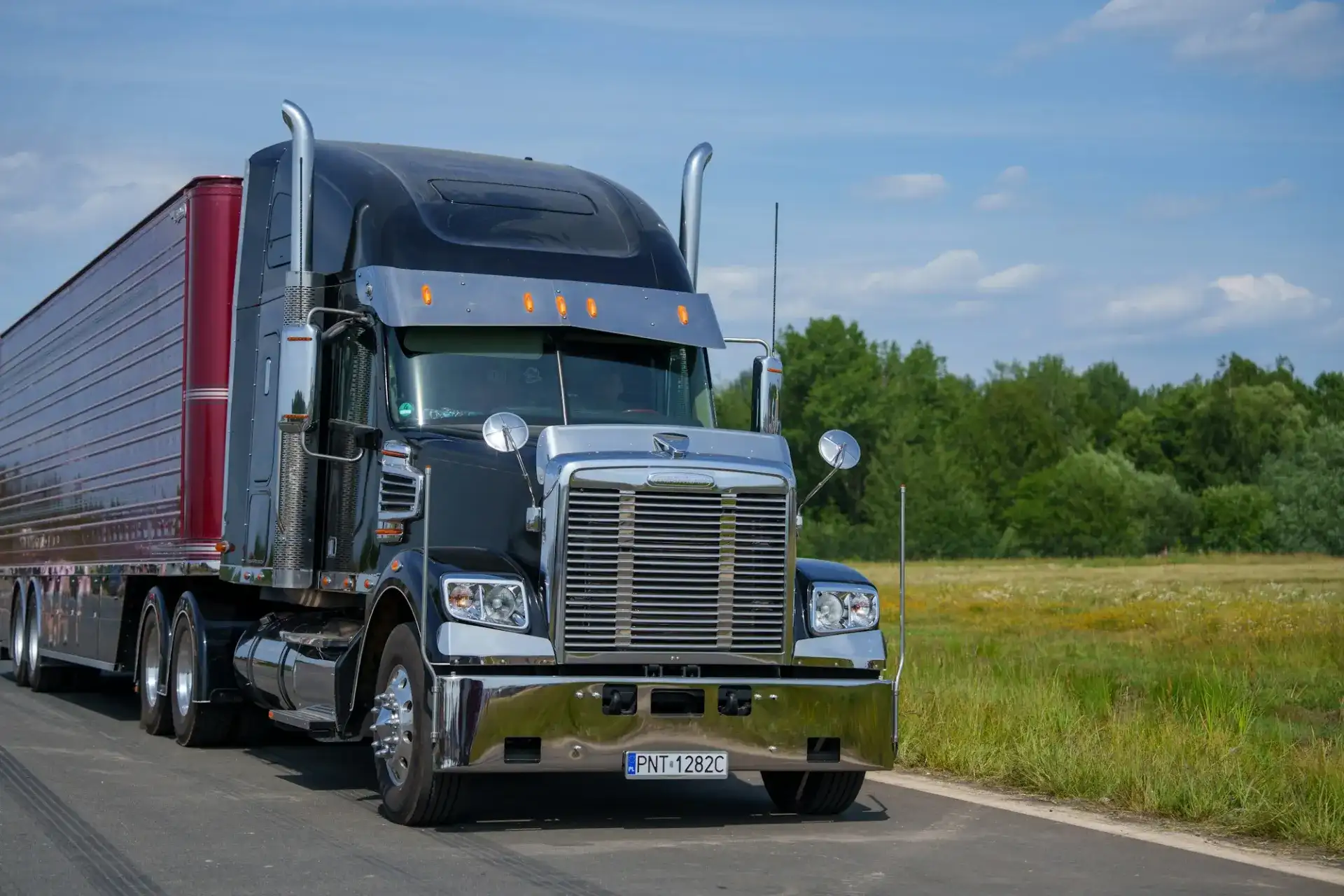
A black tractor-trailer with chrome stacks parked on a road beside a field

All exams/Driving & Licenses/CDL Combination Vehicles Endorsement/Free questions

Free CDL Combination Vehicles Endorsement practice questions

Tap an answer to see if you are right, and why. 20 questions across 8 topics, mostly Driving rollover (3).

Questions last updated October 22, 2026 · Original practice questions on the combination vehicles endorsement, written from the federal knowledge requirements in 49 CFR Part 383 and the public CDL manual facts; not official state test questions.

The real test

Multiple-choice knowledge test · 80% to pass (49 CFR 383.135) · item count set by your state.

80% to pass · question count set by your state

0 of 20 answeredTap an answer to check it
  1. Driving rollover1 of 20

    Which crash type accounts for more than half of truck driver deaths in crashes, according to the manual?

    The answer

    Answer: B. The manual says more than half of truck driver crash deaths come from rollovers. Piling more cargo up in a truck raises its centre of gravity, and that makes it easier to turn over. Rear-end crashes, head-on railroad collisions and fixed-object crashes are real risks, but the manual singles out rollovers as the main cause of truck driver deaths.

    Source: 6.1.1 - Rollover Risks

  2. Driving rollover2 of 20

    Which two actions does the manual name as helping to prevent a rollover?

    The answer

    Answer: C. Low cargo keeps the centre of gravity down, and a lower speed in turns reduces the sideways force on the rig. Both reduce the chance of tipping. Filling the tanks, loading to one side, speeding through curves or braking only with the engine do nothing to keep the load low or slow the rig in turns.

    Source: 6.1.1 - Rollover Risks

  3. Driving rollover3 of 20

    What following distance does the manual give for a combination vehicle at speeds up to 40 mph?

    The answer

    Answer: C. The manual's rule is at least one second for each 10 feet of vehicle length, with one more second added when you go faster than 40 mph. Forty feet per second, a flat two seconds or a car length per 10 mph ignore how much longer a rig is than a car and so give too little room.

    Source: 6.1.2 - Steer Gently

  4. Off tracking swing4 of 20

    What is off-tracking?

    The answer

    Answer: C. In a turn the rear wheels cut inside the path of the front wheels. The manual also calls this 'cheating'. Drifting on a straight road, front-wheel traction loss and valve closing are different events; off-tracking is specifically the rear wheels cutting inside the front wheels in a turn.

    Source: 6.1.6 - Turn Wide

  5. Off tracking swing5 of 20

    If you cannot finish a turn without entering another traffic lane, what does the manual say to do?

    The answer

    Answer: C. Turning wide while you finish the turn keeps other drivers from passing on the right. Swinging wide to the left before you start the turn does not. Swinging wide to the left first invites other drivers to pass on the right, and backing up or speeding up through the turn does not fix the lane problem. Plan the path before you commit.

    Source: 6.1.6 - Turn Wide

  6. Backing trailer6 of 20

    Compared with backing a straight truck, how does backing a trailer change the way you steer?

    The answer

    Answer: D. With a car, straight truck or bus you turn the top of the wheel the way you want to go. With a trailer you turn the opposite way. Steering the same way, using only a quarter turn or turning away from the driver's side are not the rule, because the trailer reverses the usual steering direction. Practice in an open area before a tight dock.

    Source: 6.1.7 - Backing with a Trailer

  7. Backing trailer7 of 20

    Why does the manual say to back slowly with a trailer?

    The answer

    Answer: B. At a slow speed small mistakes stay small, and you have time to correct them before the trailer is far from the path you want. Slow backing is not about air-line stretch, landing gear strain or the trailer brakes; it simply gives you time to see the trailer drift and correct it.

    Source: 6.1.7 - Backing with a Trailer

  8. Coupling8 of 20

    After coupling, how much space should there be between the upper and lower fifth wheel?

    The answer

    Answer: A. A gap means something is wrong. The kingpin may be on top of the closed jaws, and the trailer would come loose very easily. One inch, three inches or room for a hand would all show the jaws are not closed around the kingpin, so recouple instead of driving away.

    Source: 6.4.1 - Coupling Tractor-Semitrailers (Step 13)

  9. Coupling9 of 20

    Before you couple, how should the trailer be held in place?

    The answer

    Answer: D. A trailer that is not held could move when the tractor touches it. Chock the wheels, or be sure the trailer spring brakes are on. The tractor parking brake alone, a half-lowered landing gear or leaving the supply knob in do not stop the trailer from moving, so chocks or spring brakes are the safeguard.

    Source: 6.4.1 - Coupling Tractor-Semitrailers (Step 2)

  10. Coupling10 of 20

    How should you position the tractor when backing toward the trailer?

    The answer

    Answer: D. Backing under at an angle might push the trailer sideways and break the landing gear, so line the tractor up in front of the trailer first. Backing at an angle, beside the trailer or past its centreline all put the kingpin in the wrong place, and sideways pressure can damage the landing gear.

    Source: 6.4.1 - Coupling Tractor-Semitrailers (Step 3)

  11. Uncoupling11 of 20

    Before you uncouple, what must you check about the parking area?

    The answer

    Answer: B. Step 1 says to make sure the surface of the parking area can support the trailer's weight, and to line the tractor up with the trailer so you do not damage the landing gear. Dry ground, extra length or a fuel island are not the concern; what matters is that the surface will not give way under the landing gear and the trailer's weight.

    Source: 6.4.2 - Uncoupling Tractor-Semitrailers (Step 1)

  12. Uncoupling12 of 20

    When should you chock the trailer wheels during uncoupling?

    The answer

    Answer: C. Air could leak out of the trailer air tank and release the emergency brakes. Without chocks the trailer could move. Chock if the trailer lacks spring brakes or you are unsure, because a loaded trailer, a slope or locked brakes are not guarantees that air will stay in the tank.

    Source: 6.4.2 - Uncoupling Tractor-Semitrailers (Step 3)

  13. Combination air brakes13 of 20

    What are two other names for the trailer hand valve?

    The answer

    Answer: D. The trailer hand valve is also called the trolley valve or Johnson bar, and it works the trailer brakes. The foot valve and treadle valve are names for the brake pedal, the relay valve and cut-out cock are other parts, and a glad hand or gooseneck is a coupling device.

    Source: 6.2.1 - Trailer Hand Valve

  14. Combination air brakes14 of 20

    What is the only use of the trailer hand valve the manual recommends?

    The answer

    Answer: A. Do not use it while driving because it risks making the trailer skid. The hand valve is for testing the trailer brakes. Slowing on a downgrade, holding a parked trailer or fixing a jackknife with the hand valve would put brakes on the trailer wheels and could cause or worsen a skid.

    Source: 6.2.1 - Trailer Hand Valve

  15. Combination air brakes15 of 20

    What does the tractor protection valve do?

    The answer

    Answer: A. The tractor protection valve is controlled by the trailer air supply control valve in the cab. It does not prevent wheel lock in turns, set how hard the trailer brakes apply or charge the trailer tanks; its job is protecting the tractor's air if the trailer is lost.

    Source: 6.2.2 - Tractor Protection Valve

  16. Abs16 of 20

    Trailers and converter dollies built on or after which date are required to have ABS?

    The answer

    Answer: A. Many older units were voluntarily fitted with ABS, but every trailer and converter dolly built on or after March 1, 1998 must have it. The 1997 date applies to air-braked truck tractors in the other manual section, and January 1994 and July 2001 are not the dates the manual gives for trailers and dollies.

    Source: 6.3.1 - Trailers Required to Have ABS

  17. Abs17 of 20

    Where is the yellow ABS malfunction lamp found on a trailer?

    The answer

    Answer: A. Trailers carry the lamp on the left side at the front or rear corner. A converter dolly built on or after March 1, 1998 must also have a lamp on the left side. A lamp on the right side, under the trailer or in the cab would not be visible during a walk-around, and the manual puts it on the left at a corner.

    Source: 6.3.1 - Trailers Required to Have ABS

  18. Inspecting18 of 20

    Where should the locking jaws be around the kingpin?

    The answer

    Answer: C. The jaws must hold the shank of the kingpin. If they are on the head, the trailer could come loose. Jaws on the head, around the base plate or open beside the pin would not hold the trailer, because only a grip on the shank keeps the kingpin locked in.

    Source: 6.5.1 - Additional Things to Check during a Walk-around Inspection

  19. Inspecting19 of 20

    Which inspection procedure do you use to inspect a combination vehicle?

    The answer

    Answer: C. There are more things to inspect on a combination vehicle than on a single vehicle. There are also some new things to check. A three-step check, an inspection without the air brake checks or a weekly mechanic's check would miss defects, since the driver does the seven-step inspection with extra items for the coupling system.

    Source: 6.5 - Inspecting a Combination Vehicle

  20. Inspecting20 of 20

    How do you test the trailer service brakes?

    The answer

    Answer: B. The hand valve is used to test the trailer brakes. In normal operation the foot pedal controls them. Pressing the pedal with the engine off, pulling with the supply knob out or disconnecting the trailer would not show that the hand valve applies the trailer service brakes.

    Source: 6.5.2 - Combination Vehicle Brake Check

That’s the free set. The full bank has 100.

More original practice questions across the listed topics, a 50-question timed exam simulator, and saved mistake review. 80% is the federal threshold in 49 CFR 383.135. The regulation sets the percentage only — your state driver licensing agency sets how many questions the test has. One payment of $8.99, yours forever.

Practice the free set