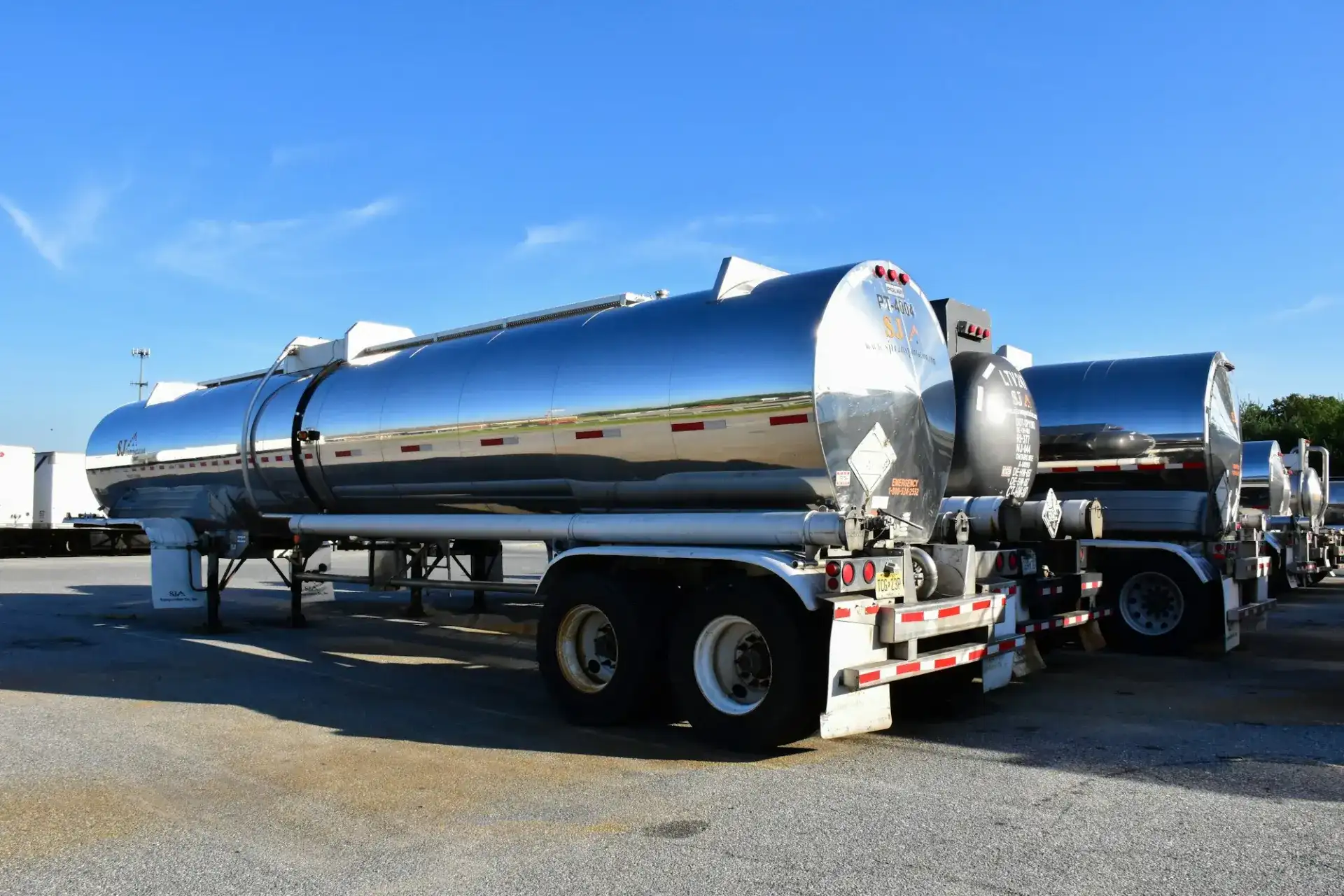
Polished stainless steel tank trailers parked in a lot under a blue sky

All exams/Driving & Licenses/CDL Tank Vehicle Endorsement/Free questions

Free CDL Tank Vehicle Endorsement practice questions

Tap an answer to see if you are right, and why. 20 questions across 10 topics, mostly Braking skids (3).

Questions last updated October 22, 2026 · Original practice questions on the tank vehicle endorsement, written from the federal knowledge requirements in 49 CFR Part 383 and the public CDL manual facts; not official state test questions.

The real test

Multiple-choice knowledge test · 80% to pass (49 CFR 383.135) · item count set by your state.

80% to pass · question count set by your state

0 of 20 answeredTap an answer to check it
  1. Tank endorsement1 of 20

    A tank endorsement is needed to haul liquid or liquid gas in tanks with an individual rated capacity of more than how much?

    The answer

    Answer: D. The introduction to Section 8 sets two thresholds. Each tank must be rated at more than 119 gallons, and the tanks together must reach an aggregate rated capacity of 1,000 gallons or more. The 55 gallon, 500 gallon and 1,000 gallon figures are not the per-tank test, because the 1,000 gallons applies only to the combined rated capacity of all tanks on the vehicle.

    Source: Section 8 - Tank Vehicles (introduction)

  2. Tank endorsement2 of 20

    Does the liquid or gas have to be a hazardous material for a tank endorsement to be required?

    The answer

    Answer: C. The manual states that a tank endorsement is required for certain vehicles hauling liquids or gases, and that the load does not have to be a hazardous material. Hazard class, flammability and a 5,000 gallon size are not conditions, so a milk, water or fuel tanker of the rated size needs the endorsement just like a hazardous one.

    Source: Section 8 - Tank Vehicles (introduction)

  3. Inspection3 of 20

    On all tank vehicles, what is the most important item to check for?

    The answer

    Answer: A. Check under and around the vehicle for signs of leaking before loading, unloading or driving. Tyres, mirrors and wipers matter on every vehicle, but on a tank vehicle a leak means lost cargo and possible harm, so the shell, valves and hoses come first in the inspection.

    Source: 8.1.1 - Leaks

  4. Inspection4 of 20

    What should you check the tank's body or shell for?

    The answer

    Answer: C. Dents or leaks in the shell are listed first among the general checks for a tank vehicle. Paint, tape, stickers and strap rust are cosmetic, whereas dents or leaks in the shell can mean the tank no longer holds its liquid safely, so those are what you look for.

    Source: 8.1.1 - Leaks

  5. Cargo surge5 of 20

    What is liquid surge?

    The answer

    Answer: C. Surge results from liquid moving inside partially filled tanks, and it can have bad effects on handling. Pressure from heat, extra axle weight and foam from filling are different things, whereas surge is the sloshing of liquid in a tank that is not full, which pushes on the vehicle as it moves.

    Source: 8.2.2 - Danger of Surge

  6. Cargo surge6 of 20

    What does the liquid do inside a partly filled tank when the truck comes to a stop?

    The answer

    Answer: D. Coming to a stop sends the liquid surging back and forth, which is why smooth braking matters. The liquid does not settle, stay level or rise on its own when you stop, because its momentum carries it forward and then back, so a hard stop starts a surge that can push the truck.

    Source: 8.2.2 - Danger of Surge

  7. Baffles compartments7 of 20

    What is a baffled liquid tank?

    The answer

    Answer: D. The holes let the liquid flow through the baffles, which control the forward and backward surge. No walls, sealed compartments without holes and lids with vents describe other designs, whereas baffles are walls with holes, which let the liquid flow but slow its movement.

    Source: 8.2.4 - Baffled Tanks

  8. Baffles compartments8 of 20

    What are un-baffled liquid tankers sometimes called?

    The answer

    Answer: A. Smooth bore tanks have nothing inside to slow down the flow of the liquid. Open top, double wall and pressure tanks describe construction or use, whereas smooth bore means no baffles inside, so the liquid can move freely and surge more strongly.

    Source: 8.2.5 - Un-baffled Tanks

  9. Loading outage9 of 20

    Why should you never load a cargo tank totally full?

    The answer

    Answer: B. Leave room for the expanding liquid. That space is called outage. Freezing, pump trouble and steering lightness are not the reason, because a liquid takes up more space as it warms, so a tank filled to the top could overflow or burst.

    Source: 8.2.6 - Outage

  10. Loading outage10 of 20

    What is outage?

    The answer

    Answer: A. Different liquids expand by different amounts, so different liquids need different amounts of outage. Weight, unloading time and valve leakage are different measures, whereas outage is the empty space left at the top so that a warming liquid has somewhere to expand.

    Source: 8.2.6 - Outage

  11. Braking skids11 of 20

    How do wet roads affect the normal stopping distance?

    The answer

    Answer: B. The manual says that wet roads double the normal stopping distance. Ten percent, no change, or a shorter distance for a loaded tanker are all wrong, since a wet surface reduces tyre grip a great deal, so allow double the dry stopping distance.

    Source: 8.3.4 - Stopping Distance

  12. Braking skids12 of 20

    What can happen on a tank trailer if the drive wheels or trailer wheels begin to skid?

    The answer

    Answer: D. On tank trailers, a skid of the drive wheels or trailer wheels can jackknife the vehicle. A skid does not stop the surge, lift the tank or release the trailer brakes, because the heavy trailer swings past the tractor when its wheels lose traction, which is jackknifing.

    Source: 8.3.5 - Skids

  13. Rollover curves13 of 20

    What does a high centre of gravity mean for a tank vehicle?

    The answer

    Answer: C. A high centre of gravity makes the vehicle top-heavy and easy to roll over. A low load, even weight on all axles or weight in the cab would be more stable, but a tank vehicle carries its heavy liquid high, so it tips over in turns more readily.

    Source: 8.2.1 - High Center of Gravity

  14. Rollover curves14 of 20

    How should you approach a curve in a tank vehicle?

    The answer

    Answer: A. The manual says to slow down before curves, then accelerate slightly through the curve. Hard braking in a curve, holding speed or accelerating before the curve would push the load outward or upset the balance, so you do the slowing before the curve begins.

    Source: 8.3.3 - Curves

  15. Emergency systems15 of 20

    Which of these does the manual list as special purpose equipment to check on a tank vehicle?

    The answer

    Answer: D. The list also includes vapor recovery kits, emergency shut-off systems and a built-in fire extinguisher. If your vehicle has the equipment, make sure it works. Livestock ramps, refrigeration units and hydraulic dump hoists belong to other vehicles, while grounding and bonding cables help prevent sparks when handling flammable liquids.

    Source: 8.1.2 - Check Special Purpose Equipment

  16. Emergency systems16 of 20

    What must you do before moving a tank of hazardous materials, however small the amount or short the trip?

    The answer

    Answer: A. Manholes and valves must be closed to prevent leaks. Open vents, capped hoses and the manufacturer's label do not prevent spills, because open manholes or valves allow liquid or vapor to escape, even on a short trip with a small amount.

    Source: 9.5.2 - Tank Loading

  17. Tank types17 of 20

    What are cargo tanks?

    The answer

    Answer: A. Cargo tanks remain on the vehicle when you load and unload them. Bulk packaging loaded off the vehicle, small cab containers and water-only tanks are other things, whereas cargo tanks stay on the vehicle and are filled and emptied while attached.

    Source: 9.5 - Bulk Packaging Marking, Loading and Unloading

  18. Dot marking retest18 of 20

    What must you display on portable tanks and cargo tanks carrying hazardous materials?

    The answer

    Answer: C. Identification numbers are in column 4 of the Hazardous Materials Table. Weight, wash dates, driver names, plant numbers and loading times are not what the rule requires, because responders need the material's identification number to know what is inside. Responders look the number up in the Emergency Response Guidebook to learn how to deal with the material.

    Source: 9.5.1 - Markings

  19. Rollover curves19 of 20

    How fast should you take highway curves and on or off ramp curves in a tank vehicle?

    The answer

    Answer: C. Take highway curves and on ramp and off ramp curves well below the posted speeds. Posted speeds, a slightly higher speed or the speed of traffic are too fast for a top-heavy tank vehicle, since the posted speed for a curve assumes a lower, more stable load.

    Source: 8.2.1 - High Center of Gravity

  20. Braking skids20 of 20

    What must you do when any vehicle starts to skid?

    The answer

    Answer: C. When any vehicle starts to skid, you must take action to restore traction to the wheels. Braking harder, steering sharply away or waiting for the skid to end would make the skid worse or leave you without control, so you must act at once to restore traction.

    Source: 8.3.5 - Skids

That’s the free set. The full bank has 80.

More original practice questions across the listed topics, a 40-question timed exam simulator, and saved mistake review. 80% is the federal threshold in 49 CFR 383.135. The regulation sets the percentage only — your state driver licensing agency sets how many questions the test has. One payment of $6.99, yours forever.

Practice the free set