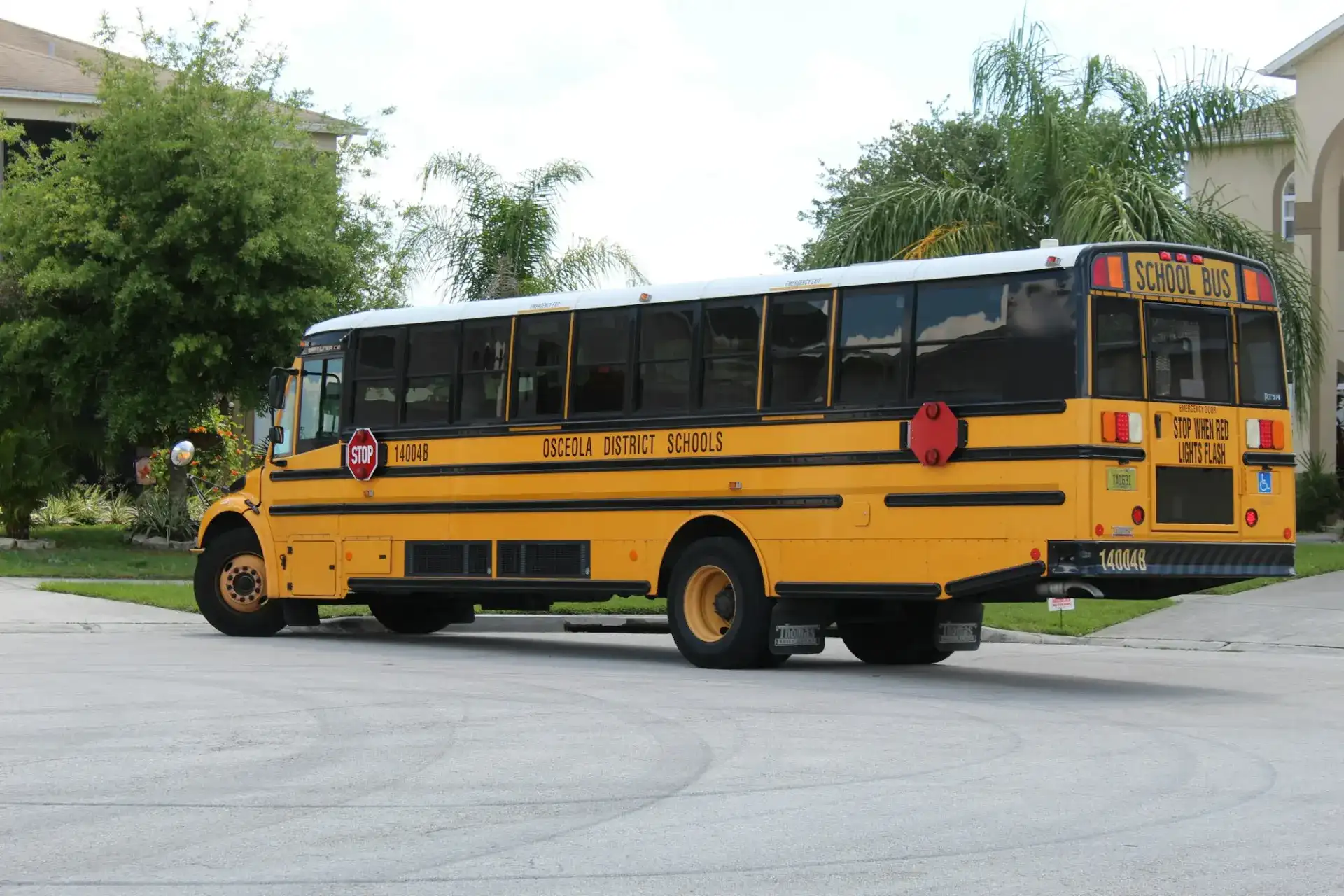
A yellow school bus with its stop arm out seen from the rear corner

All exams/Driving & Licenses/CDL School Bus Endorsement/Free questions

Free CDL School Bus Endorsement practice questions

Tap an answer to see if you are right, and why. 20 questions across 8 topics, mostly Loading unloading (4).

Questions last updated October 22, 2026 · Original practice questions on the school bus endorsement, written from the federal knowledge requirements in 49 CFR Part 383 and the public CDL manual facts; not official state test questions.

The real test

Multiple-choice knowledge test · 80% to pass (49 CFR 383.135) · item count set by your state.

80% to pass · question count set by your state

0 of 20 answeredTap an answer to check it
  1. Danger zones mirrors1 of 20

    What is the danger zone around a school bus?

    The answer

    Answer: D. The danger zone is where children can be hit either by another vehicle or by their own bus. It is not under the bus, inside the bus or 500 feet ahead; it is the area on all sides of the bus where students are at greatest risk, which is why you must know who is in it.

    Source: 10.1.1 - Danger Zones

  2. Danger zones mirrors2 of 20

    When should you check each mirror and have it adjusted if necessary?

    The answer

    Answer: B. Check each mirror before operating the bus to obtain the maximum viewing area. Waiting until after the first stop, checking once a week or adjusting only when students ask would leave blind spots, so every mirror is checked and adjusted before you operate the bus.

    Source: 10.1.2 - Correct Mirror Adjustment

  3. Danger zones mirrors3 of 20

    How far behind the bus should the outside flat mirrors let you see when properly adjusted?

    The answer

    Answer: D. You should also be able to see along the sides of the bus and the rear tires touching the ground. Twenty feet, 60 feet and 500 feet are not the distance the manual gives, since a properly adjusted outside flat mirror shows 200 feet, or 4 bus lengths, behind the bus.

    Source: 10.1.3 - Outside Left and Right Side Flat Mirrors

  4. Loading unloading4 of 20

    Which students are killed more often each year, according to the manual?

    The answer

    Answer: C. More students are killed while getting on or off a school bus than are killed as passengers inside it. Students riding inside, walking to school and waiting in school are not the group with the highest toll, because more are killed getting on or off the bus, usually when hit by another vehicle or by their own bus.

    Source: 10.2 - Loading and Unloading

  5. Loading unloading5 of 20

    How far from the students at the stop should the front bumper be when you stop the bus?

    The answer

    Answer: B. This forces the students to walk to the bus, so you have a better view of their movements. Stopping about 2 feet away, 30 feet away or at the curb line would not give the same view, whereas stopping 10 feet back makes students walk toward the bus where you can see them.

    Source: 10.2.1 - Approaching the Stop

  6. Loading unloading6 of 20

    How should students board the bus at a stop?

    The answer

    Answer: A. The dome light should be on while loading in the dark. Boarding quickly, together, in any order, without the handrail or younger students last invites pushing and falls, whereas slow single file with the handrail, on your signal, keeps the loading orderly and safe.

    Source: 10.2.2 - Loading Procedures

  7. Loading unloading7 of 20

    What should you look for when you walk through and around the bus in the post-trip inspection?

    The answer

    Answer: A. Look also for mechanical or operational problems, with special attention to mirror systems, flashing warning lamps and stop signal arms. Fuel level, oil pressure, weather, traffic and homework are not what a post-trip walkthrough is for, since you check for items and students left behind, windows and doors, and damage.

    Source: 10.2.6 - Post-trip Inspection

  8. Emergency evacuation8 of 20

    What is the first and most important consideration in an emergency?

    The answer

    Answer: B. If time permits, contact your dispatcher to explain the situation before deciding to evacuate. Calling parents, starting the engine and turning the bus around come after you understand the problem, because you cannot choose the right response until you recognise the hazard.

    Source: 10.3.1 - Planning for Emergencies

  9. Emergency evacuation9 of 20

    In which situation must the driver evacuate the bus?

    The answer

    Answer: B. Mandatory evacuations also include a bus stalled on or adjacent to a railroad-highway crossing. A student who feels ill, a late schedule or low fuel are problems to handle without an evacuation, whereas fire or a threat of fire and a bus stalled at a railroad crossing require everyone out.

    Source: 10.3.1 - Planning for Emergencies

  10. Emergency evacuation10 of 20

    How far off the road, and in which direction, should a safe place be?

    The answer

    Answer: C. This keeps students from being hit by debris if another vehicle collides with the bus. Ten feet off the road away from traffic, 500 feet along the road or directly beside the bus would not protect students from debris, so the safe place is 100 feet off the road toward oncoming traffic.

    Source: 10.3.2 - Evacuation Procedures

  11. Railroad crossings11 of 20

    How far from the nearest rail should you stop at a crossing?

    The answer

    Answer: A. Stop where you have the best view of the tracks. One to three feet, 60 to 100 feet or exactly 25 feet are not the right range, since stopping no closer than 15 feet and no farther than 50 feet from the nearest rail gives you a view of the tracks.

    Source: 10.4.3 - Recommended Procedures

  12. Railroad crossings12 of 20

    What does a cross-buck sign require you to do?

    The answer

    Answer: C. A sign below the cross-buck shows the number of tracks if there is more than one set. Slowing and continuing, sounding the horn or proceeding whenever no train is in view do not meet the sign's requirement, since a cross-buck means you must yield the right-of-way to a train.

    Source: 10.4.2 - Warning Signs and Devices

  13. Railroad crossings13 of 20

    What should you do if your bus stalls or is trapped on the tracks?

    The answer

    Answer: B. Getting everyone off the tracks comes first. Keeping students seated, calling the dispatcher first, moving to the back or sending older students away would delay or endanger them, so the first step is to evacuate and move away from the tracks.

    Source: 10.4.4 - Special Situations

  14. Railroad crossings14 of 20

    What should you do if the gate stays down after the train has passed?

    The answer

    Answer: C. Remain stopped until the gates go up and the lights stop flashing, then proceed when it is safe. Driving around, honking or driving through a lowered gate is dangerous or illegal, so stay stopped until the gate lifts and the lights stop flashing, and if it does not, call your dispatcher.

    Source: 10.4.2 - Warning Signs and Devices

  15. Student management15 of 20

    Where should you park the bus to handle a serious problem?

    The answer

    Answer: C. Secure the bus and take the ignition key with you if you leave your seat. Stopping in the road, anywhere beside the road or at a railroad crossing would endanger students or block traffic, so move to a safe location off the road such as a lot or driveway before handling the problem.

    Source: 10.5.2 - Handling Serious Problems

  16. Abs16 of 20

    School buses with air brakes built on or after which date must have ABS?

    The answer

    Answer: B. Many buses built before these dates have been voluntarily equipped with ABS. March 1, 1996, July 1, 2002 and January 1, 1990 are not the date given, so air-braked school buses built on or after March 1, 1998 must have ABS, and many earlier ones were fitted voluntarily.

    Source: 10.6.1 - Vehicles Required to Have Antilock Braking Systems

  17. Abs17 of 20

    Where is the yellow ABS malfunction lamp on a school bus?

    The answer

    Answer: A. Your school bus will have the lamp if it is equipped with ABS. The rear bumper cover, a left mirror and the stop signal arm are not places for the lamp, so look on the instrument panel, where the yellow ABS malfunction lamp shows if the system has a fault.

    Source: 10.6.1 - Vehicles Required to Have Antilock Braking Systems

  18. Special safety18 of 20

    When should the roof-mounted white strobe light be used, if the bus has one?

    The answer

    Answer: C. Limited visibility means you cannot easily see around you in front, behind or beside the bus. The strobe is not for use whenever the bus moves, only at crossings or only on rural morning stops, so use it when visibility is limited, within state or local regulations.

    Source: 10.7.1 - Strobe Lights

  19. Special safety19 of 20

    Why do strong winds affect a school bus so much?

    The answer

    Answer: B. Strong winds can push the bus sideways, move it off the road or, in extreme conditions, tip it over. The bus is not lifted by the wind and the mirrors or stop arm do not act as a sail or rudder, since the large flat side of the bus catches the wind like a sail and pushes it sideways.

    Source: 10.7.2 - Driving in High Winds

  20. Endorsement rules20 of 20

    What must an applicant for the school bus endorsement do first, under 49 CFR 383.123(a)?

    The answer

    Answer: A. The applicant must also pass the school bus knowledge test and a skills test in a school bus. A tank, hazmat or combination endorsement test is not the starting point, since the school bus endorsement builds on the passenger endorsement before the school bus knowledge test and a skills test in a school bus.

    Source: 49 CFR 383.123 - Requirements for a school bus endorsement

That’s the free set. The full bank has 80.

More original practice questions across the listed topics, a 40-question timed exam simulator, and saved mistake review. 80% is the federal threshold in 49 CFR 383.135. The regulation sets the percentage only — your state driver licensing agency sets how many questions the test has. One payment of $6.99, yours forever.

Practice the free set