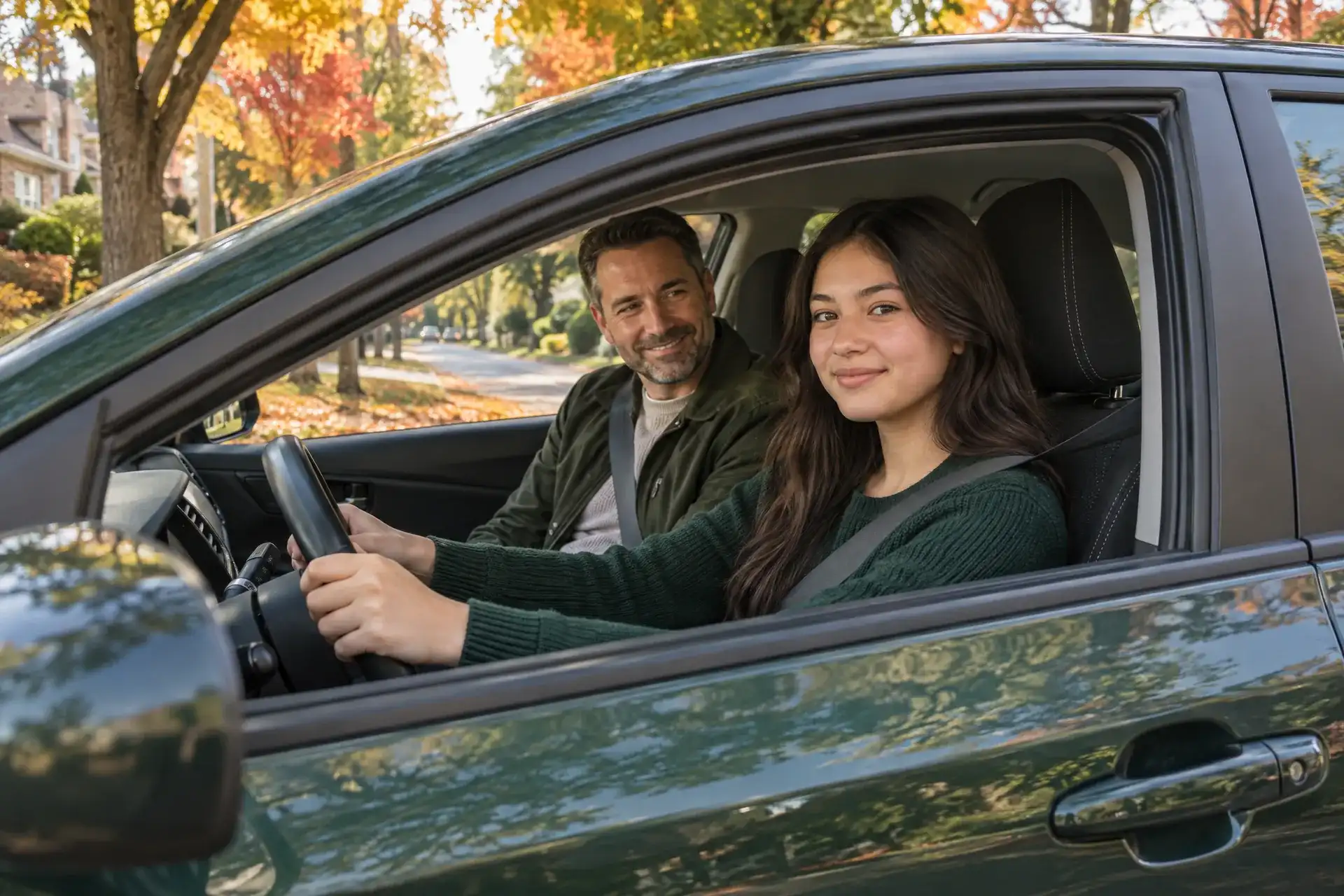
Young driver and an adult smiling from the front seats of a car
Free practice set · Original questions

All exams/Driving & Licenses/Ontario G1 Knowledge Test/Free questions

Free Ontario G1 Knowledge Test practice questions

Tap an answer to see if you are right, and why. 20 questions across 10 topics, mostly Alcohol and drugs (2).

Passing score: 80% (target)
Format: Multiple-choice knowledge test
Bank: 300 Qs (20 free)
100% Sourced explanations

Questions last updated October 15, 2026 · Original practice questions written from the Official MTO Driver's Handbook and Ontario licensing pages; not official MTO or DriveTest questions. Not affiliated with the MTO or DriveTest.

0 of 20 answeredTap an answer to check it
  1. Alcohol and drugs1 of 20

    As a G1 driver, your permitted blood alcohol concentration is:

    The answer

    Answer: C. G1 and G2 drivers must have zero blood alcohol — none at all — whenever they drive. The fully licensed adult limit does not apply to learner or novice drivers. Prescription or illegal drugs that impair ability are also prohibited. One drink can be enough to breach zero tolerance rules and trigger immediate roadside consequences.

    Source: MTO Handbook — Keeping your driver's licence — Alcohol and new drivers

  2. Demerit points2 of 20

    Accumulating too many demerit points can result in:

    The answer

    Answer: A. Demerit points record convictions for certain offences. Exceeding the provincial threshold can lead to suspension of your driver's licence, with longer suspensions for repeat or novice drivers. Points also affect insurance costs. New drivers face stricter thresholds, so a single careless-driving conviction can already threaten a G1 or G2 privilege.

    Source: MTO Handbook — Keeping your driver's licence — Demerit point system

  3. Emergencies3 of 20

    You see a fire truck or ambulance approaching from behind with lights and sirens. You should:

    The answer

    Answer: D. When an emergency vehicle approaches with flashing lights and siren, keep a safe distance (at least 15 m when it is stopped, and avoid tailgating when following), then pull over to the right edge of the roadway and come to a clear stop when safe. Do not block an intersection. Only move again when the vehicle has passed and the way is clear.

    Source: MTO Handbook — Sharing the road — Emergency vehicles

  4. Intersections and turns4 of 20

    Before turning left at a green light, you should:

    The answer

    Answer: B. A left turn is only allowed when you can complete it without conflicting with oncoming vehicles, transit, cyclists, or pedestrians. Signal early, position safely, wait for a clear gap, and never assume oncoming traffic will slow. A green light permits the turn but does not give you right-of-way over those already lawfully in or crossing the intersection.

    Source: MTO Handbook — Changing directions — Left turns

  5. Licensing (G1)5 of 20

    To apply for a G1 licence you must be at least:

    The answer

    Answer: D. Applicants must be at least 16 years old, be an Ontario resident (not merely a visitor), pass a vision test, and pass a knowledge test on the rules of the road and traffic signs. After passing you enter Level One with a Class G1 licence. Age alone is not enough — residency and the two tests are equally required.

    Source: MTO Handbook — Getting your driver's licence — Requirements

  6. Parking6 of 20

    When parking downhill next to a curb, you should turn your front wheels:

    The answer

    Answer: B. Park downhill with the front wheels turned toward the curb so a rolling vehicle is caught by the curb rather than rolling into traffic. Uphill (without a curb) the usual advice is wheels turned away from the curb or toward the shoulder, depending on configuration. Always set the parking brake. The curb is your backup if the transmission fails.

    Source: MTO Handbook — Parking along roadways — Parking on hills

  7. Right of way7 of 20

    You are approaching an all-way stop. Two other vehicles arrived at the same time as you. Who goes first?

    The answer

    Answer: D. At an all-way stop, if two or more vehicles arrive together, the driver on the right has the right-of-way. Size, impatience, or signalling does not change that rule. If you arrived clearly first, you proceed first; if arrival is simultaneous, yield to the right, then continue in a courteous, predictable order so nobody assumes a different turn sequence.

    Source: MTO Handbook — Driving through intersections — Four-way stops

  8. Road signs8 of 20

    An octagonal red sign always means what?

    The answer

    Answer: B. An octagon is reserved for one meaning: stop. Drivers must bring the vehicle to a complete halt at the limit line or before entering the intersection, then proceed only when safe. Other shapes carry different jobs — a triangle warns or yields, and a rectangle usually regulates — so shape alone is a reliable clue when visibility is poor.

    Source: MTO Handbook — Signs — Regulatory signs

  9. Sharing the road9 of 20

    When a school bus with flashing red lights is stopped on your side of a divided road, you must:

    The answer

    Answer: A. A school bus stopped with alternating red flashing lights requires traffic to stop until the lights cease flashing, regardless of whether you can see children. On a physically divided highway, rules can differ by configuration, but the safe and legal habit is to stop when the bus signals loading or unloading. Failing to stop endangers students and carries heavy fines and demerit points.

    Source: MTO Handbook — Sharing the road — School buses

  10. Speed limits10 of 20

    Unless otherwise posted, the maximum speed limit in most built-up (urban) areas in Ontario is:

    The answer

    Answer: A. The default urban maximum is 50 km/h when no sign states another limit. School, construction, or posted residential zones may be lower (for example 30 or 40 km/h). Always obey a posted sign over the default. Speed must also be reasonable for traffic, weather, and road conditions even when you are at or below the limit.

    Source: MTO Handbook — Safe and responsible driving — Speed limits

  11. Alcohol and drugs11 of 20

    The general adult impaired-driving limit in Ontario for fully licensed drivers is a BAC of:

    The answer

    Answer: D. Fully licensed drivers face impaired-driving charges at 0.08% BAC or higher for the criminal offence threshold commonly referenced in study materials, while warning and roadside administrative thresholds can apply at lower levels. Learner and novice drivers remain at zero tolerance. Because impairment begins before 0.08%, the only safe choice is to plan a sober ride before you drink.

    Source: MTO Handbook — Keeping your driver's licence — Alcohol limits

  12. Demerit points12 of 20

    Careless driving is a serious offence because it:

    The answer

    Answer: A. Careless driving means operating a vehicle without due care and attention or without reasonable consideration for other road users. Courts treat it seriously: substantial fines, demerit points, and possible suspension follow convictions. Distracted behaviours — phone use, eating, adjusting controls blindly — often escalate into this charge when a collision or near-miss occurs.

    Source: MTO Handbook — Keeping your driver's licence — Careless driving

  13. Emergencies13 of 20

    When following an emergency vehicle responding to a call, the recommended minimum following distance is about:

    The answer

    Answer: D. Guidance is to keep roughly 15 metres (about 5 car lengths) behind an emergency vehicle using lights and siren when you cannot yet pull over, and never follow closely as if drafting. This buffer gives you reaction space if the unit stops short or manoeuvres. Once you can safely move right and stop, do so until it passes.

    Source: MTO Handbook — Sharing the road — Emergency vehicles

  14. Intersections and turns14 of 20

    When making a right turn on red, you must first:

    The answer

    Answer: A. A right turn on red is not a rolling yield. You must stop fully behind the stop line or crosswalk, then turn only when the way is clear and no sign prohibits the turn. Yield to pedestrians in the crosswalk and to traffic with the green. If visibility is blocked, inch forward only when safe, then complete the turn.

    Source: MTO Handbook — Changing directions — Right turns

  15. Licensing (G1)15 of 20

    A Class G1 driver may drive only when:

    The answer

    Answer: B. G1 drivers must never drive alone. The front-seat passenger must be a fully licensed driver with at least four years of driving experience and a blood alcohol level under 0.05 (zero if that driver is 21 or under). That person must be the only other occupant of the front seat. Violating these conditions risks roadside charges and licence consequences.

    Source: MTO Handbook — Getting your driver's licence — Level One (Class G1)

  16. Parking16 of 20

    You must not park within how far of a crosswalk at an intersection?

    The answer

    Answer: D. Parking that blocks a crosswalk, stop sign sightline, fire hydrant access, or sidewalk is prohibited. Exact metric setbacks vary by provision and municipality, but the principle is fixed: never park where you hide pedestrians from drivers or force them into traffic. When in doubt, choose a legal marked stall — convenience is not a defence.

    Source: MTO Handbook — Parking along roadways — Where not to stop or park

  17. Right of way17 of 20

    When entering a roundabout, you must yield to:

    The answer

    Answer: A. Traffic already in the roundabout has priority. Approach in the correct lane, slow, and enter only when there is a safe gap. Do not stop inside the circle unless traffic conditions require it, and do not change lanes within the roundabout. Signalling your exit helps other drivers, but yielding to circulating traffic is the non-negotiable rule.

    Source: MTO Handbook — Driving through intersections — Roundabouts

  18. Road signs18 of 20

    A sign shaped like an inverted triangle (point down) tells you to:

    The answer

    Answer: A. The upside-down triangle is the yield sign. You slow down, give the right-of-way to vehicles and pedestrians in or approaching the intersection, and stop only if needed. It is the only sign with this shape, so even when paint is faded the outline still communicates yield rather than stop or warning.

    Source: MTO Handbook — Signs — Regulatory signs

  19. Sharing the road19 of 20

    A cyclist is riding near the right edge of the lane ahead of you. You should:

    The answer

    Answer: D. Cyclists are vehicles with the same right to use the road. Pass only when it is safe to give roughly a metre of clearance (more at higher speeds), signal, and return to your lane without cutting them off. Do not require them to use a sidewalk. Patience and space prevent dooring and right-hook crashes at intersections.

    Source: MTO Handbook — Sharing the road — Cyclists

  20. Speed limits20 of 20

    Outside cities and towns, the default maximum speed on many open roads is:

    The answer

    Answer: A. Rural or unincorporated stretches often default to 80 km/h unless signed otherwise; urban default remains 50 km/h. Freeways and 400-series roads usually post 100 or higher where allowed. Never treat the default as a target in bad weather — you must still reduce speed so you can stop within the distance you can see to be clear.

    Source: MTO Handbook — Safe and responsible driving — Speed limits

Official Test Specs & Sourced Summary

The official Ontario G1 Knowledge Test knowledge examination covers Multiple-choice knowledge test with a passing threshold of 80%. Original practice questions written from the Official MTO Driver's Handbook and Ontario licensing pages; not official MTO or DriveTest questions. Not affiliated with the MTO or DriveTest. Every question on this page is original, with an explanation and a note citing its source.

Passing Score80% target
FormatMultiple-choice knowledge test · road signs + rules of the road
Question Bank300 questions (20 free)

Now try them under test conditions.

Practice the free set as a quiz with instant scoring, drill one topic at a time, or sit the free timed mock exam. Internal QuizCram practice target. Ontario's official pages require passing a knowledge test on the rules of the road and traffic signs but publish no item count or percentage — the widely reported 40-question, 16-per-section format is secondary consensus, not an MTO-published threshold.

Ontario G1 Knowledge Test alcohol and drug questions

Part of the bank cover alcohol and drugs. 2 are free here, with the answer and where it comes from:

  • As a G1 driver, your permitted blood alcohol concentration is: Answer: Zero — no alcohol at allMTO Handbook — Keeping your driver's licence — Alcohol and new drivers
  • The general adult impaired-driving limit in Ontario for fully licensed drivers is a BAC of: Answer: 0.08%MTO Handbook — Keeping your driver's licence — Alcohol limits