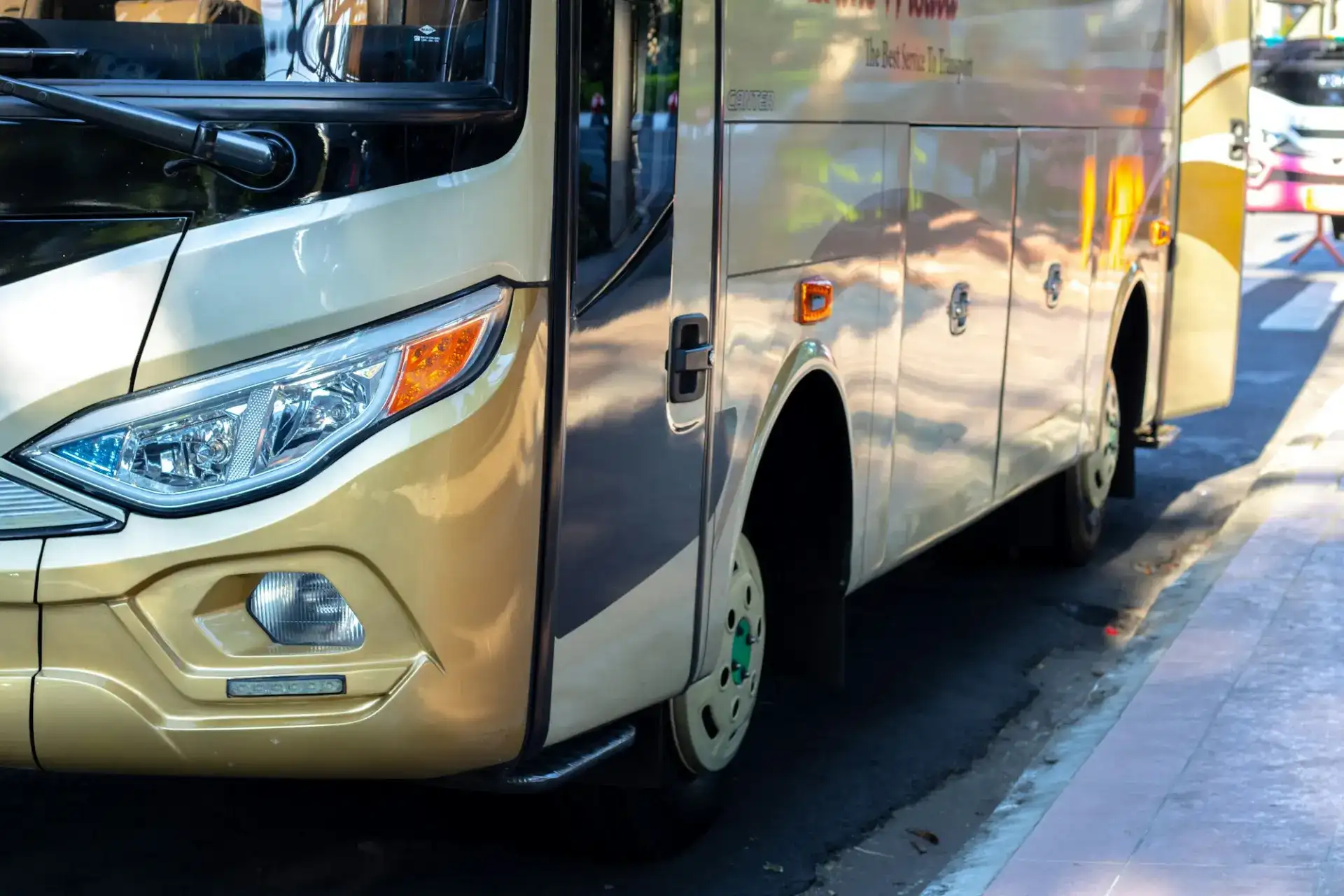
A tan coach bus parked at a curb seen from the front corner

All exams/Driving & Licenses/CDL Passenger Endorsement/Free questions

Free CDL Passenger Endorsement practice questions

Tap an answer to see if you are right, and why. 20 questions across 8 topics, mostly Inspection (3).

Questions last updated October 22, 2026 · Original practice questions on the passenger endorsement, written from the federal knowledge requirements in 49 CFR Part 383 and the public CDL manual facts; not official state test questions.

The real test

Multiple-choice knowledge test · 80% to pass (49 CFR 383.135) · item count set by your state.

80% to pass · question count set by your state

0 of 20 answeredTap an answer to check it
  1. Passenger endorsement1 of 20

    On which sections of the manual do you take the knowledge test for the passenger endorsement?

    The answer

    Answer: A. The test covers Sections 2 and 4. If your bus has air brakes you must also pass the knowledge test on Section 5. Sections 1 and 3, 4 and 6 or 2 and 8 pair the passenger topic with unrelated material such as vehicle control, combination vehicles or tank vehicles, so the passenger test rests on the general and bus sections.

    Source: Section 4 - Transporting Passengers Safely (introduction)

  2. Passenger endorsement2 of 20

    Besides the knowledge test, what must you pass to get the passenger endorsement?

    The answer

    Answer: A. You must pass the skills tests that go with the class of vehicle you will drive. Hazard placards, a tank road test and a company medical review are not part of getting the endorsement, because the skills tests for your class of vehicle are what is added to the knowledge test.

    Source: Section 4 - Transporting Passengers Safely (introduction)

  3. Inspection3 of 20

    Before driving a bus, what must you review?

    The answer

    Answer: B. The manual says you must review the previous driver's inspection report before driving. A route plan, a rider list and a fuel receipt say nothing about the bus's condition, whereas the previous driver's inspection report lists defects you must know about before driving.

    Source: 4.1 - Vehicle Inspection

  4. Inspection4 of 20

    What must you never do with the emergency exits on a bus?

    The answer

    Answer: D. Never drive with an open emergency exit door or window. Checking exits on the walk-around, closing them before leaving and marking them with a sign are correct habits, but driving with an open emergency door or window is the thing you must never do.

    Source: 4.1 - Vehicle Inspection

  5. Inspection5 of 20

    What should the driver's seat have, and what should you do with it?

    The answer

    Answer: C. The driver's seat should have a seat belt, and you should always use it for safety. A headrest, a cushion and a safety bar are not what the manual names, whereas a seat belt protects you in a crash and you should always wear it, not just on highways.

    Source: 4.1.5 - Use Your Seatbelt!

  6. Loading baggage hazmat6 of 20

    Where must you not allow riders to leave carry-on baggage?

    The answer

    Answer: D. There should also be nothing in the aisle that might trip other riders. Under a seat, on the lap and in an overhead rack are acceptable places, but a doorway or aisle blocks the way out in an emergency and can trip riders, so carry-ons must not be left there.

    Source: 4.2 - Loading and Trip Start

  7. Loading baggage hazmat7 of 20

    What does the manual say about most hazardous materials on a bus?

    The answer

    Answer: D. Watch for cargo or baggage containing hazardous materials, and do not transport any unless you are sure the rules allow it. Using the baggage bay, sealed containers or rider agreement does not make dangerous goods allowed, because most hazardous materials cannot be carried on a bus, and you should not carry any unless sure the rules allow it.

    Source: 4.2.1 - Hazardous Materials

  8. Loading baggage hazmat8 of 20

    How many different four-inch, diamond-shaped hazard labels does the manual say there are?

    The answer

    Answer: C. The manual shows the nine hazard classes in Figure 4.1. Five, twelve and twenty are not the number of hazard classes in the manual's figure, which shows nine four-inch diamond-shaped labels, one for each class. Learning to read the label on a package helps you spot a hazardous material before it is loaded on the bus.

    Source: 4.2.1 - Hazardous Materials

  9. Standee destination9 of 20

    What is the standee line?

    The answer

    Answer: A. No rider may stand forward of the rear of the driver's seat. All standing riders must stay behind the line. A queue line, a baggage area edge and a last-row line are not what the standee line marks, since it shows riders where they may not stand forward of, keeping the driver's view and the front door clear.

    Source: 4.2.3 - Standee Line

  10. Standee destination10 of 20

    What should you announce when arriving at a destination or intermediate stop?

    The answer

    Answer: C. Announce these at every destination and intermediate stop. Weather, fares, the driver's name and the next stop's time are not what riders need most, since announcing the location, reason, next departure time and bus number helps them get back on the right bus.

    Source: 4.2.4 - At Your Destination

  11. On the road11 of 20

    What should you scan while driving a bus?

    The answer

    Answer: A. You may have to remind riders about rules, or to keep arms and heads inside the bus. Watching only the road, only the interior or only the left mirrors would miss either the traffic or the riders, so you scan the road ahead, the sides, the rear and the interior of the bus.

    Source: 4.3.1 - Passenger Supervision

  12. On the road12 of 20

    Where do bus accidents often happen?

    The answer

    Answer: D. Use caution at intersections even if a signal or stop sign controls other traffic. Straight highway stretches, parking lots and tunnels are not where bus accidents most often occur, because the crossing paths of other vehicles at intersections create the main risk.

    Source: 4.3.3 - Common Accidents

  13. On the road13 of 20

    What does the manual say about the posted speed for a curve?

    The answer

    Answer: A. Every banked curve has a safe design speed. Reduce speed for curves. It is not always safe for a bus, it is not meant for buses only and it is not always too low, because the posted curve speed suits cars and a taller bus with a higher centre of gravity may need to go slower.

    Source: 4.3.4 - Speed on Curves

  14. Railroad drawbridge14 of 20

    How far from a railroad crossing should you stop your bus?

    The answer

    Answer: B. The manual's stop rule is between 15 and 50 feet before railroad crossings. Five to ten feet, 100 to 150 feet or exactly 25 feet are not the manual's range, which is a stop between 15 and 50 feet before the crossing, close enough to see but safely away from the tracks.

    Source: 4.3.5 - Railroad-highway Crossing/ Stops

  15. Railroad drawbridge15 of 20

    When must you stop at a drawbridge?

    The answer

    Answer: B. Stop at drawbridges that do not have a signal light or traffic control attendant. Stopping only when the draw is open, only at night or only with standees would miss the situations in which a drawbridge could suddenly open, so stop whenever there is no signal light or attendant.

    Source: 4.3.6 - Drawbridges

  16. Railroad drawbridge16 of 20

    What must you never do with a manual transmission while crossing the tracks?

    The answer

    Answer: A. Never change gears while crossing the tracks. Slowing down, opening the door and using the horn are all allowed or even needed at a crossing, whereas changing gears on the tracks could stall the engine on the rails. A missed shift or a stall with the wheels on the rails leaves the bus in the path of a train.

    Source: 4.5 - Prohibited Practices

  17. After trip prohibited17 of 20

    When must you inspect your bus after the trip?

    The answer

    Answer: A. Inspect your bus at the end of each shift. A weekly check, a monthly check or one after an accident would leave long gaps, because you inspect the bus at the end of each shift so defects are noticed and reported before the next driver takes it.

    Source: 4.4 - After-trip Vehicle Inspection

  18. After trip prohibited18 of 20

    What must a driver for an interstate carrier complete for each bus driven?

    The answer

    Answer: C. The report must specify the bus and list any defect that would affect safety or result in a breakdown. A route map, a rider list and fares or a fuel log do not meet the rule, since an interstate carrier's driver must complete a written inspection report for each bus that names the bus and lists any safety defect.

    Source: 4.4 - After-trip Vehicle Inspection

  19. Brake door interlocks19 of 20

    What does a brake-door interlock do when the rear door is open?

    The answer

    Answer: D. The interlock is a safety feature for urban mass transit coaches. Releasing the brakes, locking the front door, and the horn or hazard lights are not what the interlock does, because with the rear door open it holds the bus by applying the brakes and keeping the throttle at idle.

    Source: 4.6 - Use of Brake-door Interlocks

  20. Brake door interlocks20 of 20

    What should you not use the brake-door interlock in place of?

    The answer

    Answer: A. Do not use this safety feature in place of the parking brake. The service brake, the horn and the emergency exit are not what the interlock replaces, since it is a safety feature that does not hold the bus the way the parking brake does.

    Source: 4.6 - Use of Brake-door Interlocks

That’s the free set. The full bank has 80.

More original practice questions across the listed topics, a 40-question timed exam simulator, and saved mistake review. 80% is the federal threshold in 49 CFR 383.135. The regulation sets the percentage only — your state driver licensing agency sets how many questions the test has. One payment of $6.99, yours forever.

Practice the free set