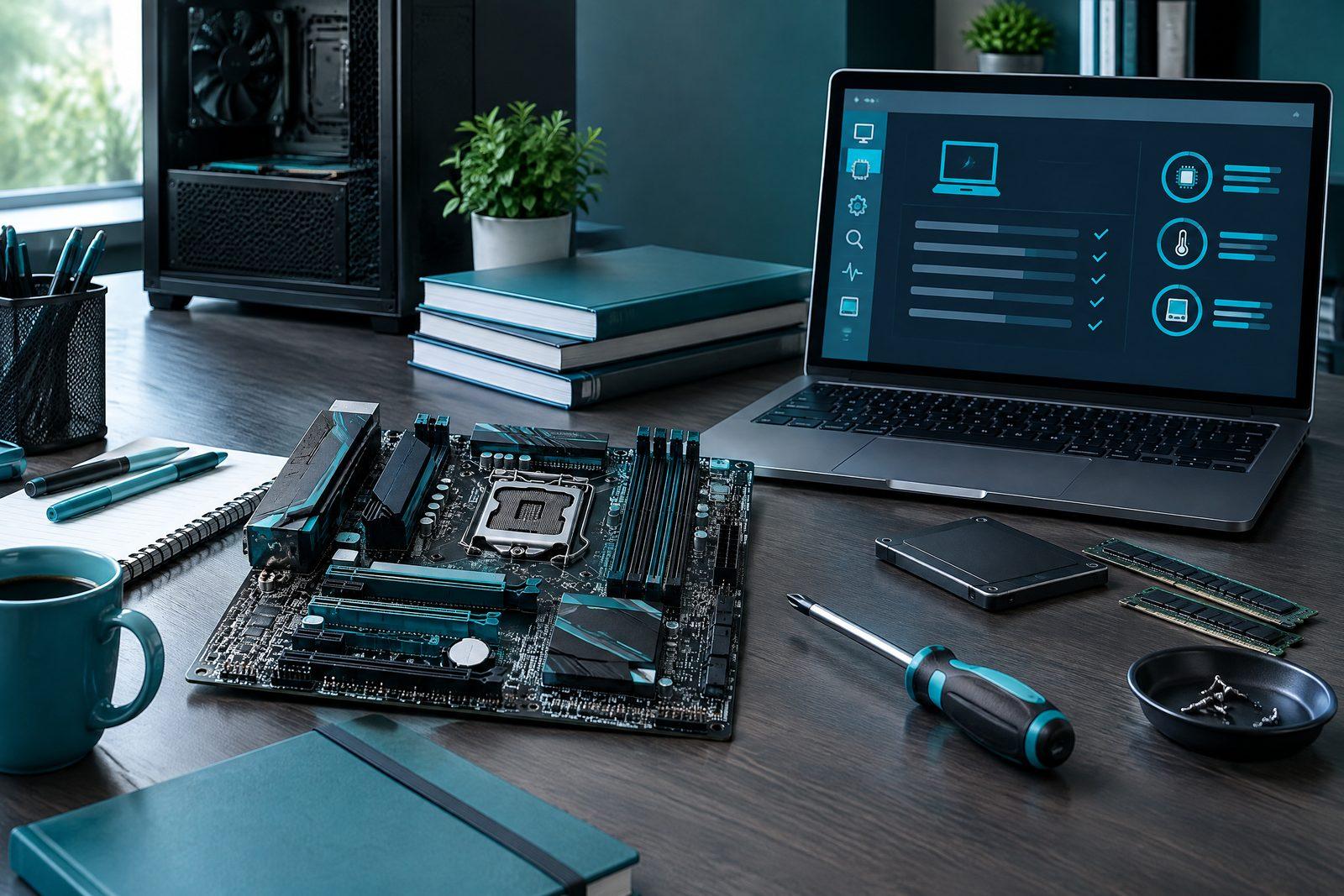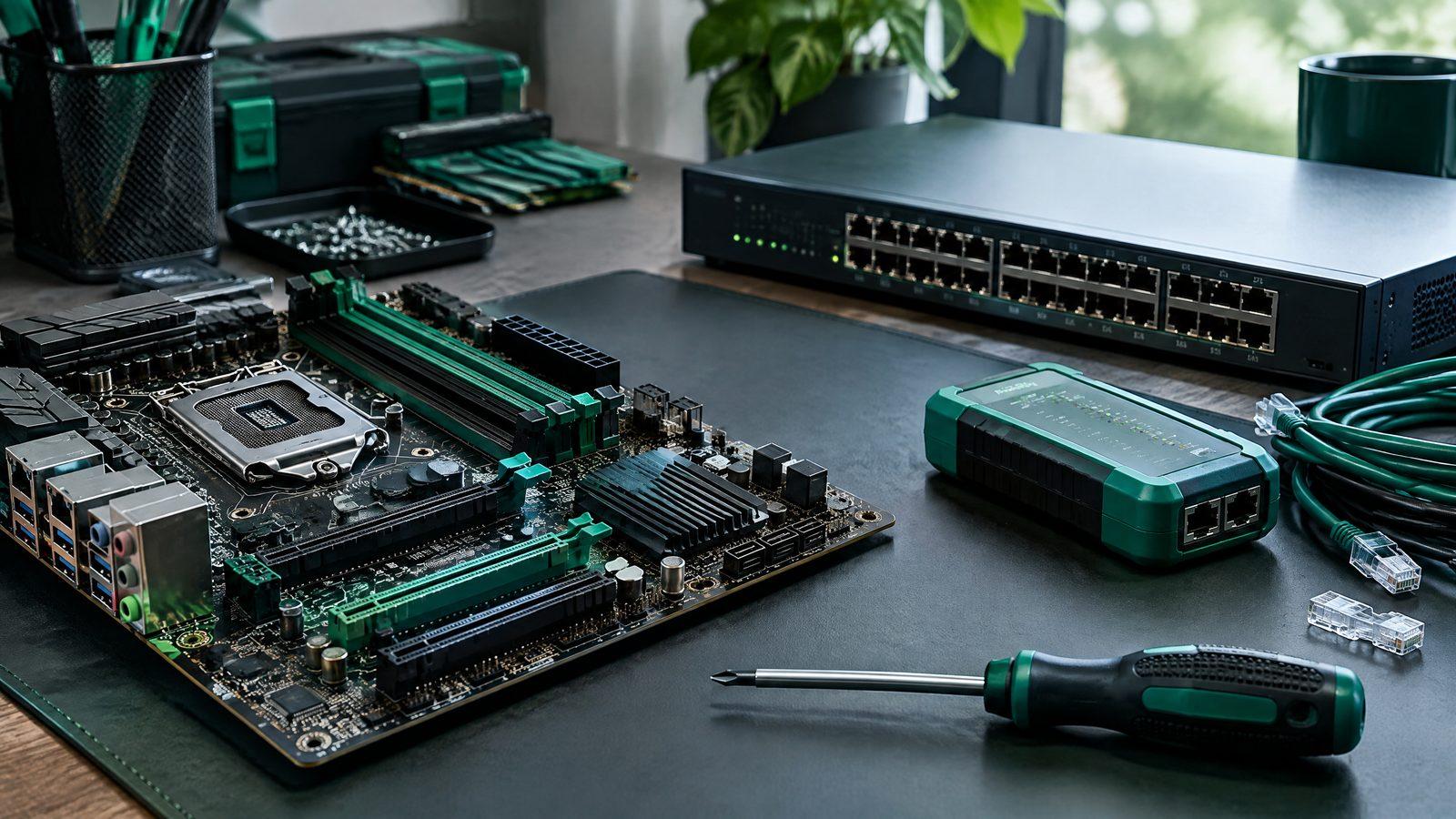
Why Domain 5 Decides Your Score
Hardware and Network Troubleshooting is 28% of the CompTIA A+ Core 1 exam (220-1201) — the largest of its five domains, and the one that produces most of the performance-based questions. Its objectives are written as lists of symptoms: a clicking drive, a swollen battery, port flapping, ghost images on a print. Every question in the domain is the same shape — here is what the user reports, which cause fits, what do you do first — so the fastest way to score is to know, for each listed symptom, the one or two causes CompTIA has in mind.
This guide goes objective by objective through all seven symptom lists in the 220-1201 document and pairs each symptom with its exam cause and first action. It also explains what changed in this version of the exam: the six-step troubleshooting methodology is still printed in the objectives, but CompTIA now states it is not tested. Practise the pattern on our free A+ Core 1 questions, which follow the same domain weights.
The Numbers
| Item | A+ Core 1 (220-1201, objectives v2.0) |
|---|---|
| Domain 5 weight | 28% — about 25 of a 90-question exam |
| Objectives in the domain | 7: motherboards/RAM/CPUs/power · drives and RAID · video and displays · mobile devices · network · printers (and the methodology, which is not tested) |
| Symptoms listed across the seven objectives | About 85 |
| Question shape | "Given a scenario" — a user report plus one or two clues, then the most likely cause or the best next step |
| Passing score | 675 of 900; 90 minutes; up to 90 questions |
| Where the methodology went | Printed in the objectives as a "competency standard", explicitly excluded from the exam in 220-1201 |
The Six-Step Method — Still Worth Knowing
CompTIA's troubleshooting methodology was a numbered objective in the previous exam (220-1101) and produced reliable "what is the next step" questions. In 220-1201 the objectives document keeps the list but says the decision was made not to include it in the exam. Two reasons to learn it anyway: it is how the scenario questions are still structured (they always ask for the next step, and the next step is always the next rung), and it is how a technician is expected to work.
- Identify the problem — question the user, identify symptoms, check for recent changes, and back up before making any change.
- Establish a theory of probable cause — question the obvious first (is it plugged in?), then research the knowledge base if needed.
- Test the theory — if it holds, move on; if not, form a new theory or escalate.
- Establish a plan of action and implement the solution — one change at a time, following vendor guidance.
- Verify full system functionality and put preventive measures in place.
- Document findings, actions and outcomes.
5.2 Motherboards, RAM, CPUs and Power
| Symptom | Most likely cause on the exam | First action |
|---|---|---|
| POST beeps | Memory or video not detected; the beep pattern is the diagnosis | Look up the code for that BIOS vendor; reseat RAM or the graphics card |
| Proprietary crash screens (BSOD, pinwheel) | Faulty RAM, a bad driver or overheating | Note the stop code; test memory; roll back the last driver |
| Blank screen, fans spinning | Video output, monitor input or a failed POST | Check the input source and cable, then listen for beeps |
| No power at all | Power supply, switch on the PSU, wall outlet, front-panel connector | Test the outlet, check the PSU switch and the 24-pin connector |
| Sluggish performance | Thermal throttling, too little RAM, a failing drive | Check temperatures and Task Manager/Activity Monitor |
| Overheating, random shutdown | Dust, a failed fan, dried thermal paste, blocked vents | Clean, replace the fan, reapply paste |
| Burning smell | Failed capacitor or power supply | Power off at once; inspect; replace the part |
| Application crashes | Bad RAM module, overheating, corrupt install | Memory test; check temperatures |
| Unusual noise | A fan bearing, a drive, or a loose cable in a fan | Locate by ear with the side panel off |
| Capacitor swelling | Motherboard nearing failure | Replace the board |
| Inaccurate system date/time | Dead CMOS battery (CR2032) | Replace the coin cell, re-enter BIOS settings |
5.3 Drives and RAID
| Symptom | Most likely cause | First action |
|---|---|---|
| Clicking or grinding sounds | Mechanical hard-drive failure | Back up immediately; replace the drive |
| S.M.A.R.T. failure warning | The drive is predicting its own failure | Back up and replace — do not wait for it to die |
| Bootable device not found | Boot order changed, a loose cable, or a dead drive | Check the BIOS boot order and the SATA/power cables |
| Extended read/write times, low IOPS | Fragmentation on an HDD, a failing drive, or a near-full SSD | Check S.M.A.R.T.; free space; consider an SSD |
| Data loss or corruption | Failing drive, bad cable, sudden power loss | Restore from backup; check the drive |
| Missing drives in the OS | Uninitialised or unformatted disk, or no drive letter | Disk Management: initialise, partition, assign a letter |
| RAID failure, array missing, audible alarm | A member drive failed; with RAID 0 the data is gone, with 1/5/10 it is degraded | Identify the failed drive from the controller, replace it, let it rebuild |
| LED status indicators | Amber or red on a bay means that drive or array needs attention | Read the controller's status page |
5.4 Video, Projector and Display Issues
| Symptom | Most likely cause | First action |
|---|---|---|
| No image, "no signal" | Wrong input source selected, or a cable | Select the input; reseat the cable |
| Fuzzy image | Non-native resolution, or an analogue (VGA) cable on a long run | Set the native resolution; use a digital cable |
| Dim image | Brightness or power-saving setting; failed backlight or inverter on older LCDs; ageing projector bulb | Check settings, then the backlight |
| Flashing / flickering screen | Loose cable, failing backlight, wrong refresh rate, driver | Reseat, then set the refresh rate |
| Dead pixels | Panel defect | Replace under warranty; not repairable |
| Burn-in | Static image left on an OLED or plasma | Pixel-shift and screensavers prevent it; a burned panel is replaced |
| Incorrect colour | Bent pin on a VGA/DVI cable, colour profile, failing panel | Inspect the connector; reset the profile |
| Distorted or sized-wrong image | Resolution or aspect-ratio setting; projector keystone | Set the native resolution; adjust keystone |
| Intermittent projector shutdown | Overheating — blocked filter or vents | Clean the filter; give it airflow |
| Burnt-out bulb | Lamp at end of life | Replace the lamp; reset the lamp-hours counter |
| Audio issues | Wrong output device, or HDMI audio not selected | Set the output device in the OS |
5.5 Mobile Devices
| Symptom | Most likely cause | First action |
|---|---|---|
| Swollen battery | Lithium cell failure | Stop using it; do not puncture; replace and dispose of properly — a safety answer, not a repair answer |
| Poor battery health, short life | Cell wear, background apps, brightness, radios left on | Check battery health; reduce drains; replace the battery |
| Improper charging | Damaged port, wrong or counterfeit charger, lint in the port | Try a known-good cable and charger; clean the port |
| Overheating | Charging while gaming, direct sun, a runaway app | Close apps, cool it, check for malware |
| Poor or no connectivity | Airplane mode, a disabled radio, a bad profile, out of range | Toggle airplane mode; forget and rejoin the network |
| Liquid damage | Corrosion; liquid-contact indicator tripped | Power off, do not charge, dry thoroughly; expect replacement |
| Digitizer issues, cursor drift, touch calibration | Damaged digitizer, screen protector, or calibration | Remove the protector; recalibrate; replace the digitizer |
| Stylus does not work | Dead stylus battery, unpaired stylus, or a screen that does not support it | Charge/replace the battery; re-pair |
| Unable to install applications | Storage full, OS too old, or an MDM policy | Free space; update; check with the administrator |
| Degraded performance | Full storage, too many background apps, malware | Free space; close apps; scan |
| Malware | Sideloaded apps, unofficial stores | Remove the app; factory reset if needed; keep to official stores |
5.6 Network Issues
| Symptom | Most likely cause | First action |
|---|---|---|
| Limited connectivity, 169.254 address | No DHCP reply — server down, wrong VLAN, bad cable | Renew the lease; check the DHCP server and the port |
| Intermittent wireless connectivity | Interference, weak signal, channel congestion, roaming between APs | Wi-Fi analyser; change channel; add or move an AP |
| Intermittent internet, LAN fine | Modem, ONT or ISP problem; a flapping WAN link | Check the modem's status lights; contact the ISP |
| Slow network speeds | Duplex mismatch, a damaged cable negotiating at 100 Mb/s, a saturated link, a Cat 5 cable on a gigabit port | Check the negotiated speed; test the cable |
| High latency and jitter | Congestion, a long path, wireless interference | Trace the path; move real-time traffic to wired or a QoS queue |
| Poor VoIP quality | Jitter and packet loss, usually Wi-Fi or a saturated uplink | Wired connection; QoS; separate voice VLAN |
| Port flapping | A bad cable or connector, a failing NIC or switch port, a loop | Replace the cable; move to another port; check for loops |
| External interference | Microwaves, cordless phones and neighbours on 2.4 GHz; fluorescent ballasts and motors on copper runs | Move to 5 GHz; use STP or reroute the cable |
| Authentication failures | Wrong password or passphrase, an expired certificate, an account locked out, the wrong security type | Verify credentials and the security setting; check the RADIUS server for enterprise Wi-Fi |
The tools from objective 2.8 belong here: a cable tester for a suspect patch cable, a toner probe to find where a cable goes, a loopback plug to test a port, a Wi-Fi analyser for channels and signal, a punchdown tool for patch panels and keystones, and a network tap to capture traffic without disturbing it.
5.7 Printer Issues
| Symptom | Most likely cause | First action |
|---|---|---|
| Lines down the page | Scratched drum or dirty transfer roller (laser); clogged nozzle (inkjet) | Replace the drum or toner cartridge; run a head clean |
| Faded prints | Low toner, or economy mode | Shake and then replace the cartridge; check settings |
| Speckling | Toner spilled inside, or a dirty drum | Clean the printer; replace the drum |
| Double / echo images (ghosting) | Drum not cleaned or worn; a fuser problem | Replace the drum unit |
| Toner rubs off | Fuser failure | Replace the fuser assembly |
| Garbled print | Wrong or corrupt driver, or a bad cable | Reinstall the correct driver; clear the queue |
| Paper jams, paper not feeding, multipage misfeed | Worn pickup rollers, worn separation pad, damp or wrong paper, an overfilled tray | Clear the path; replace rollers; fan and reload paper |
| Grinding noise | Gear or roller wear; a stuck object | Inspect the paper path; service the unit |
| Multiple prints pending, frozen queue | A stuck job in the spooler | Restart the print spooler service; clear the queue |
| Incorrect page orientation, tray not recognised | Driver or tray settings | Check the driver's device settings and tray configuration |
| Staple jams, hole-punch faults | Finisher unit | Clear the finisher; refill staples |
| Connectivity issues | Changed IP address, wrong port, offline status | Reserve the printer's IP in DHCP; check the port and status |
Worked Scenarios
Scenario 1
A user's desktop reboots at random during video calls. The case is warm and the CPU fan is loud. The most likely cause?
Overheating. Random shutdown plus heat plus a fan working hard points to thermal protection kicking in. First action: clean the heatsink and check the paste — not "replace the power supply", which fits "no power", and not "replace the motherboard", which is never first.
Scenario 2
After a switch replacement, one PC shows "limited connectivity" and its address is 169.254.12.7. Other PCs on the same switch are fine.
The PC did not get a DHCP lease. Because its neighbours are fine, the server is up; the likely cause is that this port was patched to the wrong VLAN or the cable is bad. First action: renew the lease and, if that fails, check the port configuration and the patch cable.
Scenario 3
A laser printer prints pages with a faint copy of the previous page on each one.
Ghosting from a worn drum or a failed cleaning step. Replace the drum (or imaging unit); low toner would give faded, not repeated, output.
Scenario 4
A user's phone case no longer closes and the screen is lifting at one corner.
Swollen battery. The correct answer is a safety one: stop using and charging it, do not press or puncture it, and have the battery replaced and disposed of through an approved channel.
Frequently Asked Questions
Is the CompTIA troubleshooting methodology on the 220-1201 exam?
No. The 220-1201 objectives print the six steps as a competency standard and state that the methodology itself is not tested. Troubleshooting is still 28% of the exam through the symptom-based objectives 5.2 to 5.7, and scenario questions still ask for the next logical step.
What is the biggest domain on A+ Core 1?
Hardware and Network Troubleshooting at 28%, ahead of Hardware (25%), Networking (23%), Mobile Devices (13%) and Virtualization and Cloud Computing (11%).
What does a swollen battery mean on the exam?
A failed lithium cell that could vent or catch fire. The correct response is to stop using and charging the device, avoid puncturing the battery, and have it replaced and disposed of properly — never to keep using it or to squeeze the case shut.
What causes toner to smear or rub off a laser print?
A failed fuser. The fuser's heat and pressure bond toner to the paper; when it fails the toner sits loose on the surface. Replace the fuser assembly.
How do I approach performance-based troubleshooting questions?
Read the whole scenario first, identify the single symptom the question hinges on, and choose the least disruptive step that addresses it. PBQs are scored on the end state, so work through every part of the simulation, and skip and return if one is taking too long — the multiple-choice items later are worth the same time.
Sources
- CompTIA A+ Core 1 (220-1201) Exam Objectives, version 2.0, CompTIA — the domain weights, the note that the troubleshooting methodology is not tested, and the full symptom lists in objectives 5.2–5.7 and the tools in 2.8.
- The causes and first actions are QuizCram's summary of standard CompTIA-aligned course material; they paraphrase the objectives and reproduce no CompTIA exam items.