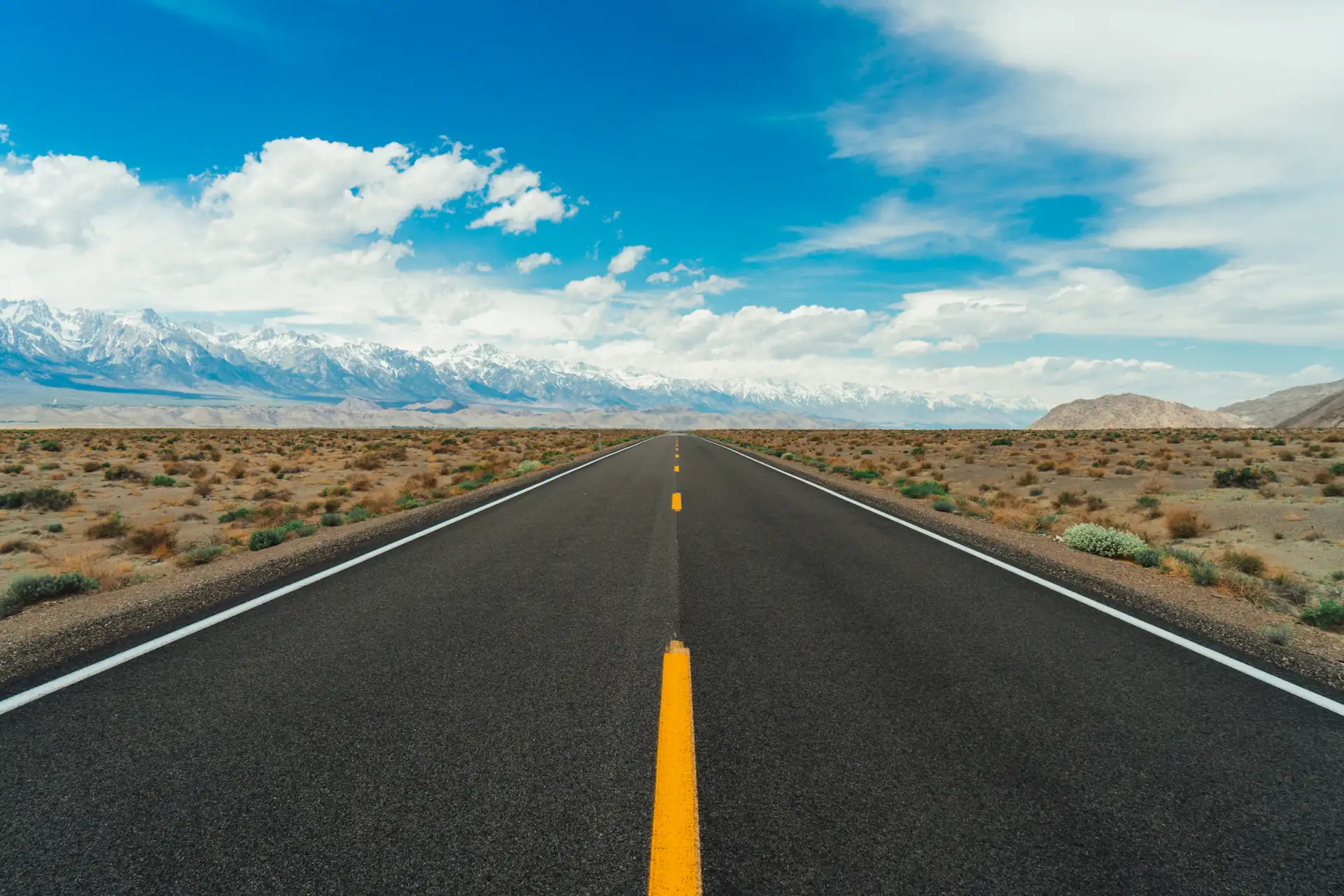
Desert highway curving through red sandstone formations in Valley of Fire State Park, Nevada

All exams/Driving & Licenses/Nevada Driver License/Free questions

Free Nevada Driver License practice questions

Tap an answer to see if you are right, and why. 20 questions across 10 topics, mostly Road signs (2), and 1 has a road sign to read.

Questions last updated October 18, 2026 · Original practice questions written from the Nevada Driver's Handbook (Nevada Department of Motor Vehicles, October 2026 Edition) and checked against its text; not official DMV questions. Not affiliated with or endorsed by the Nevada Department of Motor Vehicles.

The real test

25 questions · 20 to pass (80%) · 60 minutes online or untimed in person.

Need 20 of 25You can miss 5

0 of 20 answeredTap an answer to check it
  1. Road signs1 of 20

    STOPWhat does this sign mean?

    What does an eight-sided octagonal traffic sign always indicate?

    The answer

    Answer: B. An octagonal (eight-sided) red traffic sign always means STOP. Motorists must come to a complete stop behind the stop line or marked crosswalk, yield to pedestrians and cross traffic, and proceed only when clear. If there is no painted stop line, stop before entering the intersection itself at the point nearest the intersecting roadway where you have a clear view of approaching traffic.

    Source: Nevada Driver's Handbook — Chapter 3: Driving Safely (p. 28)

  2. Road signs2 of 20

    What does an inverted downward-pointing triangular traffic sign require drivers to do?

    The answer

    Answer: D. An inverted (downward-pointing) triangular sign is a YIELD sign. It requires drivers to slow down, yield the right-of-way to pedestrians and approaching traffic on the through highway, and stop if necessary to avoid a collision. You must be prepared to stop completely if necessary to let any oncoming or cross traffic and crossing pedestrians pass before proceeding onto the roadway.

    Source: Nevada Driver's Handbook — Chapter 3: Driving Safely (p. 28)

  3. Intersections and turns3 of 20

    When two vehicles arrive at an uncontrolled intersection at approximately the same time, which driver must yield?

    The answer

    Answer: C. Under Nevada traffic law, at an intersection where there are no traffic signs or signals, the driver on the left must yield the right-of-way to the vehicle approaching from the right. Even when you legally have the right-of-way, you must do everything possible to avoid a collision. Drivers should always signal their intentions, communicate clearly through eye contact with other motorists, and proceed through the junction only when cross-traffic is fully stopped.

    Source: Nevada Driver's Handbook — Chapter 3: Driving Safely (p. 34)

  4. Intersections and turns4 of 20

    At a four-way stop intersection in Nevada, which vehicle has the legal right-of-way to proceed first?

    The answer

    Answer: D. At a four-way stop intersection, the first vehicle to reach the intersection and come to a complete stop has the right-of-way. If two vehicles arrive at the exact same time, the driver on the left must yield to the driver on their right. Never assume another driver will yield to you, and always verify that cross-traffic has actually stopped before accelerating into the intersection.

    Source: Nevada Driver's Handbook — Chapter 3: Driving Safely (p. 29)

  5. Alcohol and drugs5 of 20

    In Nevada, an adult driver age 21 or older is considered legally intoxicated (DUI) at what Blood Alcohol Concentration (BAC)?

    The answer

    Answer: A. In Nevada, operating a motor vehicle with a blood alcohol concentration (BAC) of 0.08 percent or higher constitutes Driving Under the Influence (DUI). For commercial drivers, the legal limit is 0.04 percent, and drivers can be convicted at lower levels if their driving ability is noticeably impaired. Nevada law also establishes severe administrative penalties and license revocations that take effect immediately upon arrest for driving under the influence.

    Source: Nevada Driver's Handbook — Chapter 10: Driving Under the Influence (p. 79)

  6. Alcohol and drugs6 of 20

    Under Nevada's Zero Tolerance law, what is the maximum legal BAC limit for drivers under age 21?

    The answer

    Answer: D. Nevada enforces strict Zero Tolerance laws for drivers under 21 years of age. A driver under 21 with a BAC of at least 0.02 percent but less than 0.08 percent faces an administrative driver license revocation of 185 days and mandatory substance evaluation. The court also requires clinical substance abuse evaluation, and based on that evaluation report, the judge may order comprehensive alcohol or drug treatment for the young offender.

    Source: Nevada Driver's Handbook — Chapter 10: Driving Under the Influence (p. 81)

  7. Traffic signals and markings7 of 20

    What does a flashing red traffic signal light mean at a Nevada intersection?

    The answer

    Answer: A. A flashing red traffic light means the same as a stop sign. You must come to a complete stop before the stop line or crosswalk, yield the right-of-way to cross traffic and pedestrians, and proceed only when it is safe to do so. Drivers facing a flashing red signal at a railroad crossing must also come to a complete stop and remain stationary until the train has fully cleared the tracks.

    Source: Nevada Driver's Handbook — Chapter 3: Driving Safely (p. 30)

  8. Traffic signals and markings8 of 20

    What does a steady circular yellow traffic signal light indicate to motorists?

    The answer

    Answer: C. A steady yellow traffic signal warns that the green interval has ended and the signal will be turning red. Drivers who have not entered the intersection must stop safely; drivers already in the intersection must continue moving and clear it safely. Never accelerate to beat a yellow light, as entering after the light turns red is an illegal violation that endangers turning vehicles and crossing pedestrians.

    Source: Nevada Driver's Handbook — Chapter 3: Driving Safely (p. 30)

  9. Speed and space9 of 20

    Under Nevada's Basic Speed Rule, at what speed are you legally required to drive?

    The answer

    Answer: C. Nevada's Basic Speed Rule requires motorists to drive at a reasonable and proper speed, taking into account traffic amount and type, weather conditions, visibility, road surface condition, and roadway width. Depending on adverse conditions, a safe speed may be considerably less than the posted limit. During adverse conditions such as heavy rainfall, ice, or blowing sand, traveling at the posted speed limit can be considered reckless and unlawful driving.

    Source: Nevada Driver's Handbook — Chapter 3: Driving Safely (p. 35)

  10. Speed and space10 of 20

    Unless otherwise posted, what is the speed limit in an active Nevada school zone or school crossing?

    The answer

    Answer: B. Under Nevada traffic law, the speed limit in school zones and active school crossings is 15 miles per hour when children are present, during posted hours, or when warning beacons are flashing. Motorists must pay close attention to crossing guards and children entering crosswalks. U-turns and overtaking other vehicles are strictly prohibited within active school zones from the first school speed limit sign to the end school zone sign.

    Source: Nevada Driver's Handbook — Chapter 3: Driving Safely (p. 35)

  11. Sharing the road11 of 20

    Under Nevada's Move Over law, what must you do when approaching a stopped emergency vehicle with flashing lights?

    The answer

    Answer: A. Nevada's Move Over law requires motorists approaching stopped emergency or service vehicles with flashing lights to decrease their speed below the posted speed limit, proceed with caution, be prepared to stop, and move over to a lane away from the stopped vehicle if safe. If lane changing is impossible due to adjacent traffic or road conditions, slow down substantially and be ready to stop if personnel enter travel lanes.

    Source: Nevada Driver's Handbook — Chapter 5: Special Driving Conditions (p. 61)

  12. Sharing the road12 of 20

    Under Nevada law, when must you stop for a school bus stopped with flashing red overhead lights?

    The answer

    Answer: B. Motorists must come to a complete stop when approaching a school bus displaying flashing red lights from either direction on any undivided highway or street. The only exception is on divided highways with an unpaved median or physical barrier, where oncoming traffic does not stop. Children crossing streets around stopped buses are vulnerable to unexpected traffic movements, requiring complete driver alertness until the bus resumes travel.

    Source: Nevada Driver's Handbook — Chapter 6: Sharing the Road (p. 64)

  13. Passing lane usage13 of 20

    On a two-lane undivided highway in Nevada, on which side must you overtake and pass another vehicle?

    The answer

    Answer: B. On two-lane roads, passing must occur on the left side of the vehicle being overtaken. Passing drivers must ensure oncoming lanes are clear of traffic and return safely to the right lane before meeting oncoming vehicles. Check oncoming sightlines and blind spots thoroughly before moving out, and use your left turn signal to communicate your passing maneuver.

    Source: Nevada Driver's Handbook — Chapter 3: Driving Safely (p. 46)

  14. Passing lane usage14 of 20

    When passing a vehicle on a two-lane road, when is it safe to return to the right travel lane?

    The answer

    Answer: D. Never cut in sharply after passing. Drivers must continue until the entire front of the passed vehicle is visible in the inside rearview mirror before signaling and steering smoothly back into the right lane. Cutting back into the lane too soon can clip the front bumper of the passed car and cause a serious multi-vehicle rollover crash.

    Source: Nevada Driver's Handbook — Chapter 3: Driving Safely (p. 47)

  15. Parking15 of 20

    Under Nevada law, what is the maximum legal distance your wheels may be from the curb when parallel parking?

    The answer

    Answer: D. Under Nevada traffic law, vehicles parked along a roadway where curbs exist must be parked with the right-hand wheels parallel to and within 18 inches of the right-hand curb or edge of the roadway. Always signal before steering toward the curb and check rearview and side mirrors to verify adequate space before backing into the parking stall.

    Source: Nevada Driver's Handbook — Chapter 3: Driving Safely (p. 49)

  16. Parking16 of 20

    When parking facing downhill on a street with a curb, which way should you turn your front wheels?

    The answer

    Answer: C. When parking downhill on a street with a curb, turn your front wheels toward the curb (to the right). If your vehicle rolls forward, the front tires will roll into the curb, preventing the car from rolling into traffic. Always engage your emergency parking brake securely and place automatic transmissions in Park before switching off the vehicle ignition.

    Source: Nevada Driver's Handbook — Chapter 3: Driving Safely (p. 49)

  17. Licensing (GDL)17 of 20

    At what minimum age may a Nevada resident apply for an instruction learner's permit?

    The answer

    Answer: B. In Nevada, a teenager must be at least 15 and 1/2 years old to obtain an instruction permit. The applicant must pass a vision screening and the written knowledge test, and have parental or guardian consent. Applicants must also submit proof of full-time school enrollment or attendance and maintain good standing to retain their valid driving privileges.

    Source: Nevada Driver's Handbook — Chapter 1: Getting Your Nevada Driver's License (p. 15)

  18. Licensing (GDL)18 of 20

    Under Nevada's GDL laws, how many hours of supervised driving practice are required before the driving test?

    The answer

    Answer: A. Nevada teen drivers holding an instruction permit must complete a minimum of 50 hours of supervised driving experience behind the wheel, with at least 10 hours completed during nighttime darkness, logged in their DMV driving log. All supervised practice hours must be conducted with a licensed parent, guardian, or other licensed adult driver who is at least 21 years old.

    Source: Nevada Driver's Handbook — Chapter 1: Getting Your Nevada Driver's License (p. 15)

  19. Emergencies safety19 of 20

    Why are flash floods extremely dangerous to motorists on Nevada desert roadways?

    The answer

    Answer: B. In Nevada's desert climate, flash floods can inundate low washes in minutes. Just 6 inches of rushing water will reach the bottom of most cars and cause engine stalling, 12 inches will float many vehicles, and 2 feet will sweep almost any vehicle away. 'Turn Around, Don't Drown.' More than half of all flash flood fatalities are auto-related, and vehicles caught in rising water can easily roll over as they are swept toward deeper, swifter currents.

    Source: Nevada Driver's Handbook — Chapter 5: Special Driving Conditions (p. 59)

  20. Emergencies safety20 of 20

    What is the mandatory seat belt requirement under Nevada law?

    The answer

    Answer: D. Nevada law requires every occupant of a motor vehicle—both front seat and rear seat—to wear a properly adjusted and securely fastened safety belt whenever the vehicle is operated on public roads. This requirement applies to all vehicles manufactured after January 1, 1968, and wearing a lap and shoulder belt significantly reduces serious injury or death in collisions.

    Source: Nevada Driver's Handbook — Chapter 2: Buckle Up (p. 25)

That’s the free set. The full bank has 300.

More original practice questions across the listed topics, a 25-question timed exam simulator, and saved mistake review. Published Nevada DMV threshold: 20 correct of 25 questions to pass (80%); 60-minute time limit online, untimed in person at DMV offices. One payment of $8.99, yours forever.

Practice the free set

Nevada Driver License alcohol and drug questions

36 of the 300 questions in the bank cover alcohol and drugs. 2 are free here, with the answer and where it comes from:

  • In Nevada, an adult driver age 21 or older is considered legally intoxicated (DUI) at what Blood Alcohol Concentration (BAC)? Answer: 0.08 percent or higherNevada Driver's Handbook — Chapter 10: Driving Under the Influence (p. 79)
  • Under Nevada's Zero Tolerance law, what is the maximum legal BAC limit for drivers under age 21? Answer: 0.02 percentNevada Driver's Handbook — Chapter 10: Driving Under the Influence (p. 81)

All 36 alcohol and drug questions →