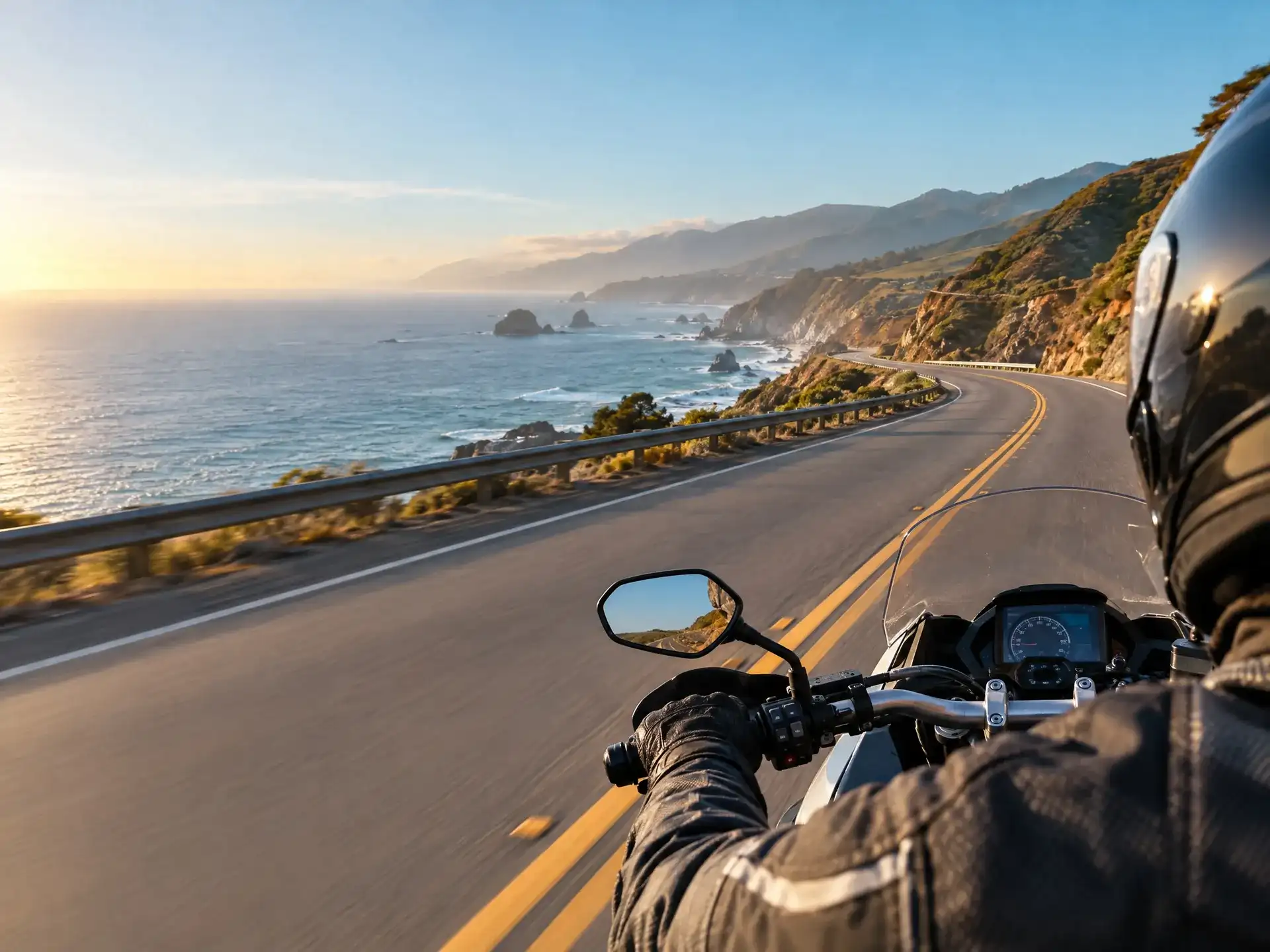
Rider's view from a motorcycle on a coastal California highway at sunset
Free practice set · Original questions

All exams/Driving & Licenses/California Motorcycle Knowledge Test / Class M/Free questions

Free California Motorcycle Knowledge Test / Class M practice questions

Tap an answer to see if you are right, and why. 20 questions across 3 topics, mostly Protective gear and visibility (7).

Passing score: 80% (official)
Format: Multiple-choice knowledge test
Bank: 300 Qs (20 free)
100% Sourced explanations

Questions last updated October 15, 2026 · Questions written from the California Motorcycle Handbook (DL 665 English REV. 2/2024) and official California DMV motorcycle licensing pages; not official DMV questions.

0 of 20 answeredTap an answer to check it
  1. Licensing and test requirements1 of 20

    What passing score does California DMV state for the motorcycle knowledge test?

    The answer

    Answer: C. The California DMV motorcycle knowledge test requires an 80% passing score, which means you must answer at least 18 of22 questions correctly. This passing threshold is higher than many people expect, so thorough preparation is essential. The test covers topics from the California Motorcycle Handbook (DL 665), including traffic laws, safe riding practices, and motorcycle-specific rules. A score below 80% means you must retake the test, and after three failed attempts on the same test, your application is no longer valid and you must reapply. Study the handbook thoroughly before attempting the exam.

    Source: Instruction Permits — motorcycle knowledge tests

  2. Licensing and test requirements2 of 20

    What is the minimum age DMV lists for applying for a California motorcycle instruction permit?

    The answer

    Answer: C. California DMV sets the minimum age for a motorcycle instruction permit at 15½ years old. This is the same minimum age requirement as for a regular Class C driver license, reflecting the state's view that motorcycle operation requires similar maturity levels. Applicants under 18 must also complete a California Highway Patrol-approved motorcycle training course and hold the permit for at least six months before taking the driving test. The age requirement exists because younger riders may lack the judgment and reaction time needed for safe motorcycle operation in traffic.

    Source: Instruction Permits — motorcycle permit eligibility

  3. Licensing and test requirements3 of 20

    Which class authorizes any two-wheeled motorcycle and all vehicles listed under M2?

    The answer

    Answer: C. Class M1 is the broader motorcycle license class in California, authorizing the holder to operate any two-wheeled motorcycle, including all vehicles covered under Class M2. This means an M1 license permits riding everything from small motorized bicycles to large touring motorcycles. Class M2 is more restrictive, covering only motorized bicycles, mopeds, and bicycles with attached motors. If you want to ride a full-sized motorcycle, you need the M1 class. The distinction matters because the knowledge test and driving test requirements differ between these classes.

    Source: Motorcycle Licenses — Motorcycle License Classes

  4. Licensing and test requirements4 of 20

    Which vehicle is included in the DMV description of Class M2?

    The answer

    Answer: A. Class M2 in California specifically authorizes motorized bicycles, mopeds, and bicycles with attached motors. These are lighter, lower-powered vehicles that typically have smaller engines or electric motors. A four-axle bus would require a commercial driver license, a passenger car requires a Class C license, and a commercial truck requires a Class A or B commercial license. The M2 class exists because these smaller vehicles have different operational characteristics and safety requirements than full-sized motorcycles, warranting their own license category.

    Source: Motorcycle Licenses — Motorcycle License Classes

  5. Licensing and test requirements5 of 20

    For an applicant under 21 seeking a motorcycle license, what permit period does DMV specify before applying?

    The answer

    Answer: B. California law requires applicants under 21 to hold a motorcycle instruction permit for at least six months before taking the driving test. During this period, the rider must complete a California Highway Patrol-approved motorcycle training course, which includes both classroom instruction and actual riding practice. This extended holding period gives younger riders more time to develop their skills under supervised conditions. The requirement exists because statistics show that younger riders are involved in more motorcycle accidents, so additional preparation time helps improve safety outcomes.

    Source: Motorcycle Licenses — under-21 requirements

  6. Licensing and test requirements6 of 20

    What happens after failing the same DMV knowledge test three times?

    The answer

    Answer: C. When you fail the same DMV knowledge test three times, your application is no longer valid and you must reapply from the beginning. This means completing a new application, paying the application fee again, and starting the testing process over. The three-attempt limit exists to ensure that riders demonstrate sufficient knowledge before receiving a permit. If you fail, you should study the California Motorcycle Handbook more thoroughly, take practice tests, and consider additional training before reapplying. There is no waiting period between attempts, but the reapplication requirement adds time and cost.

    Source: Motorcycle Licenses — knowledge-test attempts

  7. Protective gear and visibility7 of 20

    Which clothing choice does the handbook identify as improving the chance that others will see a rider?

    The answer

    Answer: A. The California Motorcycle Handbook emphasizes that brightly colored or reflective clothing significantly increases a rider's visibility to other motorists. Motorcycles are smaller than cars and can easily disappear in a driver's blind spot, so wearing high-visibility gear is a critical safety measure. Reflective materials are especially important at dawn, dusk, and nighttime when visibility is reduced. All-black clothing without reflective material makes a rider nearly invisible to other drivers, dramatically increasing collision risk. The handbook recommends incorporating visibility gear into your regular riding attire, not just for night riding.

    Source: Motorcycle Handbook — Clothing

  8. Protective gear and visibility8 of 20

    What lighting practice does the handbook identify as helping others notice a motorcycle?

    The answer

    Answer: C. The handbook identifies keeping the headlight on at all times as one of the most effective ways to increase motorcycle visibility. California law requires headlights to be on from sunset to sunrise, but the handbook recommends keeping them on during daylight hours as well. If your motorcycle is equipped with additional running lights, those should also remain on. This practice makes your motorcycle more noticeable to other drivers, especially in traffic where motorcycles can easily blend into the background. Riding with lights off dramatically reduces your visibility and increases collision risk.

    Source: Motorcycle Handbook — Headlight

  9. Protective gear and visibility9 of 20

    When does the handbook say a rider should use the low beam rather than the high beam?

    The answer

    Answer: B. The handbook specifically advises using the low beam headlight when riding in foggy conditions. High beams can reflect off fog particles and create a wall of white light that actually reduces your visibility rather than improving it. Low beams provide better illumination in fog because they direct light downward where it can illuminate the road surface without creating excessive glare. This is a counterintuitive safety measure that many riders get wrong. The handbook also notes that you should use low beams when following other vehicles closely to avoid blinding the driver ahead.

    Source: Motorcycle Handbook — Headlight

  10. Protective gear and visibility10 of 20

    What is the purpose of a motorcycle helmet in the handbook’s protective-gear discussion?

    The answer

    Answer: C. The handbook's protective gear discussion emphasizes that helmets reduce the risk of head injury in a crash, which is the leading cause of motorcycle fatalities. California law requires all motorcycle riders and passengers to wear DOT-compliant helmets. However, the handbook is careful to note that helmets do not prevent collisions from occurring—they only reduce the severity of injuries when crashes happen. A helmet is one component of a comprehensive safety approach that includes defensive riding, proper training, and wearing other protective gear like gloves, jackets, and sturdy boots.

    Source: Motorcycle Handbook — Helmet Use

  11. Protective gear and visibility11 of 20

    Why can reflective material on the sides of a helmet help?

    The answer

    Answer: B. Reflective material on the sides of a helmet helps drivers see the motorcycle rider from lateral angles, which is particularly important at intersections where many motorcycle crashes occur. When a car is turning left across your path, the driver may be looking for other cars but not specifically for motorcycles. Side-mounted reflective material catches headlights from cross-traffic and makes your presence known from angles that front and rear reflectors cannot cover. The handbook recommends combining helmet reflectors with reflective vest material for maximum visibility from all directions.

    Source: Motorcycle Handbook — Clothing

  12. Protective gear and visibility12 of 20

    When should a rider use turn signals according to the handbook?

    The answer

    Answer: D. The handbook instructs riders to use turn signals anytime they plan to change lanes or turn, even when they believe no other drivers are nearby. This practice serves two purposes: it communicates your intentions to any hidden traffic, and the flashing lights make your motorcycle more visible. Many motorcycle collisions occur because a driver did not see the rider until it was too late. Turn signals add moving light points that attract attention. The handbook emphasizes that signals should be activated well before the maneuver, not simultaneously with it.

    Source: Motorcycle Handbook — Turn Signals

  13. Protective gear and visibility13 of 20

    What should a rider do with turn signals after completing a turn?

    The answer

    Answer: C. Leaving a turn signal on after completing a turn creates a dangerous miscommunication with other drivers. The handbook warns that a lingering signal tells following drivers you plan to turn again when you actually intend to continue straight. This can cause a following driver to attempt a pass or take other actions based on false information. Always cancel your turn signals after completing a maneuver. If your motorcycle does not have automatic signal cancellation, you must develop the habit of manually turning them off. This small detail prevents many potential conflicts in traffic.

    Source: Motorcycle Handbook — Signals

  14. Controls inspection and basic operation14 of 20

    What does the handbook recommend before riding a motorcycle?

    The answer

    Answer: B. The handbook's pre-ride preparation section recommends thoroughly checking your motorcycle and becoming familiar with all its controls before riding. This includes testing the brakes, checking tire pressure and condition, verifying all lights work, and understanding where each control is located. The T-CLOCS inspection pattern (Tires, Controls, Lights, Oil, Chassis, Stand) provides a systematic approach. Becoming familiar with controls means knowing exactly where the clutch, throttle, brakes, and shift lever are without looking down. This familiarity is critical for safe operation, especially in emergency situations.

    Source: Motorcycle Handbook — Get Familiar with the Controls; Check Your Motorcycle

  15. Controls inspection and basic operation15 of 20

    Which topic is included in the handbook’s preparing-to-ride material?

    The answer

    Answer: A. The handbook's preparing-to-ride section includes knowing your motorcycle as a fundamental safety topic. This encompasses understanding your motorcycle's specific characteristics, weight distribution, turning radius, and how it responds to different inputs. Every motorcycle handles differently, so taking time to learn your particular bike's quirks prevents surprises in traffic. The section also covers pre-ride inspection, protective gear selection, and mental preparation. Knowing your motorcycle means you can operate it confidently and predictably, which makes you a safer rider and more visible to other motorists.

    Source: Motorcycle Handbook — Preparing to Ride

  16. Controls inspection and basic operation16 of 20

    What does the handbook identify as part of basic vehicle control?

    The answer

    Answer: A. Body position is a fundamental element of basic vehicle control that the handbook includes in its ride-within-your-abilities section. Proper body position affects balance, steering input, and your ability to respond to hazards. This includes how you sit on the motorcycle, where you place your feet, how you grip the tank with your knees, and how you position your upper body during turns. Correct body position allows you to make smooth, controlled inputs rather than abrupt movements that can destabilize the motorcycle. The handbook emphasizes practicing these fundamentals in a safe, closed environment before riding in traffic.

    Source: Motorcycle Handbook — Basic Vehicle Control

  17. Controls inspection and basic operation17 of 20

    Which control-related subject is specifically covered in the handbook?

    The answer

    Answer: A. Shifting gears is a core motorcycle control skill that the handbook covers in detail. Unlike automatic transmission cars, motorcycles require the rider to manually shift gears using a clutch lever and foot shift lever. Proper shifting technique involves coordinating the throttle, clutch, and shift lever in smooth sequence. The handbook explains when to upshift for acceleration, when to downshift for deceleration, and how to use engine braking effectively. Incorrect shifting can cause the motorcycle to lurch, stall, or lose traction, all of which are dangerous in traffic. Practice shifting in a parking lot before riding on public roads.

    Source: Motorcycle Handbook — Shifting Gears

  18. Controls inspection and basic operation18 of 20

    Why does the handbook discuss becoming familiar with motorcycle controls?

    The answer

    Answer: B. The handbook emphasizes control familiarity because a rider must be able to operate the motorcycle's controls instinctively, without looking down or thinking about which lever does what. In emergency situations, you may have only a fraction of a second to react, and fumbling for the wrong control can be catastrophic. The handbook recommends spending time in a safe area learning how the throttle responds, how much pressure the brakes require, and how the clutch engages. This muscle memory development is essential for safe riding and is a prerequisite for the more advanced skills covered later in the handbook.

    Source: Motorcycle Handbook — Get Familiar with the Motorcycle Controls

  19. Controls inspection and basic operation19 of 20

    Which item is part of the official motorcycle driving test description on DMV’s motorcycle-license page?

    The answer

    Answer: A. The DMV motorcycle driving test includes several specific components that riders must demonstrate proficiency in. These include a pre-trip inspection where you show the examiner you can check your motorcycle's safety systems, riding through designated track paths that test steering and balance, slow-speed riding that demonstrates clutch and throttle control, and gear shifting that shows you can operate the transmission smoothly. The test also evaluates your ability to observe traffic laws, use turn signals, and maintain proper lane position. Preparing for each component individually helps ensure you pass on your first attempt.

    Source: Motorcycle Licenses — motorcycle driving test

  20. Controls inspection and basic operation20 of 20

    What should a rider do when a motorcycle control or inspection item is unfamiliar?

    The answer

    Answer: D. The handbook's preparation guidance stresses that any unfamiliar control or inspection item must be learned and checked before riding. Ignoring something you don't understand creates a knowledge gap that can lead to accidents. If you're unsure what a particular warning light means, how to check your brake fluid level, or what pressure your tires should be, find out before you ride. The handbook provides explanations for all motorcycle systems, and DMV staff or motorcycle dealers can help clarify anything you don't understand. Never assume a system works correctly without verifying it.

    Source: Motorcycle Handbook — Know Your Motorcycle

Official Test Specs & Sourced Summary

The official California Motorcycle Knowledge Test / Class M knowledge examination covers Multiple-choice knowledge test with a passing threshold of 80%. Questions written from the California Motorcycle Handbook (DL 665 English REV. 2/2024) and official California DMV motorcycle licensing pages; not official DMV questions. Every question on this page is original, with an explanation and a note citing its source.

Passing Score80% official
FormatMultiple-choice knowledge test · 80% to pass
Question Bank300 questions (20 free)

Now try them under test conditions.

Practice the free set as a quiz with instant scoring, drill one topic at a time, or sit the free timed mock exam. California DMV publishes an 80% passing score; the live test denominator and time limit are not published in the reviewed official materials.