What Is the California DMV Written Test?
The California Department of Motor Vehicles (DMV) written knowledge test is a computer-based exam that evaluates your understanding of California's traffic laws, road signs, and safe driving practices. It is a mandatory requirement for anyone applying for a Class C (standard) driver's license or learner's permit in the state of California.
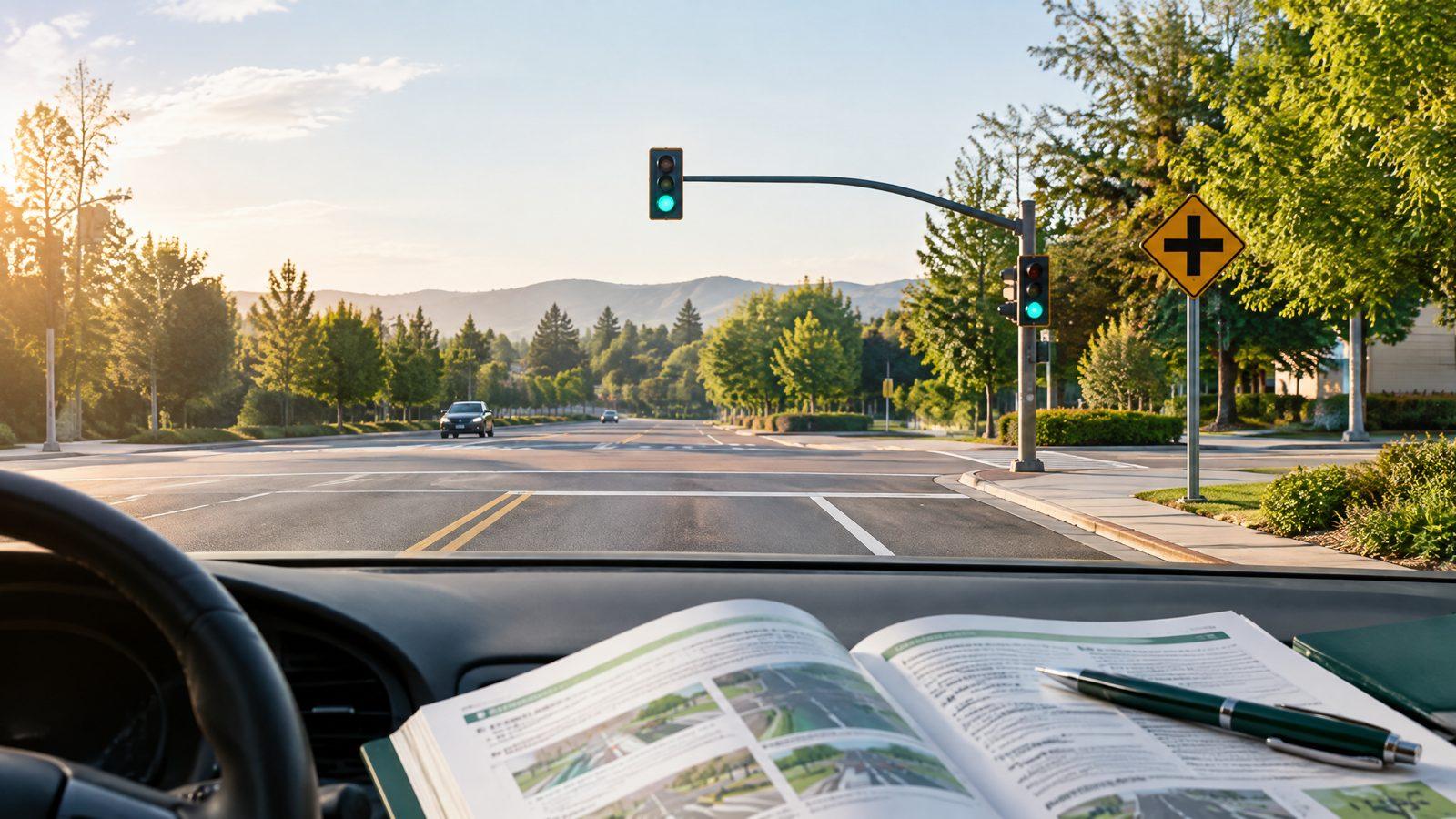
The test is based entirely on the California Driver Handbook, which is available free online from the DMV. Every single question on the test comes from this handbook—nothing is hidden or trick-based. If you read the handbook and understand it, you will pass.
Most applicants take the test at a local DMV field office, though some may qualify for online testing depending on their circumstances. Whether you are a first-time applicant, a new resident of California, or renewing your license, this guide will prepare you to pass on your first attempt.
Test Format: What to Expect
Understanding the test format removes most of the anxiety. Here is exactly what you are walking into:
| Detail | Information |
|---|---|
| Number of Questions | 36 for applicants 18 and older; 46 for applicants under 18 |
| Question Format | Multiple choice (3-4 answer options) |
| Time Limit | None published by the DMV; most people finish in 20-30 minutes |
| Passing Score | 30 out of 36 (83.3%); under 18: 38 out of 46 |
| Cost | $46 original Class C application fee (includes the knowledge test) |
| Retake Policy | 3 attempts per application before you must reapply; minors wait 7 days between attempts |
| Languages Available | English, Spanish and several other languages — ask when you check in |
| Accommodations | Available for disabilities—request in advance |
The DMV does not publish a time limit for the knowledge test, and most people finish in 20-30 minutes, so time is rarely an issue. The real challenge is accuracy.
What's on the Test: Topic Breakdown
The California DMV draws questions from four main topic areas. Knowing the distribution helps you focus your study time on the highest-weighted areas.
Topic Weight Distribution
| Topic Area | Approximate Weight | Number of Questions | Difficulty |
|---|---|---|---|
| Traffic Laws and Rules of the Road | 46% | ~17 questions | Medium-High |
| Safe Driving Practices | 32% | ~12 questions | Medium |
| Laws and Rules of the Road | 14% | ~5 questions | Medium |
| Vehicle Registration and Insurance | 8% | ~2 questions | Low |
What Each Topic Covers
Traffic Laws and Rules of the Road (46%) — This is the largest section. Expect questions about right-of-way rules, lane changes, turns at intersections, railroad crossings, passing zones, and when to stop. You will need to know specific speed limits for different zones and when certain maneuvers are legal versus illegal.
Safe Driving Practices (32%) — Covers defensive driving, following distances, blind spots, mirror usage, sharing the road with cyclists and pedestrians, and how to handle adverse weather conditions. This section also includes questions about impaired driving (alcohol and drugs) and distracted driving laws.
Laws and Rules of the Road (14%) — Focuses on specific regulations like turn signal requirements, lane markings, one-way streets, HOV lane rules, and emergency vehicle protocols.
Vehicle Registration and Insurance (8%) — The smallest section, but still important. Know the requirements for vehicle registration, proof of insurance, and what documents you need when pulled over.
Most Common Mistakes (and How to Avoid Them)
Based on DMV data and common test-taker reports, these are the areas where people consistently lose points:
Many test-takers struggle with who goes first at four-way stops, uncontrolled intersections, and when yielding to pedestrians. Remember: always yield to pedestrians in crosswalks. At a four-way stop, the first vehicle to arrive goes first. If two arrive simultaneously, the vehicle on the right goes first.
People assume residential areas are always 25 mph, but California law specifies 25 mph only in business or residential districts when no speed limit is posted. School zones are typically 25 mph when children are present. Highway speed limits vary by road type and can range from 55-70 mph.
The legal BAC limit for drivers 21 and over is 0.08%. For drivers under 21, it is 0.01%—essentially zero tolerance. For commercial drivers, it is 0.04%. Many people only remember the 0.08% figure and miss questions about the lower limits for younger and commercial drivers.
You must stop when a school bus activates its flashing red lights and extends the stop arm, regardless of direction—unless there is a physical barrier (like a median) separating the lanes. Many people think they can pass a school bus from the opposite direction on a divided road, but the rules are specific about what constitutes a physical barrier.
The handbook recommends a minimum 3-second following distance under normal conditions. In adverse conditions (rain, fog, heavy traffic), increase this to 4-6 seconds. People often underestimate this on the test.
Common Road Signs You Must Know
The test includes questions about identifying and understanding road signs. Here are the most frequently tested signs:
Sign Categories
- Regulatory Signs — Tell you what you must or must not do. These are typically white, red, or black and white. Examples: Stop, Yield, Speed Limit, No U-Turn, One Way.
- Warning Signs — Alert you to potential hazards ahead. These are typically yellow diamond-shaped. Examples: School Zone, Pedestrian Crossing, Railroad Crossing Ahead.
- Guide Signs — Provide information about directions, distances, and services. These are typically green or blue. Examples: Highway exit signs, rest area signs.
- Construction Signs — Warn about road work zones. These are typically orange diamond-shaped.
Your 2-Week Study Plan
You do not need months to prepare. A focused two-week plan is sufficient for most people. Here is the timeline:
Week 1: Learn the Material
- Day 1-2: Read the California Driver Handbook cover to cover. Do not skim—read actively. Highlight sections that seem unfamiliar.
- Day 3-4: Take notes on key facts: speed limits, BAC limits, right-of-way rules, parking rules, and sign meanings.
- Day 5: Review your notes and re-read the sections you struggled with.
- Day 6-7: Take your first practice test. Identify which topics you need to study more.
Week 2: Practice and Refine
- Day 8-9: Focus on your weak areas. If you missed right-of-way questions, re-read that section of the handbook.
- Day 10-11: Take 2-3 more practice tests. Track your score—aim for 90%+ consistently.
- Day 12-13: Do a final review of tricky questions and signs you keep missing.
- Day 14: Light review only. Do not cram the night before. Get good sleep.
Test Day Tips
Knowing what to expect on test day reduces stress and helps you perform better.
Before You Go
- Bring your completed DL 44 application form (available online)
- Bring valid identification: passport, birth certificate, or immigration documents
- Bring proof of California residency: utility bill, bank statement, or lease agreement
- Bring your Social Security card or proof of SSN
- Bring payment: $46 application fee (cash, check, or card)
- Bring glasses or contacts if you need them for the vision test
At the DMV
- Check in at the kiosk or front desk. You will be given a number.
- Vision screening — Simple eye test. If you wear corrective lenses, this will be noted on your license.
- Photo — Your license photo will be taken.
- Written test — You will sit at a computer terminal and work through the questions at your own pace.
- Results — You find out immediately whether you passed or failed.
During the Test
- Read every question completely before looking at the answers.
- If you are unsure, eliminate obviously wrong answers first.
- Do not spend more than 2 minutes on any single question—mark it and come back if possible.
- Pay attention to words like "always," "never," "except," and "most"—they change the meaning of a question.
- Trust your preparation. If you studied the handbook, you know this material.
The Complete Process: From Study to License
Step-by-Step Breakdown
- Study Phase: Read the handbook, take practice tests, and build confidence.
- Schedule Phase: Make an appointment at your local DMV office. Walk-ins are accepted but expect long waits.
- Test Day: Arrive early with all required documents. Complete vision test, photo, and written exam.
- Results: If you pass, you receive a temporary paper license. Your permanent license arrives by mail in 3-4 weeks.
- Get Your License: If you are under 18, you will also need to complete driver education, hold a permit for 6 months, and complete 50 hours of supervised driving before getting your full license.
After You Pass
Congratulations—passing the written test is a major milestone. Here is what happens next:
- Temporary License: You receive a paper temporary license immediately. This is valid for 90 days and can be used as ID.
- Permanent License: Your plastic card arrives by mail in 3-4 weeks. If it does not arrive within 6 weeks, contact the DMV.
- If Under 18: You now hold an instruction permit. You must complete driver education (if not already done), hold the permit for at least 6 months, complete 50 hours of supervised driving (10 at night), and pass the behind-the-wheel driving test.
- If 18 or Over: You can schedule your behind-the-wheel driving test at any time. You do not need to wait.
Frequently Asked Questions
How many questions are on the California DMV written test?
The California DMV written test has 36 multiple-choice questions. You need to answer at least 30 correctly (83%) to pass.
Can I take the California DMV test online?
As of 2026, most applicants must take the test in person at a DMV field office. However, certain renewal scenarios may qualify for online testing. Check the DMV website for current eligibility requirements.
How much does the California DMV written test cost?
The original Class C application fee is $46, which includes the knowledge test and up to three attempts. If you fail all three, you must reapply and pay the fee again.
What happens if I fail the California DMV test?
You can retake the test up to 3 times within 12 months. Minors must wait seven days between attempts (not counting the day of the failure); the DMV publishes no waiting period for adults. If you fail all 3 attempts, you must reapply and pay the full $46 fee again.
Do I need to study the entire California Driver Handbook?
Yes, questions come from all sections of the handbook. However, 78% of the test covers traffic laws and safe driving practices, so prioritize those sections. Use the topic breakdown in this guide to focus your study time.
What language is the California DMV test available in?
The test is offered in English, Spanish and several other languages; the DMV publishes its sample knowledge tests in nine languages plus American Sign Language. Choose the language when you check in — there is no extra fee. Road signs appear with their English wording whichever language you choose.
How long do I have to complete the California written test?
The DMV does not publish a time limit for the 36-question test. Most people finish in 20-30 minutes, so time pressure is not typically an issue.
Do I need a California driver's license if I just moved here?
Yes. California law requires new residents to obtain a California driver's license within 10 days of establishing residency. You will need to pass the written test and vision screening, but you do not need to take the driving test if you have a valid out-of-state license.
Sources
- California Driver’s Handbook, California DMV — Section 3, The Testing Process (three attempts per application; minors wait seven days to retake).
- Licensing Fees, California DMV — $46 original Class C driver’s license.
- Evaluation of the Class C Driver License Written Knowledge Tests, California DMV Research and Development Branch — 36-item original test allowing six errors; 46-item provisional (under 18) test allowing eight errors.