Why the Same Eight Rules Keep Failing People
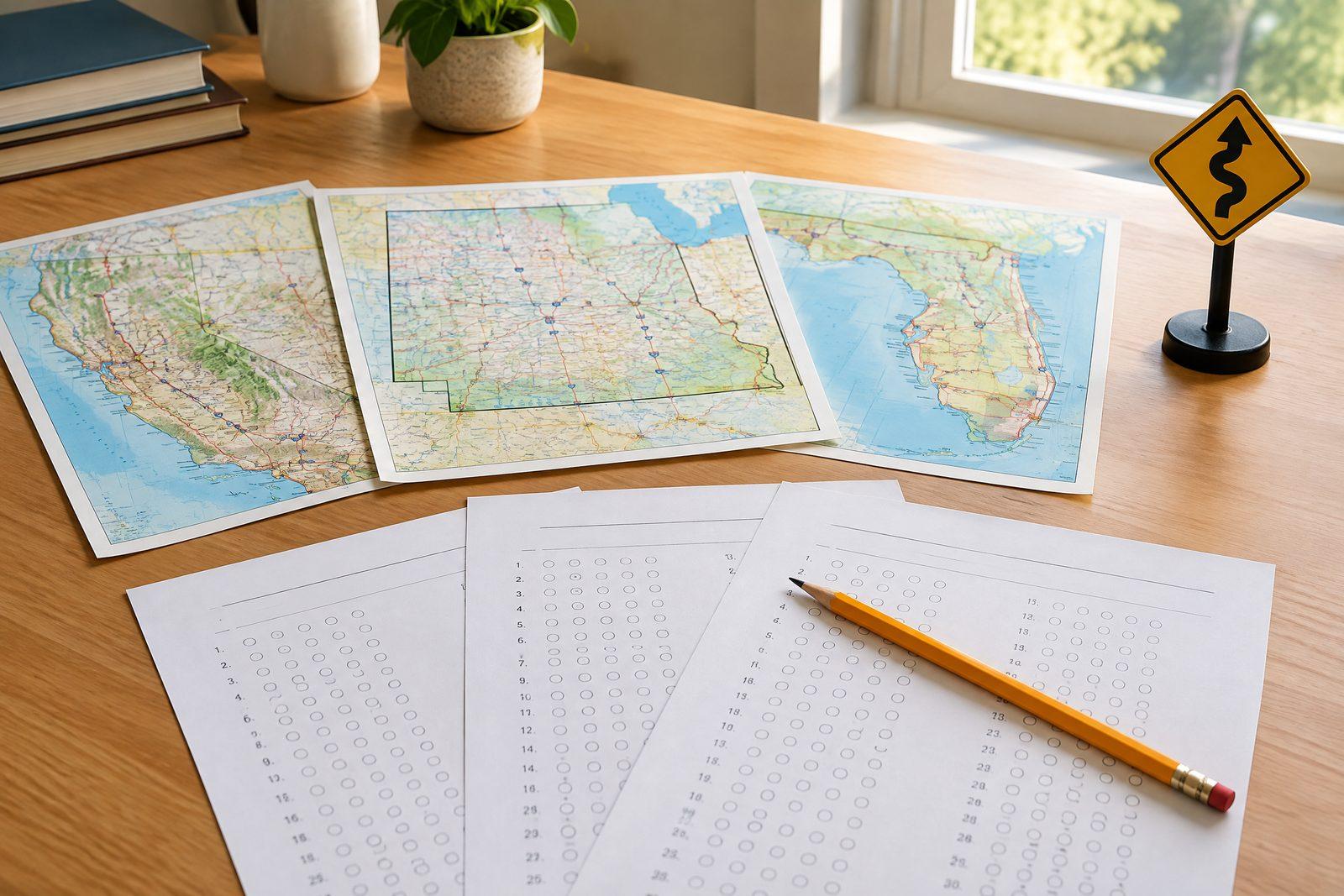
Across our California, Texas and Florida question banks the misses cluster. It is rarely the sign shapes or the right-of-way basics; it is the rules with an exception attached, and the rules that are a specific number rather than a principle. Worse, the number often changes when you cross a state line — so a driver who learned in Texas and is retesting in Florida can be confidently wrong.
This guide takes the eight highest-miss concepts and gives you the rule, the trap the test sets, and the figure each state's official handbook uses: the California Driver's Handbook, the Texas Driver Handbook (DL-7) and the Florida Class E Driver License Handbook. Where the states agree, you get one thing to memorize. Where they differ, the table tells you which column to study.
1. When Oncoming Traffic May Pass a Stopped School Bus
The rule everyone knows: stop for a school bus with flashing red lights and stay stopped until the lights go off or the bus moves. The rule the test asks: when oncoming traffic is excused from stopping.
| State | Oncoming traffic need not stop when… | Note |
|---|---|---|
| California | The bus is on the other side of a divided highway or a multilane road with two or more lanes in each direction | Undivided two-lane road: both directions stop |
| Texas | You are on a different road, or on a controlled-access highway where the bus is stopped in a loading zone and pedestrians may not cross | First-conviction fine $500–$1,250 |
| Florida | The highway is divided by a raised barrier or an unpaved median at least five feet wide | Painted lines are not a barrier — a painted median means stop |
2. Following Distance Is a Different Number in Each State
All three handbooks teach the same technique — pick a fixed object, count when the car ahead passes it, and you should not reach it before the count ends — but the count differs:
| State | Baseline gap | When to add more |
|---|---|---|
| California | 3 seconds | Poor weather, being tailgated, following motorcycles or large vehicles, towing |
| Texas | 2 seconds at 30 mph or less; 4 seconds above 30 mph | Adverse conditions; the handbook calls a four-second interval “best practice for a beginning driver” |
| Florida | 4 seconds in favourable conditions | Rain, wet roads, low visibility, heavy loads, being followed too closely |
If your state's question gives a speed, use it: a Texas question at 45 mph wants four seconds, not two. If the question mentions any adverse condition, the answer is always “more than the baseline”.
3. Headlight Distances — the One Rule All Three States Share
This is the good news. California, Texas and Florida all require you to switch from high to low beams:
- within 500 feet of an oncoming vehicle, and
- within 300 feet when following another vehicle.
Texas adds that headlights are required when people or vehicles cannot be seen clearly for 1,000 feet; Florida requires them from sunset to sunrise and whenever visibility is poor; California requires them whenever wipers are on continuously. The 500 / 300 pair is the number the test wants — and it is oncoming first, following second. Reversing them is the classic miss.
4. How Far From the Hydrant, Crosswalk, Sign and Rails
| No parking within… | California | Texas | Florida |
|---|---|---|---|
| Fire hydrant | 15 ft | 15 ft | 15 ft |
| Crosswalk / intersection | 20 ft on the approach side of any crosswalk, marked or not (AB 413 daylighting, ticketed since 2025); 15 ft where the curb extends | 20 ft of a crosswalk at an intersection | 20 ft of an intersection |
| Stop sign or flashing signal | Red curb / posted | 30 ft on the approach | 30 ft of a stop sign, yield sign or signal |
| Railroad crossing | Not on the tracks | Per posted signs | 50 ft |
| Fire station driveway | Posted | 20 ft; 75 ft on the opposite side | 20 ft of a fire, ambulance or rescue station entrance |
Fifteen feet from a hydrant is universal. The ladder 15 / 20 / 30 / 50 — hydrant, intersection, sign, railroad — is worth memorising for Texas and Florida; California tests the 20-foot crosswalk rule and curb colours: red (no stopping), yellow (commercial loading), white (brief passenger loading), green (limited time), blue (disabled placard only).
5. Turning on Red, Precisely
All three states allow a right turn on a steady red after a complete stop, yielding to pedestrians and traffic, unless a sign prohibits it. All three also allow a left turn on red only from a one-way street onto another one-way street, again after a full stop. The misses come from two directions:
- Two-way onto one-way: not allowed on red in any of the three states. The one-way rule applies to both streets.
- Red arrow: no turn in that direction until the arrow changes — a red arrow is not a “stop then go” signal.
Texas phrases it exactly: “You may also turn left if both streets are one way, unless prohibited by law.” If a question describes the cross street as two-way, the answer is wait.
6. Railroad Crossings: the Distance, the Second Train and the 15 mph
- Where to stop: Texas and Florida say between 15 and 50 feet from the nearest rail — never on the tracks and never closer than 15 feet. California's test focuses on stopping behind the gate or stop line and at least 15 feet from the tracks.
- When you must stop: flashing lights, a lowered gate, a flag person, or a train that is visible and close. Texas adds a specific figure: a train within about 1,500 feet sounds its horn, and that horn means stop.
- The second train: after one train passes at a multi-track crossing, do not cross until you have checked for a train on the other track.
- The 15 mph rule (California): within 100 feet of a railroad crossing where you cannot see the tracks for 400 feet in both directions, the speed limit is 15 mph. The same 15 mph applies in alleys and at blind intersections.
- Never go around a lowered gate. Every handbook says it; every bank tests it.
7. Default Speed Limits When No Sign Is Posted
| Where | California | Texas | Florida |
|---|---|---|---|
| Alley | 15 mph | 15 mph | — |
| Residential / business district | 25 mph | 30 mph (urban district) | 30 mph |
| School zone | 25 mph when children are present (15 mph where posted) | Posted | 20 mph |
| Rural / other highways | 55 mph on two-lane undivided highways unless posted | 60 mph un-numbered; 70 mph numbered state and U.S. highways | 55 mph |
| Freeway / interstate | 65 mph unless posted 70 | 70 mph (posted up to 75/80/85) | 70 mph |
Two habits fix most speed misses. First, read whether the question says “unless otherwise posted” — that is your cue for the default. Second, remember every state's basic speed law: the posted number is a ceiling, not a target, and driving at it in rain or fog can still be a violation.
8. Under-21 Alcohol Limits Are Not 0.08
| State | 21 and over | Under 21 |
|---|---|---|
| California | 0.08% BAC | 0.01% — effectively any alcohol |
| Texas | 0.08 BAC | Any detectable amount (zero tolerance) |
| Florida | 0.08 BAL | 0.02 BAL — automatic six-month suspension |
Every state also treats refusing a breath or blood test as its own offence under implied consent, with a licence suspension that does not depend on whether you were actually over the limit. Questions about refusal are asking about implied consent, not about BAC.
How to Drill These Without Cross-Contaminating States
- Drill one state's bank at a time. Mixed-state practice is how the Florida four-second gap ends up on a California answer sheet.
- Use the topic drill on the concepts above — right-of-way, parking, speed, alcohol — until each is above 90%, then switch to mixed simulators, because the real test shuffles everything.
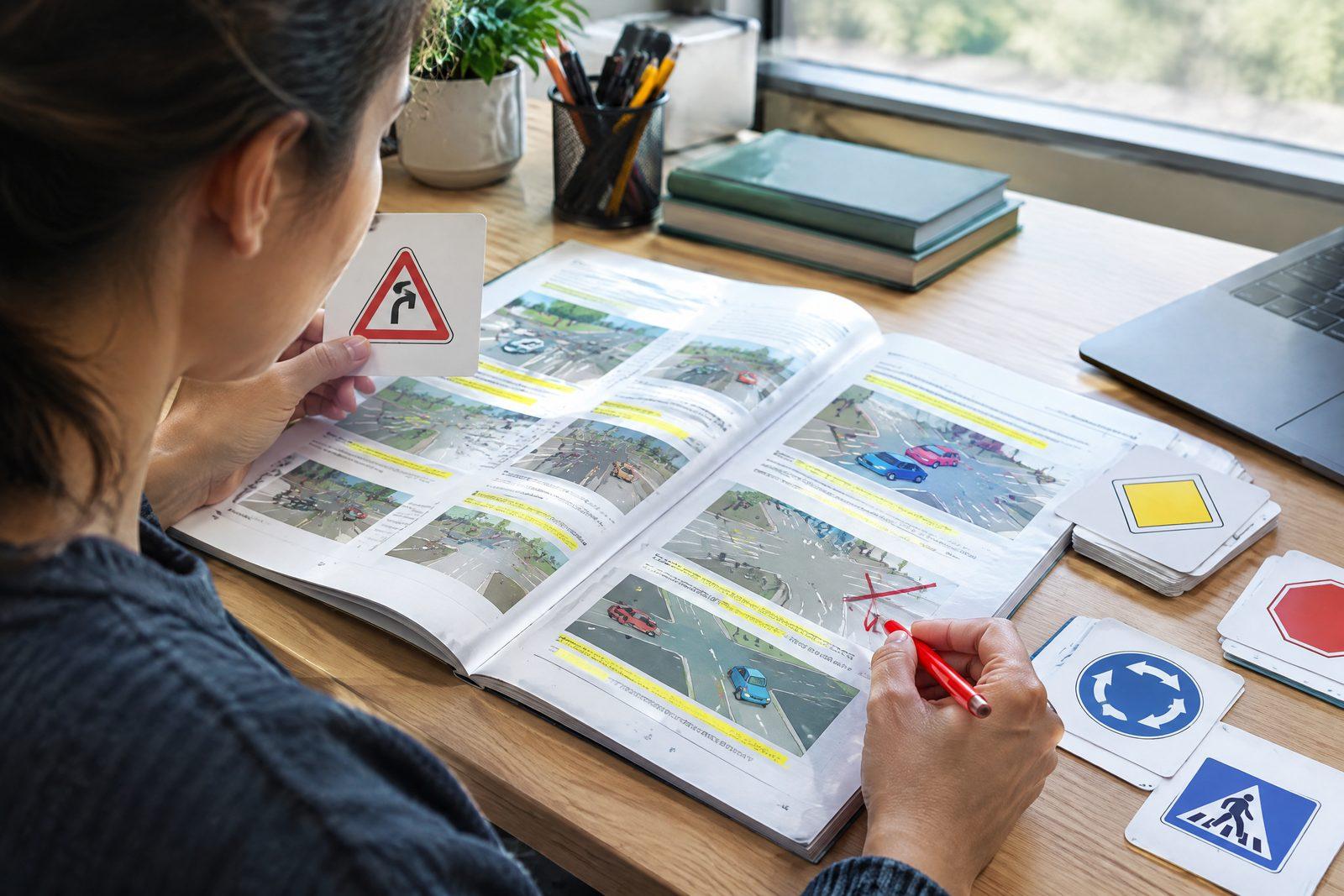
- Read the explanation on every miss, not just the answer. Our explanations cite the handbook section so you can see whether you misremembered a number or misread an exception.
- Re-run your mistake set the day before the exam. The concepts here account for a disproportionate share of second attempts.
Start with the free 20 questions for your state: California, Texas or Florida. For the full state guides, see the California written test guide, the Texas DPS knowledge test guide and the Florida Class E knowledge test guide.
Frequently Asked Questions
Do I have to stop for a school bus on the other side of a divided highway?
Generally no, but each state defines “divided” differently. California excuses oncoming traffic on a divided highway or a multilane road with two or more lanes each way; Florida requires a raised barrier or an unpaved median at least five feet wide (painted lines do not count); Texas excuses you only on a different road or on a controlled-access highway loading zone where pedestrians cannot cross.
What is the correct following distance for the DMV test?
It depends on the state's handbook: California teaches three seconds, Florida four seconds, and Texas two seconds at 30 mph or less and four seconds above 30 mph. In every state, add time for rain, poor visibility, heavy loads or towing.
When must I dim my high beams?
Within 500 feet of an oncoming vehicle and within 300 feet of a vehicle you are following. California, Texas and Florida all use the same two distances.
Can I turn left on a red light?
Only from a one-way street onto another one-way street, after a complete stop and yielding, and only where no sign prohibits it. A two-way street onto a one-way street does not qualify, and a red arrow never permits the turn.
How far from a fire hydrant can I park?
At least 15 feet in California, Texas and Florida. All three now keep 20 feet clear at crosswalks: California's daylighting law (AB 413) bans parking within 20 feet of the approach side of any crosswalk, marked or unmarked, even where the curb is not painted red; Texas and Florida bar parking within 20 feet of an intersection or crosswalk and 30 feet of a stop sign or signal, and Florida adds 50 feet from a railroad crossing.
What is the alcohol limit for drivers under 21?
Far below 0.08. California sets it at 0.01%, Texas at any detectable amount, and Florida at 0.02, which triggers an automatic six-month licence suspension.
What is the default speed limit in a residential area?
25 mph in California, 30 mph in a Texas urban district and 30 mph in a Florida business or residential area, unless a different limit is posted.
Sources
- California Driver's Handbook, California DMV — Traffic Controls, Speed Limits, Sharing the Road, Parking, Alcohol and Drugs.
- Texas Driver Handbook DL-7, Texas DPS, revised January 2026 — Chapters 3, 6, 7, 8 and 10.
- Florida Class E Driver License Handbook, FLHSMV — Sharing the Road, Following Distances, Parking, Speed Limits, Alcohol.