What the Florida Class E Knowledge Exam Is
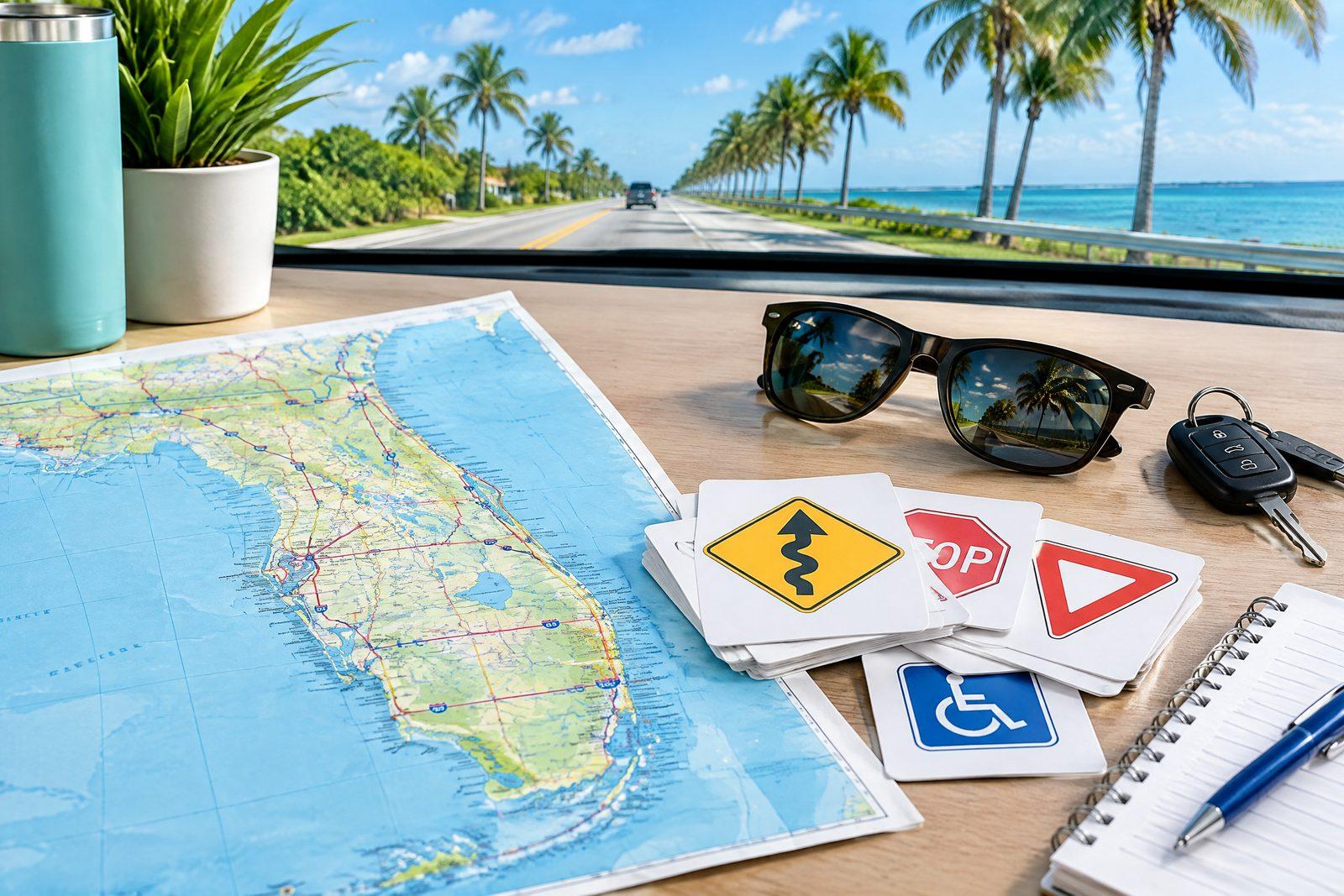
The Class E Knowledge Exam is the written test every first-time Florida driver passes before getting a learner's license or a Class E (regular) driver license. It is administered by the Florida Department of Highway Safety and Motor Vehicles (FLHSMV) and is based entirely on the Official Florida Driver License Handbook. The handbook itself says the exam consists of 50 multiple-choice questions on three things: Florida traffic laws, safe driving practices, and identifying traffic controls.
You need 40 correct answers — 80% — to pass, and you have 60 minutes. That is a higher bar than most states (Texas asks for 70%), which is why the biggest mistake Florida applicants make is treating it as a common-sense quiz. It is a test of specific Florida numbers and rules, and this guide lists the ones that come up again and again.
If you want to see how ready you are before reading further, the 20 free Florida practice questions are written from the same handbook and scored the same way.
Test Format at a Glance
| Item | Florida Class E Knowledge Exam |
|---|---|
| Questions | 50 multiple choice |
| Passing score | 40 correct (80%) |
| Time limit | 60 minutes |
| Content | Florida traffic laws · safe driving practices · traffic signs, signals and markings |
| Source | Official Florida Driver License Handbook (FLHSMV), 2023 edition with 2024–25 law updates |
| Where | Driver license office or tax collector office; approved third-party providers offer it online for under-18 applicants with restrictions |
| Retest fee | $10 per written retest (in addition to the license fee) |
Who Has to Take It, and the Steps Around It
The knowledge exam sits inside Florida's graduated licensing process for anyone under 18, and it is also required for adults getting their first license. The handbook lays out the steps:
Learner's license (age 15+)
- Be at least 15 years old.
- Complete the Traffic Law and Substance Abuse Education (TLSAE) course — required for every first-time Florida driver, at any age, unless you hold a license from another state, country or jurisdiction.
- Pass the vision exam and the Class E Knowledge Exam.
- If you are under 18, a parent or legal guardian signs the application and takes responsibility for your driving.
Class E driver license (age 16+)
- Hold the learner's license for at least 12 months or until your 18th birthday, whichever comes first, with no traffic convictions during that time.
- Log at least 50 hours of supervised driving experience, 10 of them at night, certified by a parent or guardian.
- Pass the driving skills test in a vehicle you provide.
Adults 18 and over skip the 12-month hold and the supervised-hours log, but still need the TLSAE course and the same knowledge exam.
The Florida Numbers the Exam Asks About
Florida's handbook is unusually number-heavy, and the exam follows it. These are the figures our question bank is built around, and the ones you should be able to recite before test day.
Speed limits (unless posted otherwise)
| Location | Limit |
|---|---|
| School zones | 20 mph (during the posted hours) |
| Business or residential areas | 30 mph |
| Streets and highways not otherwise posted | 55 mph |
| Limited-access highways (interstates) | 70 mph |
| Minimum on a 70 mph highway | 50 mph |
Alcohol
- 0.08% BAC — legally impaired for drivers 21 and over.
- 0.02% BAC — the zero-tolerance line for drivers under 21; a reading of 0.02 or higher brings a six-month license suspension, and 0.02–0.05 also requires a TLSAE course.
- By signing your license you have agreed to a breath, blood or urine test when an officer has reasonable cause (implied consent); refusing carries its own automatic suspension.
Insurance (Florida's no-fault minimums)
- $10,000 Personal Injury Protection (PIP) and $10,000 Property Damage Liability (PDL), kept continuously on any vehicle with a Florida registration.
- Florida is one of the few states that does not require bodily injury liability for a standard license — but after a DUI conviction you must carry the much higher FR-44 limits: $100,000 per person, $300,000 per crash, and $50,000 PDL, for three years.
Distances and other figures
- At a railroad crossing, never stop on the tracks or within 15 feet of the crossing, and never park within 50 feet of one.
- Dim high beams within 500 feet of an oncoming vehicle and within 300 feet when following.
- Headlights on from sunset to sunrise and any time you use your wipers in rain, fog or smoke — Florida law ties headlights to wipers.
- Park no closer than 15 feet to a fire hydrant, 20 feet to an intersection or the entrance to a fire, ambulance or rescue station, and 30 feet to a stop sign, traffic signal or flashing signal.
- Move Over: on a road with two or more lanes in your direction, move over one lane for stopped emergency, tow, utility and (since 2024) any disabled vehicle displaying warning lights; if you cannot move over, slow to 20 mph below the limit, or to 5 mph when the limit is 20 or less.
What the Handbook Covers, Chapter by Chapter
The exam draws from the whole handbook, but three chapters carry most of the questions. The FLHSMV publishes a three-page “Test Your Knowledge” review sheet keyed to the handbook; its questions cluster in exactly these areas.
| Handbook area | What to know | Weight on our bank |
|---|---|---|
| Traffic laws | Speed limits, right-of-way, passing, turning, parking, seat belts and child restraints, alcohol and drugs, the Move Over law, school bus rules | ~40% |
| Safe driving practices | Following distance, defensive driving, night and weather driving, hydroplaning, sharing the road with trucks, motorcycles, bicycles and pedestrians, emergencies | ~35% |
| Traffic controls | Sign shapes and colours, regulatory vs. warning vs. guide signs, signals including flashing yellow arrows, pavement markings, lane-use signals | ~25% |
School buses — the rule Florida tests hard
On a two-way road, all traffic in both directions must stop for a school bus with its red lights flashing and stop arm out, and stay stopped until the lights go off. Only on a divided highway with an unpaved space of at least five feet, a raised median, or a physical barrier may traffic on the opposite side keep moving. Getting this backwards is one of the most common fails.
Child restraints
Children under age 4 must ride in a child safety seat; children ages 4 and 5 must be in either a safety seat or a booster seat. All drivers, all front-seat passengers and every passenger under 18 must wear a seat belt, and the driver is charged for any unbelted passenger under 18.
A One-Week Study Plan That Works
- Day 1 — take a practice test cold. The free 20-question set shows you which of the three areas you are weakest in. Do not study first; you want a baseline.
- Days 2–3 — read the handbook chapters on traffic laws and signs, writing every number into one list as you go. The list should fit on one page.
- Day 4 — safe driving practices chapter, then the FLHSMV “Test Your Knowledge” sheet with the handbook open.
- Days 5–6 — timed 50-question simulators at the real 80% bar. Review every miss with its handbook citation, not just the right answer.
- Day 7 — retake only the questions you missed. If two simulators in a row clear 90%, you are ready; the real exam has fewer surprises than a good simulator.
What Happens If You Fail
You can retake the Class E Knowledge Exam, and each retest costs $10 on top of the license fee. There is no long lockout for the written test itself, though offices may ask you to study before returning the same day. What you should not do is retake it blind: the questions rotate from a large pool, so a second attempt on the same knowledge usually lands in the same 70–78% range. Fix the specific chapter you missed, then go back.
Frequently Asked Questions
How many questions are on the Florida Class E knowledge test?
50 multiple-choice questions, drawn from the Official Florida Driver License Handbook. You must answer 40 correctly (80%) within 60 minutes to pass.
How many can I get wrong and still pass?
Ten. The passing score is 40 out of 50. Florida's 80% bar is higher than Texas (70%) but close to California (83%).
Do I have to take the TLSAE course before the knowledge test?
Yes, if this is your first driver license anywhere. The Traffic Law and Substance Abuse Education course is required for every first-time Florida driver, at any age. Drivers exchanging a valid out-of-state or foreign license are exempt.
Can I take the Florida permit test online?
Students under 18 can take it online through FLHSMV-approved third-party providers. Adults take it in person at a driver license or tax collector office, or with a provider that offers it in an in-person setting.
What is the speed limit in a Florida school zone?
20 mph during the posted school hours, unless a different limit is posted. Fines are doubled for speeding in a school zone or construction zone, and if you are ticketed for more than 30 mph over any limit you cannot elect a driver-improvement course instead of points.
How long must I hold a Florida learner's license?
Twelve months, or until your 18th birthday if that comes first, with no traffic convictions, plus 50 logged hours of supervised driving including 10 at night. Adults 18+ do not need the holding period.
What insurance does Florida require to get a license?
A minimum of $10,000 Personal Injury Protection (PIP) and $10,000 Property Damage Liability (PDL) on any vehicle you register. Florida does not require bodily injury liability for a standard license, but does after a DUI conviction.
Sources
- Official Florida Driver License Handbook, FLHSMV — Chapters 1 (Your License), 2 (Insurance), 4 (Traffic Laws), 5 (Signs), 6 (Safe Driving).
- Test Your Knowledge review sheet, FLHSMV.
- Our Florida question bank is written from these documents and verified against their text; it never reproduces the handbook or any official test question.