The Short Answer
The NHA Certified Phlebotomy Technician (CPT) exam has 100 scored questions plus 20 unscored pretest questions, and you get 2 hours. NHA's current test plan is based on a job analysis completed in 2024. Because the scored items split exactly into 100, every domain's item count is also its percentage: Routine Blood Collections is 28%, Safety and Compliance 26%, Patient Preparation 20%, Processing 14% and Special Collections 12%.
To qualify you need a high school diploma or GED and hands-on proof: at least 30 successful venipunctures and 10 capillary (finger) sticks on live people. Our free phlebotomy practice test follows these weights. You pass with a scaled score of 390 or higher on NHA's 200 to 500 scale.
What the Exam Covers
| Domain | Scored items | Share |
|---|---|---|
| Routine Blood Collections | 28 | 28% |
| Safety and Compliance | 26 | 26% |
| Patient Preparation | 20 | 20% |
| Processing | 14 | 14% |
| Special Collections | 12 | 12% |
| Total | 100 | 100% |
Routine Blood Collections (28 items)
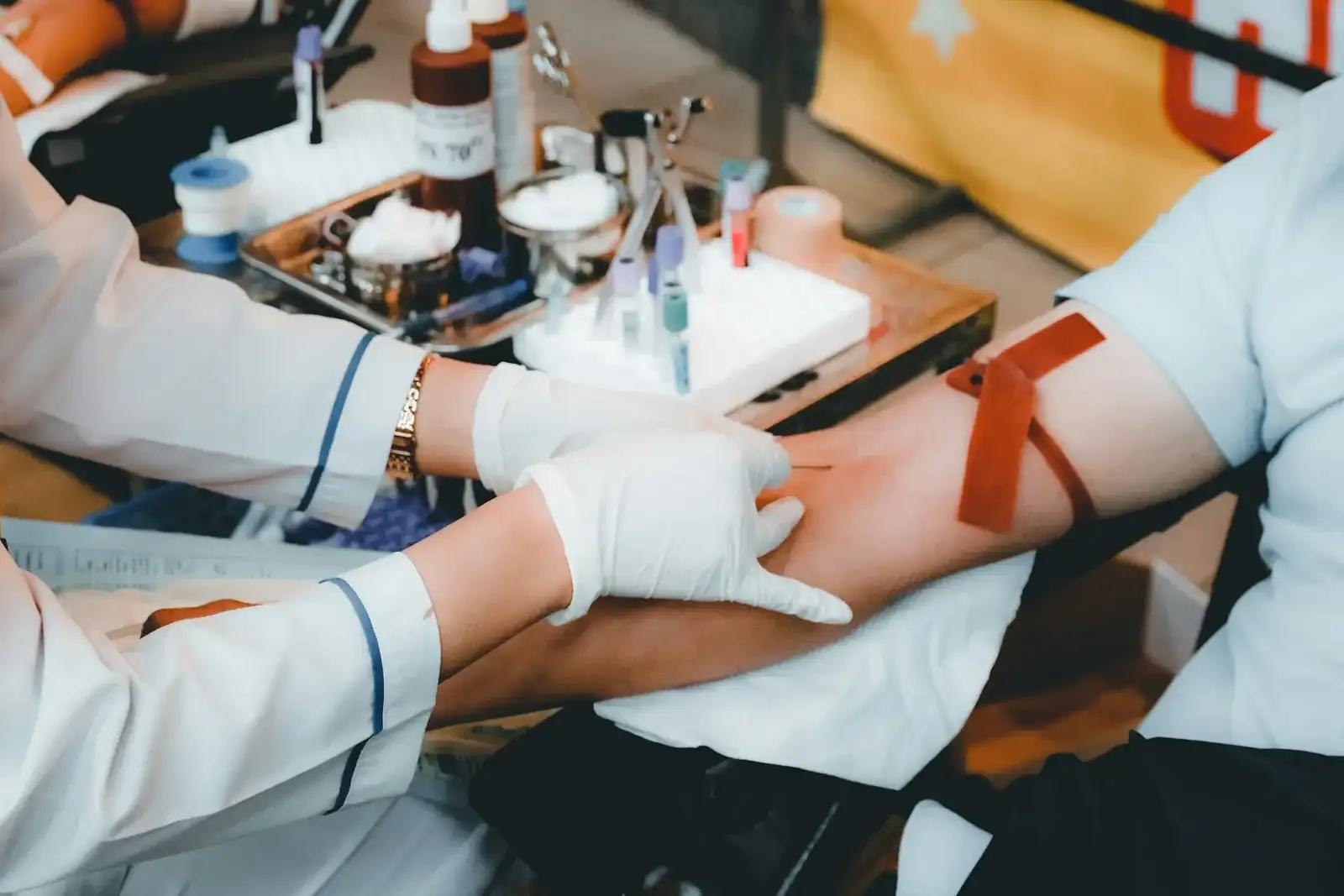
The largest domain follows a draw from start to finish: select and check equipment, apply the tourniquet, choose the site by observation and palpation, apply antiseptic, anchor the vein, insert the needle, follow the order of draw, mix additive tubes by inversion, remove the needle and engage the safety feature, then care for the patient afterwards and label every specimen. It also covers capillary (dermal) puncture and recognizing complications such as lack of blood flow, hematoma, petechiae or nerve pain.
Safety and Compliance (26 items)
Workplace safety rules (OSHA, NIOSH), operational standards (The Joint Commission, CLSI, CDC), HIPAA and protected health information, scope of practice and ethics, disposing of sharps and biohazards, exposure control after a needlestick, transmission-based and standard precautions, personal protective equipment, and responding to emergencies with first aid or CPR.
Patient Preparation (20 items)
Reading and verifying the order or requisition, introducing yourself, positively identifying the patient, getting implied, informed or expressed consent (or a guardian's permission), checking fasting and medication requirements, asking about allergies and a history of fainting, explaining the procedure, positioning the patient and choosing the venipuncture site.
Processing (14 items)
Preparing specimens (centrifuging, aliquoting, refrigeration or freezing), keeping specimens intact based on temperature, light and time, chain of custody when it is required, entering and retrieving data in the lab information system, and reporting critical values for point-of-care and CLIA-waived tests.
Special Collections (12 items)
Blood cultures, assisting with pediatric and geriatric collections and with lines, metabolic screening such as PKU or galactosemia, blood donation, volume limits for higher-risk patients, non-blood specimens such as throat and nasal swabs, point-of-care tests, tolerance tests, blood alcohol and drug screening.
Who Can Take the CPT Exam
NHA gives two routes. You need one of them, and both require evidence of live practice:
- Route 1: a high school diploma or GED (or you are scheduled to earn one within 18 months), a phlebotomy technician training or education program completed within the last 5 years, and proof of at least 30 successful venipunctures and 10 capillary or finger sticks on live individuals.
- Route 2: a high school diploma or GED, 1 year of supervised work experience in phlebotomy within the last 3 years (or 2 years within the last 5), and the same proof of 30 venipunctures and 10 capillary sticks.
The 30 and 10 minimums also apply if you convert a provisional certification. The NHA Candidate Handbook has the full rules, including employer-training and pre-externship routes.
How to Prepare
- Study by weight. Routine Blood Collections and Safety and Compliance together are 54 of the 100 scored items.
- Learn the draw as a sequence. Questions often hinge on which step comes next or what to do when something goes wrong, such as no blood flow or a patient who feels faint.
- Know your tubes. The test plan lists matching tube colors to laboratory tests, for example the blue stopper for coagulation, along with additives and order of draw.
- Do not skip patient preparation. Identifying the patient, consent and fasting rules are straightforward points when you have memorized the steps.
- Use NHA's free test plan to tick off the tasks and knowledge statements you cannot explain, then take a phlebotomy practice test under a 2-hour pace.
Working toward a broader medical assistant credential? See the NHA CCMA exam guide.
Scoring, Results and Retakes
- Scaled score. NHA scores every exam on a 200 to 500 scale and requires 390 or higher to pass. Scaling keeps the pass mark the same across different exam forms.
- Your score report shows your score, pass or fail, and for each major content area whether you were Above, Near or Below the passing standard. Use it to decide what to study before a retake.
- When you get it. Exams taken at PSI or by live remote proctoring report within 48 hours; exams taken at your institution give a preliminary report right away.
- Retakes. You can retake after a 30-day wait. You have three attempts with at least 30 days between them; after the third attempt, each further failure means waiting one year. Every retake needs a new registration and the full exam fee.
- Rescheduling. You can move your date without repaying within 6 months of the original date. For PSI or remote proctoring, change it at least 24 hours before or the fee is forfeited.
The 20 pretest questions do not affect your score, but you are not told which ones they are. The exam is given in English only. It is one continuous session, so remote proctoring allows no breaks, and in-person breaks count against your time. Bring a government-issued photo ID, and use the exam's built-in calculator.
Renewing Your CPT
A certification is valid for two years. Before it expires you submit 10 continuing education credits (2 hours of CE equals 1 credit) and the recertification fee, with a one-month grace period. If it expires, you can reinstate within one year with 15 credits plus the recertification and reinstatement fees; after one year you must retake the exam.
Frequently Asked Questions
How many questions are on the NHA CPT exam?
120 in total: 100 scored questions and 20 unscored pretest questions.
How long is the CPT exam?
2 hours.
What is the biggest part of the CPT exam?
Routine Blood Collections, with 28 of 100 scored items, followed by Safety and Compliance at 26.
How many venipunctures do I need before I can sit the CPT exam?
NHA requires evidence of at least 30 successful venipunctures and 10 capillary or finger sticks on live individuals, in addition to a diploma or GED and either training or work experience.
Is the order of draw on the exam?
Yes. NHA's test plan lists following the order of draw for both venipuncture and capillary collection, and for blood cultures.
What score do I need to pass the CPT exam?
A scaled score of 390 or higher on NHA's 200 to 500 scale.
How long must I wait to retake the CPT exam?
30 days after a failed attempt. You get three attempts with at least 30 days between them, then a one-year wait for each further failure, and every retake needs the full exam fee.
How often must I renew a CPT?
Every two years, with 10 continuing education credits and the recertification fee.
Sources
- NHA — CPT Test Plan (2024 job analysis) — 100 scored and 20 pretest items, 2 hours, the five domains with their item counts and the tasks and knowledge statements for each.
- NHA — Certified Phlebotomy Technician (CPT) — eligibility routes including the 30 venipunctures and 10 capillary sticks, and the two-year renewal with 10 continuing education credits.
- NHA — Candidate Handbook — scaled score of 390 (200 to 500 scale), the retake and rescheduling rules, eligibility pathways, recertification and reinstatement (edition updated 5 October 2026).