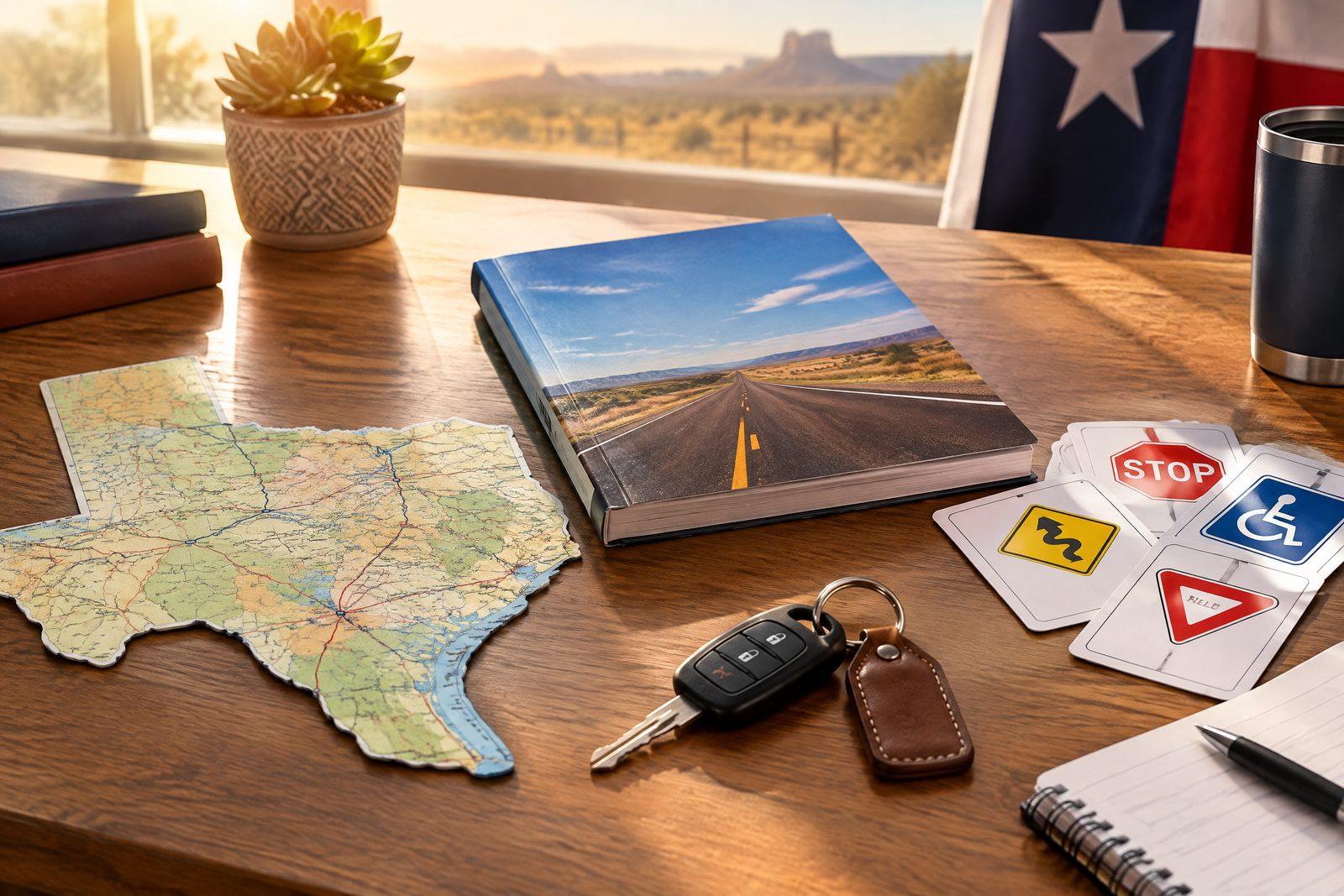
What the Texas Knowledge Exam Is
The Class C knowledge exam is the written test the Texas Department of Public Safety (DPS) gives to original driver license applicants. It is based on the Texas Driver Handbook (DL-7), and the handbook is blunt about the bar: you must score 70% or better to pass. The exam has 30 multiple-choice questions, so that means 21 correct. Compared with California (83%) and Florida (80%) that is a forgiving pass mark, and Texas does something the other big states do not — many applicants never sit the exam at a DPS office at all, because an approved driver education course includes it.
This guide covers who has to take it, what the retake rules are, and the specific DL-7 numbers that turn into questions. If you want a baseline first, the 20 free Texas practice questions are written from the same handbook.
Exam Format
| Item | Texas Class C knowledge exam |
|---|---|
| Questions | 30 multiple choice |
| Passing score | 70% — 21 correct |
| Source | Texas Driver Handbook DL-7 (revised January 2026) |
| Where | DPS driver license office, or built into an approved driver education course (parent-taught, public school, commercial, or online) |
| If you fail | Your application is held for 90 days; after 90 days or three failed exams a new application and fee are required |
| Exempt | Applicants who complete certain approved driver education courses (the course administers the exam); adults 18+ surrendering a valid out-of-state license skip both the knowledge and driving exams |
Who Takes It, and the Licensing Steps Around It
Texas ties the knowledge exam to driver education for everyone under 25 (the Less Tears More Years Act). The DL-7 lays out the path:
Learner license (age 15+)
- Complete the classroom portion of a driver education course, plus the vision and knowledge exams (the course may administer the knowledge exam).
- Present a Verification of Enrollment and Attendance (VOE) form from your school if you are under 18.
- A parent or guardian co-signs; the license shows “Learner License” and expires on your 18th birthday. Fee: $16.
- Drive only with a licensed driver 21 or older with at least one year of driving experience in the front passenger seat.
Provisional license (age 16+)
- Complete the full driver education course, classroom and behind-the-wheel.
- Hold the learner license (or a hardship license, or a combination) for at least six months.
- Complete the Impact Texas Drivers (ITD) course for your age group before the driving test — required of every applicant, at any age.
- Pass the driving exam. Provisional restrictions then apply until 18: no more than one non-family passenger under 21, no driving between midnight and 5 a.m. except for work, school or emergencies, and no wireless device use.
Adults 18–24
Must complete an approved adult driver education course before applying. Adults 25 and over need no course. Either way, adults who did not hold a learner license take the knowledge exam at the office (unless their course included it) and are issued a Class C license with learner restrictions until they pass the driving test. Fee: $32 plus a $1 administrative fee.
The DL-7 Numbers That Become Questions
Default speed limits — DL-7 Table 22
| Roadway | Limit for cars and light trucks |
|---|---|
| Urban district | 30 mph |
| Alley | 15 mph |
| Beaches and county roads next to a public beach (where declared) | 15 mph |
| Numbered Texas or U.S. highway outside an urban district (including FM and RM roads) | 70 mph |
| Un-numbered highway outside an urban district | 60 mph |
These are the defaults where no sign is posted; posted limits always override. School buses and some other vehicle classes have lower defaults on the same roads.
Insurance — minimum liability (30/60/25)
- $30,000 for injury or death of one person
- $60,000 for injury or death of two or more people
- $25,000 for property damage
Headlights
- Low beams within 500 feet of an approaching vehicle and when following within 300 feet of another vehicle; also on lighted roads and in fog, heavy rain, sleet, snow or dust.
- Headlights are required from 30 minutes after sunset to 30 minutes before sunrise, and whenever people or vehicles cannot be seen clearly for 1,000 feet.
Alcohol
- 0.08 BAC — legally intoxicated at 21 and over.
- Any detectable amount under 21 — Texas zero tolerance. Minors face license suspension even without meeting the DWI definition.
- Under implied consent, refusing a breath or blood test brings an automatic suspension.
Distances and rules the test likes
- Following distance: at 30 mph or less keep at least a 2-second gap; above 30 mph, 4 seconds in good conditions.
- Slow Down or Move Over: for a stopped emergency, law enforcement, fire, tow, utility or TxDOT vehicle with lights on, either move out of the adjacent lane on a multi-lane road, or slow to 20 mph below the posted limit (or to under 5 mph where the limit is below 25 mph).
- Fire trucks and ambulances: do not follow within 500 feet of one answering a call.
- Railroad crossings: stop when red lights flash or gates are down and remain stopped until the train has passed and the gates are up; never proceed around a lowered gate.
- School buses: stop for a bus with flashing red lights and stay stopped until it moves, the driver signals you on, or the lights stop flashing. You need not stop on a controlled-access highway where the bus is in a loading zone and pedestrians cannot cross. First-conviction fine: $500–$1,250.
- Trains: a train's horn sounds when it is about 1,500 feet from the crossing — that is your cue, not the gates.
What the Handbook Chapters Cover
| DL-7 chapter | What to know |
|---|---|
| 1 — Your License to Drive | Age and course requirements, learner and provisional rules, exam and retest rules, fees |
| 2 — Vehicle Inspection, Registration and Insurance | 30/60/25 minimums, proof of financial responsibility, penalties for no insurance |
| 3 — Right-of-Way | Intersections, emergency vehicles, school buses, pedestrians, railroad crossings, private drives |
| 4 — Traffic Signs and Signals | Shapes, colours, regulatory vs. warning, signals and flashing lights, pavement markings |
| 5 — Signaling, Passing and Turning | Signal distances, no-passing situations, turn lanes, U-turns |
| 6 — Parking, Stopping and Standing | Where you may not park, distances from hydrants and crossings, hills |
| 7 — Speed and Speed Limits | Table 22 defaults, following distance, reaction and stopping distance |
| 8 — Vehicle Operation and Emergencies | Skids, blowouts, brake failure, hydroplaning, Slow Down or Move Over |
| 10 — Alcohol and Drugs | 0.08, zero tolerance, implied consent, penalties |
A Five-Day Plan
- Day 1 — baseline. Take the free 20-question set cold and note which chapters your misses come from.
- Day 2 — chapters 3, 4 and 7 (right-of-way, signs, speed). Write every number into one list.
- Day 3 — chapters 1, 2, 5, 6, 8 and 10. Skim, but stop at every table.
- Day 4 — two timed 30-question simulators at the 70% bar; review each miss against its DL-7 citation.
- Day 5 — mistake review only. Clearing two simulators at 90% or better means the real exam, with its lower bar, is a formality.
Frequently Asked Questions
How many questions are on the Texas DPS knowledge test?
30 multiple-choice questions drawn from the Texas Driver Handbook (DL-7). You must score at least 70% — 21 correct — to pass.
What happens if I fail the Texas knowledge test?
Your application is held for 90 days and you can retake the exam within that window. After 90 days, or after three failed exams, you must submit a new application and pay the fee again.
Do I have to take the written test at the DPS office?
Not always. Under the Less Tears More Years Act everyone under 25 must complete driver education, and completing certain approved courses means the Class C knowledge exam is given by the course instead of at the office. Adults 18 and over surrendering a valid out-of-state license skip both exams.
How long must I hold a Texas learner license?
At least six months before a provisional license can be issued. Learner licenses are available from age 15 after the classroom portion of driver education, and expire on your 18th birthday.
What is the default speed limit in Texas?
Where no limit is posted: 30 mph in an urban district, 15 mph in an alley, 70 mph on a numbered state or U.S. highway outside an urban district, and 60 mph on an un-numbered highway outside an urban district (DL-7 Table 22).
What is the minimum car insurance in Texas?
Liability coverage of $30,000 per injured person, $60,000 per crash, and $25,000 for property damage — the 30/60/25 minimum. You must carry proof of it.
Do adults need driver education in Texas?
Applicants 18 to 24 must complete an adult driver education course. Applicants 25 and over do not need a course, but still take the knowledge and driving exams unless they surrender a valid out-of-state license. Everyone takes the Impact Texas Drivers course before the driving exam.
Sources
- Texas Driver Handbook DL-7, Texas Department of Public Safety, revised January 2026 — Chapters 1, 2, 3, 7, 8 and 10 and Tables 1, 15 and 22.
- Our Texas question bank is written from the DL-7 and verified against its text; it never reproduces handbook wording or any DPS test question.