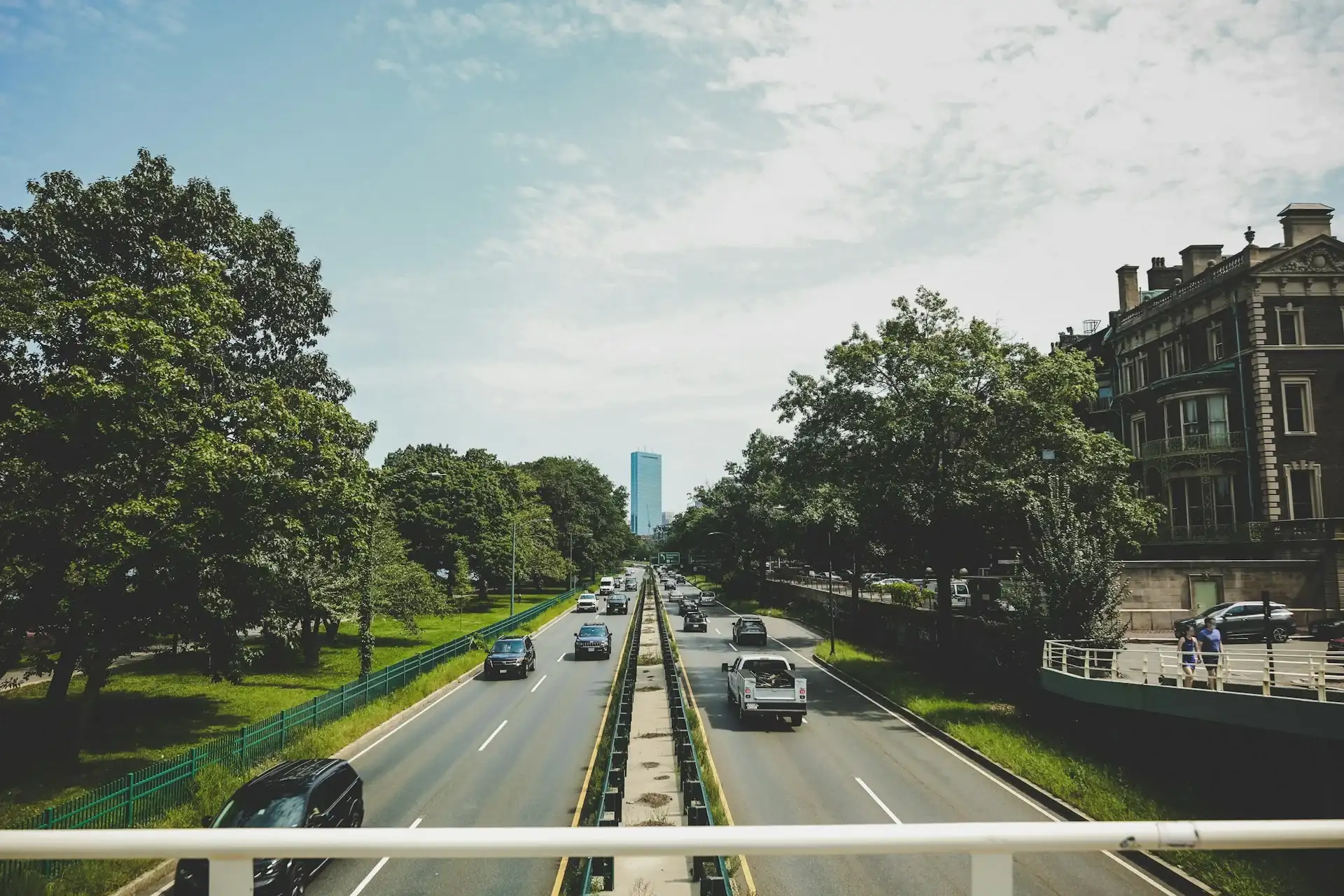
Traffic on Storrow Drive along the Charles River with the Boston skyline in Massachusetts

All exams/Driving & Licenses/Massachusetts RMV Permit/Free questions

Free Massachusetts RMV Permit practice questions

Tap an answer to see if you are right, and why. 20 questions across 10 topics, mostly Road signs (2), and 2 have a road sign to read.

Questions last updated October 18, 2026 · Original practice questions written from the Massachusetts Driver's Manual (Massachusetts Registry of Motor Vehicles, Revised April 2026) and checked against its text; not official RMV questions. Not affiliated with or endorsed by the Massachusetts RMV or MassDOT.

The real test

25 questions · 18 to pass (72%) · 25-minute limit.

Need 18 of 25You can miss 7

0 of 20 answeredTap an answer to check it
  1. Road signs1 of 20

    STOPWhat does this sign mean?

    What does an eight-sided octagonal traffic sign always indicate on Massachusetts roadways?

    The answer

    Answer: A. An octagonal (eight-sided) sign always means STOP under Massachusetts traffic law. Drivers must bring their vehicle to a complete halt before any painted stop line, crosswalk, or intersection boundary, yield the right-of-way to crossing pedestrians and approaching traffic, and proceed only when the way is completely clear.

    Source: Massachusetts Driver's Manual — Chapter 4: Traffic Signs (p. 83, 86)

  2. Road signs2 of 20

    YIELDWhat does this sign mean?

    What is the meaning of a triangular downward-pointing traffic sign?

    The answer

    Answer: B. A downward-pointing equilateral triangular sign always indicates YIELD in Massachusetts. Drivers must slow down to a reasonable speed, be prepared to stop if traffic conditions require, and grant the right-of-way to any oncoming vehicles, bicyclists, or pedestrians crossing your intended path. The handbook says that when you see a yield sign you should slow down and be prepared to stop.

    Source: Massachusetts Driver's Manual — Chapter 4: Stop and Yield Signs (p. 86)

  3. Intersections and turns3 of 20

    At an all-way stop intersection in Massachusetts, if two vehicles arrive at the exact same moment, who has the right-of-way?

    The answer

    Answer: C. Under Massachusetts right-of-way rules, at an all-way stop where two vehicles arrive and stop simultaneously, the driver on the right has the right-of-way. If vehicles arrive at different times, the first vehicle to come to a complete stop has priority to proceed across the intersection.

    Source: Massachusetts Driver's Manual — Chapter 4: Stop and Yield Signs (p. 86)

  4. Intersections and turns4 of 20

    When entering a traffic circle or rotary in Massachusetts, which vehicles have the right-of-way?

    The answer

    Answer: D. In Massachusetts, vehicles already circulating inside a rotary or roundabout have the right-of-way over vehicles attempting to enter. Drivers approaching a rotary must yield to circulating traffic, wait for an adequate gap, and merge safely into the rotary without cutting off existing motorists. Signs or police officers may direct you differently, and you must also yield to pedestrians.

    Source: Massachusetts Driver's Manual — Chapter 4: Right-of-Way Rules (p. 100)

  5. Alcohol and drugs5 of 20

    Under Massachusetts Zero Tolerance law, drivers under 21 years of age are penalized for driving with a blood alcohol concentration (BAC) of at least:

    The answer

    Answer: A. Massachusetts has a zero-tolerance law for drivers under 21. Any driver under 21 faces penalties for having a BAC of 0.02 or higher. The handbook notes that the extra suspension for drivers under 21 is meant to push youths charged with OUI, or with a BAC of 0.02 or higher, toward alcohol education, so even a small amount of alcohol puts a young driver's license at risk.

    Source: Massachusetts Driver's Manual — Chapter 3: Alcohol, Drugs, and Driving (p. 71)

  6. Alcohol and drugs6 of 20

    What is the administrative license suspension for an adult driver (21+) with no prior OUI convictions who refuses a chemical breath test in Massachusetts?

    The answer

    Answer: B. Under the Massachusetts Implied Consent Law, any licensed driver age 21 or older who refuses to submit to a chemical breath or blood test when arrested for OUI faces an automatic 180-day license suspension for a first refusal. Drivers with prior OUI convictions face substantially longer suspensions, up to lifetime revocation.

    Source: Massachusetts Driver's Manual — Chapter 3: Refusing a Chemical Test (p. 70)

  7. Traffic signals and markings7 of 20

    What must you do when approaching a flashing red traffic light at an intersection in Massachusetts?

    The answer

    Answer: C. A flashing red traffic light has the exact same legal meaning as a STOP sign in Massachusetts. Motorists must come to a complete stop at the stop line or crosswalk, look in all directions to yield the right-of-way to other traffic and crossing pedestrians, and proceed only when clear.

    Source: Massachusetts Driver's Manual — Chapter 4: Motor Vehicle Signals (p. 81)

  8. Traffic signals and markings8 of 20

    What do double solid yellow center lines indicate on a Massachusetts roadway?

    The answer

    Answer: D. Double solid yellow lines separate opposing traffic lanes and prohibit passing for vehicles traveling in either direction. Drivers may not cross double solid yellow lines except when making a lawful left turn into a driveway or private road, or when maneuvering around a vulnerable road user with at least 4 feet of clearance.

    Source: Massachusetts Driver's Manual — Chapter 4: Yellow Lane Lines (p. 90)

  9. Speed and space9 of 20

    Unless otherwise posted, what is the statutory speed limit in a thickly settled or business district in Massachusetts?

    The answer

    Answer: A. Under Massachusetts law, the statutory speed limit in a thickly settled or business district is 30 miles per hour unless signs show a lower 25 mph limit. Speed limits are maximums for good conditions, so your speed is not reasonable and proper if you drive over the limit for the area, and you may need to go slower in rain, fog, or heavy traffic.

    Source: Massachusetts Driver's Manual — Chapter 4: Speed Limits (p. 79)

  10. Speed and space10 of 20

    Under the Massachusetts Fundamental Speed Law, what governs your maximum lawful driving speed?

    The answer

    Answer: B. Massachusetts Fundamental Speed Law mandates that motorists must never travel at a speed that is greater than reasonable and proper under existing conditions. Even on roads posted for 50 or 65 mph, adverse conditions like heavy rain, fog, snow, ice, or dense pedestrian traffic require drivers to reduce their speed.

    Source: Massachusetts Driver's Manual — Chapter 4: Speed Limits (p. 79)

  11. Sharing the road11 of 20

    Under the Massachusetts Vulnerable Road Users Law, how much distance must a driver provide when passing a bicyclist or pedestrian?

    The answer

    Answer: C. The Massachusetts Vulnerable Road Users Law requires motorists to leave a safe passing distance of at least four feet when passing pedestrians, bicyclists, roadside workers, and people using wheelchairs, scooters, skateboards, or similar devices. If it is safe, you may use all or part of the lane next to you and may cross the center line if necessary, and you must still obey the speed limit while passing.

    Source: Massachusetts Driver's Manual — Chapter 2: Vulnerable Road Users Law (p. 49, 54)

  12. Sharing the road12 of 20

    What must drivers in both directions do when approaching a stopped school bus displaying flashing red lights and an extended stop sign in Massachusetts?

    The answer

    Answer: D. Under Massachusetts law, traffic in both directions must come to a complete stop whenever a school bus is stopped with its red lights flashing and stop arm extended. Drivers must remain stopped until the flashing red lights stop and the stop sign is retracted. Traffic must stay stopped until the lights stop flashing.

    Source: Massachusetts Driver's Manual — Chapter 4: Road Respect (p. 105)

  13. Passing lane usage13 of 20

    In Massachusetts, under what specific circumstance is a motorist legally permitted to pass another vehicle on the right?

    The answer

    Answer: A. In Massachusetts, passing on the right is strictly prohibited except under specific circumstances: when the vehicle being overtaken is making or about to make a left turn, or when traveling on a one-way street or divided highway with multiple marked travel lanes in the same direction. Passing on the shoulder is illegal.

    Source: Massachusetts Driver's Manual — Chapter 4: Rules for Passing (p. 103)

  14. Passing lane usage14 of 20

    How many feet before turning or changing lanes must you continuously signal on a standard city street in Massachusetts?

    The answer

    Answer: B. Massachusetts law requires drivers to signal continuously for at least 100 feet before making a turn or changing lanes on city streets and local roads. On a highway, the handbook says to signal at least 500 feet before a turn, and it is best to signal before you apply your brakes so other drivers know your intentions.

    Source: Massachusetts Driver's Manual — Chapter 4: Signaling (p. 93, 105)

  15. Parking15 of 20

    What is the minimum legal distance you must park away from a fire hydrant in Massachusetts?

    The answer

    Answer: C. Under Massachusetts parking regulations, parking within 10 feet of a fire hydrant or designated fire lane is strictly prohibited. Keeping this distance clear ensures emergency firefighting apparatus and personnel have immediate, unobstructed access to municipal water supplies during emergencies. The handbook lists parking within ten feet of a fire hydrant or fire lane among the places where you may not park.

    Source: Massachusetts Driver's Manual — Chapter 4: Parking Regulations (p. 110)

  16. Parking16 of 20

    When parallel parking along a public street in Massachusetts, your vehicle's wheels must be within what distance from the curb?

    The answer

    Answer: D. When parking along a curb in Massachusetts, your vehicle must be parked parallel to the curb and no more than 12 inches away. Parking farther out into the roadway obstructs the flow of moving traffic, impedes emergency vehicles, and creates hazards for passing bicyclists. The handbook says that in a business or residential district your vehicle must be no more than 12 inches from the curb.

    Source: Massachusetts Driver's Manual — Chapter 4: Parking Regulations (p. 110)

  17. Licensing (GDL)17 of 20

    Under the Massachusetts Junior Operator License (JOL) law, what passenger restriction applies during the first six months after obtaining a license?

    The answer

    Answer: A. During the first six months of holding a Junior Operator License (JOL) in Massachusetts, drivers under 18 may not carry any passenger under age 18 (other than immediate family members) unless accompanied by a licensed driver who is at least 21 years old, has at least one year of driving experience, and occupies the seat beside the driver.

    Source: Massachusetts Driver's Manual — Chapter 1: Junior Operator License Law (p. 10)

  18. Licensing (GDL)18 of 20

    What is the nighttime curfew for a Massachusetts Junior Operator License (JOL) holder under 18 years of age?

    The answer

    Answer: B. Under the Massachusetts Junior Operator License law, a driver under 18 may not operate a motor vehicle between 12:30 a.m. and 5:00 a.m. unless accompanied by a parent or legal guardian. The handbook notes that between 12:30 a.m. and 1:00 a.m. and between 4:00 a.m. and 5:00 a.m., this curfew is enforced only when a Junior Operator has been lawfully stopped for another violation.

    Source: Massachusetts Driver's Manual — Chapter 1: JOL License Restrictions (pp. 10-11)

  19. Emergencies safety19 of 20

    What does the Massachusetts Move Over Law require when approaching a stationary emergency or maintenance vehicle with flashing lights?

    The answer

    Answer: C. The Massachusetts Move Over Law requires drivers approaching a stationary emergency vehicle, tow truck, or maintenance vehicle displaying flashing red, blue, or amber lights to reduce speed to a reasonable rate and, if safe to do so on multi-lane highways, move over at least one lane away from the stationary vehicle.

    Source: Massachusetts Driver's Manual — Chapter 5: Stationary Emergency and Maintenance Vehicles (p. 120)

  20. Emergencies safety20 of 20

    If your vehicle begins to skid on a slippery Massachusetts roadway, what is the proper recovery technique?

    The answer

    Answer: D. If your vehicle begins to skid, take your foot off the accelerator immediately to allow tires to regain traction, avoid slamming on the brakes which will lock wheels, and steer gently in the direction you want the vehicle to travel. Oversteering can cause a secondary skid in the opposite direction.

    Source: Massachusetts Driver's Manual — Chapter 5: Driving Emergencies (p. 125)

That’s the free set. The full bank has 300.

More original practice questions across the listed topics, a 25-question timed exam simulator, and saved mistake review. Published Massachusetts Registry of Motor Vehicles threshold: 18 correct of 25 questions to pass (72%); 25-minute time limit. One payment of $8.99, yours forever.

Practice the free set

Massachusetts RMV Permit alcohol and drug questions

32 of the 300 questions in the bank cover alcohol and drugs. 2 are free here, with the answer and where it comes from:

  • Under Massachusetts Zero Tolerance law, drivers under 21 years of age are penalized for driving with a blood alcohol concentration (BAC) of at least: Answer: 0.02 percent or higherMassachusetts Driver's Manual — Chapter 3: Alcohol, Drugs, and Driving (p. 71)
  • What is the administrative license suspension for an adult driver (21+) with no prior OUI convictions who refuses a chemical breath test in Massachusetts? Answer: A mandatory 180-day license suspensionMassachusetts Driver's Manual — Chapter 3: Refusing a Chemical Test (p. 70)

All 32 alcohol and drug questions →