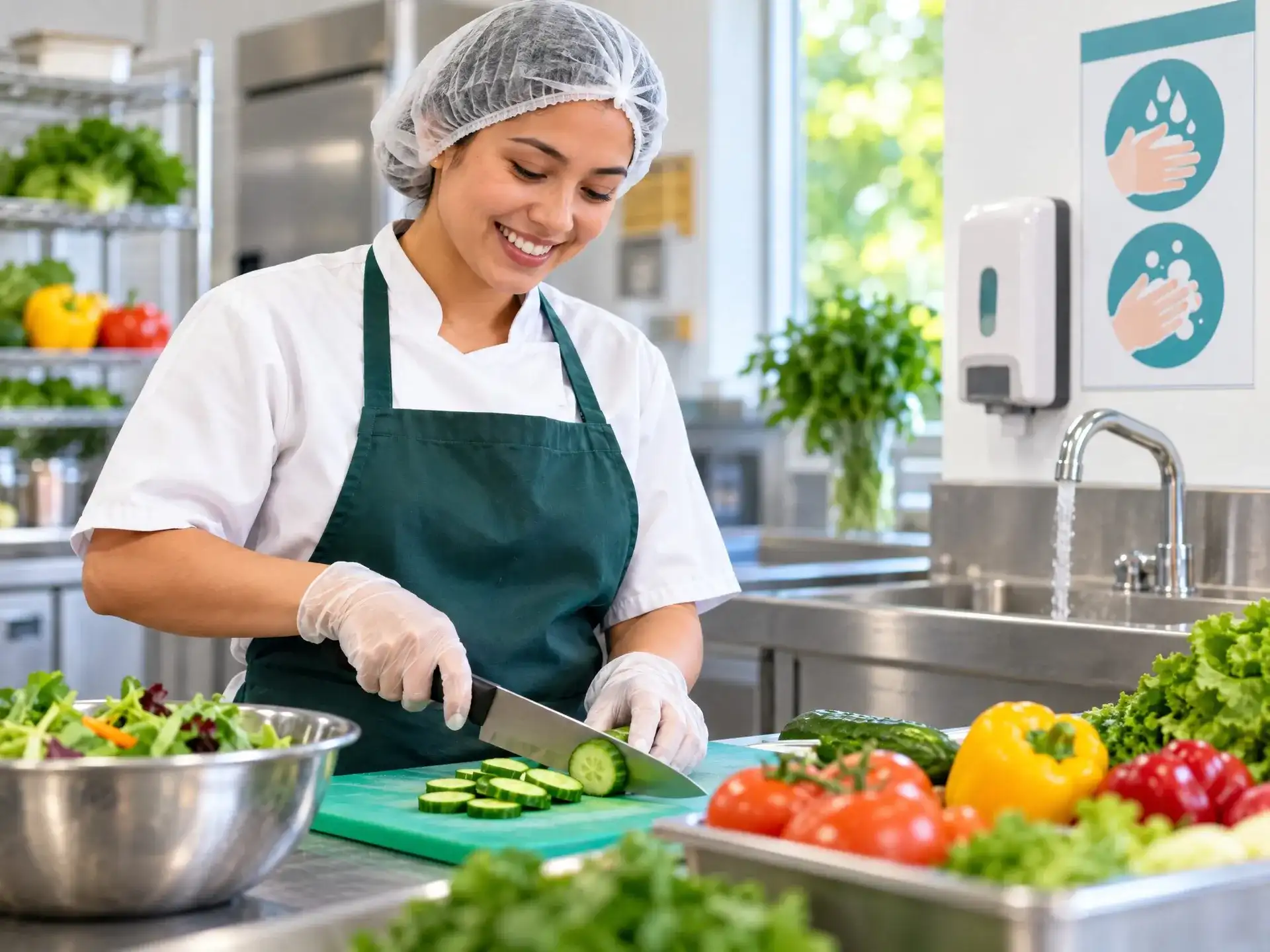
Food worker in a hairnet and gloves chopping vegetables in a clean kitchen
Free practice set · Original questions

All exams/Professional Certifications/Food Handler Certificate/Free questions

Free Food Handler Certificate practice questions

Tap an answer to see if you are right, and why. 20 questions across 6 topics, mostly Personal hygiene (5).

Passing score: 75% (target)
Format: Multiple-choice
Bank: 300 Qs (20 free)
100% Sourced explanations

Questions last updated November 6, 2026 · Questions written from the FDA Food Code topics covered by ANAB-accredited food handler programs (ANSI/ASTM E2659); not official provider items.

0 of 20 answeredTap an answer to check it
  1. Personal hygiene1 of 20

    A new hire asks how long they should scrub their hands during handwashing. What is the minimum required scrubbing time?

    The answer

    Answer: A. The scrub itself, with vigorous friction on hands and arms, must last at least 10 to 15 seconds. Twenty seconds is the minimum for the whole handwashing routine from wetting to drying, not the scrub alone. Thirty seconds is longer than required, and the water only needs to be warm (at least 100°F), not hot. Three to 5 seconds is far too short, because rinsing only carries away soil that friction has already loosened.

    Source: FDA Food Code 2022 — §2-301.12

  2. Personal hygiene2 of 20

    What is the minimum water temperature required for handwashing in a food establishment?

    The answer

    Answer: B. Handwashing sinks must supply water at a temperature of at least 100°F (38°C), warm enough to help soap lift oils from the skin. 110°F is the minimum for the wash compartment of a three-compartment sink, a dishwashing rule, not a handwashing one. 120°F is more than required and can make people rush the scrub. 80°F is below the minimum and does not loosen grease well.

    Source: FDA Food Code 2022 — §2-301.14

  3. Personal hygiene3 of 20

    A food handler finishes bussing dirty tables and is about to prepare salads. What must they do first?

    The answer

    Answer: C. Bussing tables soils the hands, so a full handwash is required before touching ready-to-eat food such as salad. Clean gloves put on over dirty hands pick up the contamination as they are pulled on. Hand sanitizer may be used only after washing, never in place of it. Changing the apron is good practice when it is dirty, but it does nothing about what is on the hands.

    Source: FDA Food Code 2022 — §2-301.11

  4. Personal hygiene4 of 20

    Which of these items must food handlers wear while working in food preparation areas?

    The answer

    Answer: A. Food handlers in prep areas must wear a hair restraint such as a hat, hair net, or beard cover so hair does not fall into food. Street clothes are not a requirement; what matters is clean outer clothing, and street clothes can carry dirt from outside. Open-toed shoes leave feet exposed to spills, hot liquids, and dropped knives. Bracelets and necklaces collect bacteria and can fall into food, so jewelry is removed except a plain band ring.

    Source: FDA Food Code 2022 — §2-402.11

  5. Personal hygiene5 of 20

    A cook has bandages on both hands while preparing food. What is the correct action?

    The answer

    Answer: C. A bandage on the hand must be covered with a single-use glove so the bandage cannot touch food or fall into it. A clean bandage still gets wet and soiled, and can carry bacteria from the wound, so leaving it uncovered is not enough. Being waterproof keeps water out but does not keep the bandage off the food. Exclusion is for illness symptoms such as vomiting or diarrhea, not for a covered wound on the hands.

    Source: FDA Food Code 2022 — §2-401.11

  6. Cross contamination6 of 20

    In a walk-in cooler, where should raw chicken be stored relative to other foods?

    The answer

    Answer: A. Raw poultry goes on the bottom shelf because it needs the highest cooking temperature, 165°F, so any juice that drips lands on nothing that will be cooked less. Sharing a shelf with ready-to-eat food lets raw juices reach items that will never be cooked. The top shelf above produce is the worst place, since everything below could be dripped on. Random placement ignores the top-to-bottom order the cooler is set up to follow.

    Source: FDA Food Code 2022 — §3-302.11

  7. Cross contamination7 of 20

    What is the correct order of steps when using a three-compartment sink?

    The answer

    Answer: B. Items are washed in detergent first, rinsed in clean water second, and sanitized third, then left to air-dry. Sanitizing before rinsing leaves detergent and soil on the item, and that residue weakens the sanitizer. Rinsing before washing wastes the step, because there is still grease to remove afterward. Starting with sanitizer applies it to dirty ware, where food soil shields germs from the chemical.

    Source: FDA Food Code 2022 — §4-501.110

  8. Cross contamination8 of 20

    What is the primary way to prevent cross-contact with food allergens during preparation?

    The answer

    Answer: A. Allergen cross-contact is prevented by washing hands and using equipment that has been washed, rinsed, and sanitized, or kept separate, for the allergy order. Higher cooking temperatures do not break down allergen proteins, so heat gives no protection. A dry towel only smears residue around the shared surface. Asking the guest to pick the allergen off the plate leaves traces behind that can still trigger a reaction.

    Source: FDA Food Code 2022 — §3-603.11

  9. Cross contamination9 of 20

    What is the required water temperature for the wash step in a three-compartment sink?

    The answer

    Answer: B. The wash compartment needs detergent solution at 110°F (43°C) or warmer to cut grease and loosen food. 171°F is the temperature for the hot-water sanitizing compartment, not for washing. 100°F is the minimum for handwashing sinks and is too cool for dishwashing. 75°F is the usual minimum for chemical sanitizer solutions such as chlorine or quats, and it will not remove grease.

    Source: FDA Food Code 2022 — §4-501.110

  10. Regulations10 of 20

    Under the FDA Food Code, when must a person in charge be present at a food establishment?

    The answer

    Answer: A. The license holder must make sure a person in charge is on site during all hours of operation, so someone is always responsible for food safety decisions. Being present only for inspections leaves most of the day unsupervised. The dinner rush is busy, but food is also received, prepped and cooled at other times. Deliveries are only one of many tasks that need oversight, along with checking temperatures and handling sick employees.

    Source: FDA Food Code 2022 — §2-101.11

  11. Time and temperature11 of 20

    How long can TCS food remain in the Temperature Danger Zone before it must be served immediately or discarded?

    The answer

    Answer: D. TCS food may spend at most 4 hours in the Temperature Danger Zone; after that it must be thrown out. One hour and 2 hours are stricter than the rule, and 2 hours is the limit for the first stage of cooling, not for total time out of temperature control. Six hours applies only to cold food under a written time-control plan that never lets it pass 70°F, so it is not the general limit.

    Source: FDA Food Code 2022 — §3-501.16

  12. Time and temperature12 of 20

    What is the correct two-stage cooling process for TCS foods?

    The answer

    Answer: D. Cooked TCS food must drop from 135°F to 70°F within 2 hours, then from 70°F to 41°F within the next 4 hours, for 6 hours in total. A single 6-hour window lets food linger in the fastest growth range above 70°F. Starting at 165°F confuses the reheating temperature with the start of cooling. Four hours from 155°F to 41°F names no first-stage checkpoint at 70°F, which is where the rule is strictest.

    Source: FDA Food Code 2022 — §3-501.15

  13. Cleaning and sanitizing13 of 20

    What is the key difference between cleaning and sanitizing?

    The answer

    Answer: D. Cleaning removes visible food and soil; sanitizing then reduces the remaining pathogens to safe levels. The option that swaps the two is backwards, since cleaning alone does not kill germs to a safe level. Cold water and a towel do not sanitize anything. Sanitizing can use chemicals or hot water, and cleaning uses detergent, so saying sanitizing is hot water only and cleaning is chemicals misstates both.

    Source: FDA Food Code 2022 — §2-101.11

  14. Cleaning and sanitizing14 of 20

    What is the required concentration range for chlorine (bleach) sanitizer?

    The answer

    Answer: A. ServSafe teaches chlorine sanitizer at 50 to 99 ppm, checked with chlorine test strips, which is the 50-100 ppm option here. 25 to 50 ppm is too weak for normal 75°F sanitizer water; lower chlorine strengths are allowed only in much hotter water. 10 to 25 ppm matches the iodine range of 12.5 to 25 ppm, not chlorine. 150 to 400 ppm is a typical range on quaternary ammonium labels.

    Source: FDA Food Code 2022 — §4-501.114

  15. Cleaning and sanitizing15 of 20

    After items are sanitized in a three-compartment sink, what is the correct next step?

    The answer

    Answer: D. After sanitizing, items go on a clean drainboard or rack to air-dry. Rinsing again with plain water would wash off the sanitizer before it finishes working and could add new contamination. Stacking items while still wet traps moisture, which lets bacteria grow. A cloth towel can carry germs back onto a surface that was just sanitized.

    Source: FDA Food Code 2022 — §4-501.110

  16. Cleaning and sanitizing16 of 20

    What temperature must hot water reach to be used as a sanitizing method in a three-compartment sink?

    The answer

    Answer: C. Hot-water sanitizing in a three-compartment sink requires water of at least 171°F (77°C), with items immersed for at least 30 seconds. 180°F is the final-rinse temperature for high-temperature dishmachines, not the manual sink minimum. 155°F and 140°F are too low to sanitize by heat alone. Keeping the water that hot usually needs a heater built into the sink compartment.

    Source: FDA Food Code 2022 — §4-501.110

  17. Food safety systems17 of 20

    Which HACCP principle involves identifying all food safety hazards at each step in the food process?

    The answer

    Answer: C. Principle 1 is the hazard analysis, where the team lists the biological, chemical, and physical hazards that could occur at each step, such as Salmonella on raw chicken. Principle 2 comes after and picks the points where those hazards can be controlled. Principle 3 sets the limits, like a minimum cooking temperature, for each control point. Principle 4 covers how those limits are checked during service.

    Source: FDA Food Code 2022 — §2-101.11 / ServSafe HACCP

  18. Food safety systems18 of 20

    What is a Critical Control Point (CCP) in a HACCP plan?

    The answer

    Answer: D. A critical control point is a step where control can prevent, eliminate, or reduce a hazard to an acceptable level, such as cooking chicken to 165°F. A posted cleaning schedule is part of basic sanitation, not a process step with a critical limit. Storing raw and cooked food together is a hazard, not a control. A handwashing station is a place, and handwashing is a prerequisite program rather than a CCP.

    Source: FDA Food Code 2022 — §2-101.11 / ServSafe HACCP

  19. Food safety systems19 of 20

    Which HACCP principle requires taking specific steps when monitoring shows a critical limit has not been met?

    The answer

    Answer: A. Principle 5 sets the corrective actions to take when monitoring shows a critical limit was missed, such as recooking or discarding the food. Principle 6, verification, checks that the whole plan works, for example by reviewing logs. Principle 7 covers keeping the records, including records of corrective actions, but it does not decide what the action is. Principle 2 identifies the control points before any limits exist.

    Source: FDA Food Code 2022 — §2-101.11 / ServSafe HACCP

  20. Food safety systems20 of 20

    What is the purpose of HACCP Principle 6: Verification Procedures?

    The answer

    Answer: C. Verification confirms the HACCP plan is working, through tasks such as calibrating thermometers, reviewing monitoring and corrective-action logs, and testing food. How long records are kept falls under Principle 7, record-keeping. Listing every hazard is the hazard analysis in Principle 1. Teaching cooking temperatures is training, which supports the plan but is not one of the seven principles.

    Source: FDA Food Code 2022 — §2-101.11 / ServSafe HACCP

Official Test Specs & Sourced Summary

The official Food Handler Certificate knowledge examination covers Multiple-choice with a passing threshold of 75%. Questions written from the FDA Food Code topics covered by ANAB-accredited food handler programs (ANSI/ASTM E2659); not official provider items. Every question on this page is original, with an explanation and a note citing its source.

Passing Score75% target
FormatMultiple-choice · item count and passing score set by your accredited provider and jurisdiction
Question Bank300 questions (20 free)

That’s the free set. The full bank has 300.

More original practice questions across the listed topics, a 40-question timed exam simulator, and saved mistake review. Internal QuizCram practice target. There is no single national food handler exam — each ANAB-accredited provider sets its own item count and passing standard, and jurisdictions differ. One payment of $8.99, yours forever.

Practice the free set