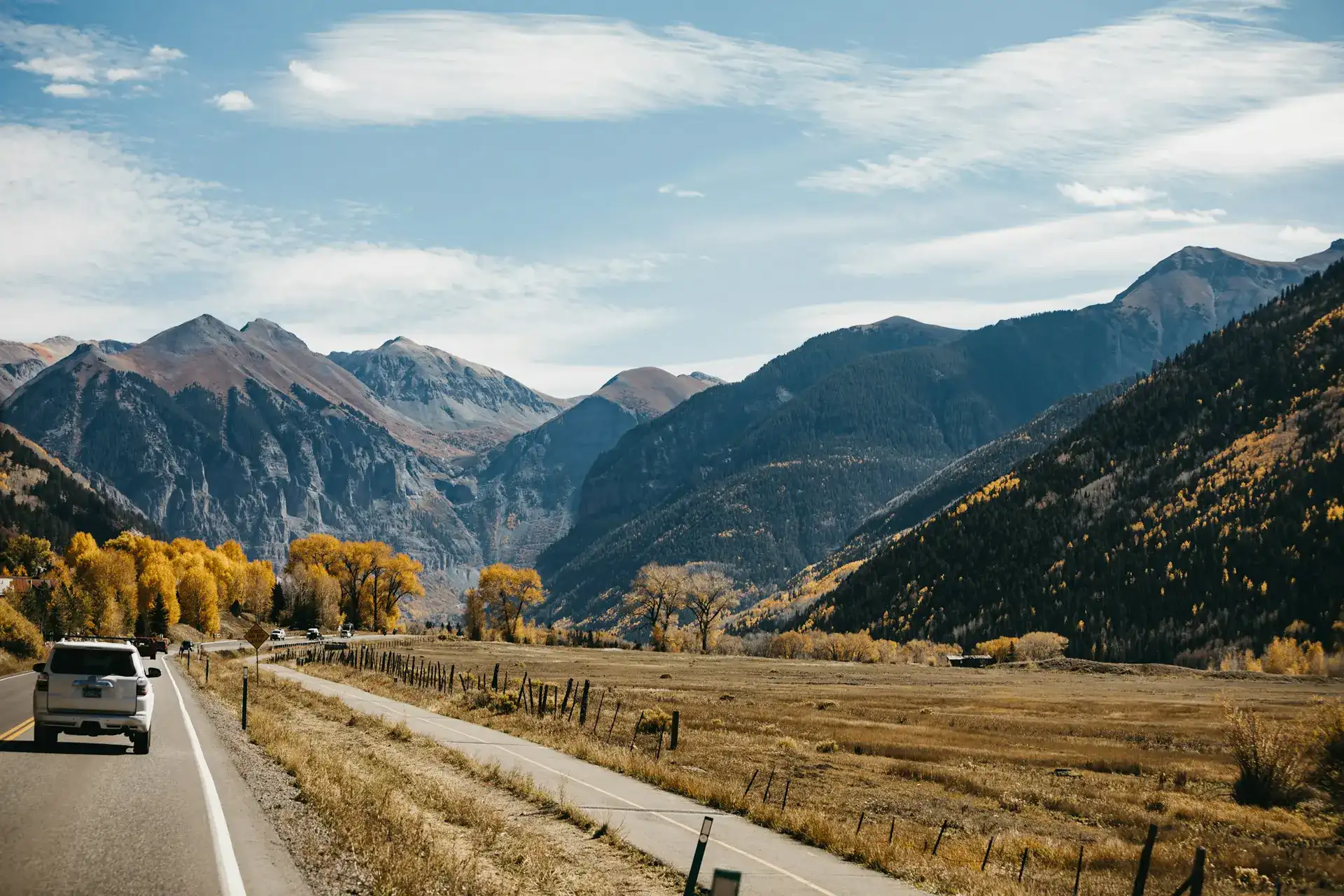
Mountain road through a green valley outside Telluride, Colorado

All exams/Driving & Licenses/Colorado DMV Permit/Free questions

Free Colorado DMV Permit practice questions

Tap an answer to see if you are right, and why. 20 questions across 10 topics, mostly Road signs (2), and 1 has a road sign to read.

Questions last updated October 18, 2026 · Original practice questions written from the Colorado Driver Handbook (Colorado Department of Revenue Division of Motor Vehicles, Form DR 2337, Revised 12/05/2024, January 2025 Edition) and checked against its text; not official DMV questions. Not affiliated with or endorsed by the Colorado Department of Revenue or DMV.

The real test

QuizCram 25-question practice sets · official question count and pass mark not published in the handbook.

The Colorado Driver Handbook publishes neither a question count nor a pass mark for the knowledge test

0 of 20 answeredTap an answer to check it
  1. Road signs1 of 20

    STOPWhat does this sign mean?

    What is the exclusive legal meaning of an eight-sided (octagonal) red traffic sign in Colorado?

    The answer

    Answer: A. An eight-sided octagonal red sign means you must come to a complete stop at the marked stop line. If there is no painted stop line or crosswalk, stop at the point nearest the intersecting roadway where you have an unobstructed view of approaching traffic. Rolling through a stop sign without stopping is a moving violation that endangers pedestrians and cross traffic.

    Source: CO Driver Handbook — Traffic Signs: Stop Signs (p. 7)

  2. Road signs2 of 20

    What action is legally required when you approach a downward-pointing triangular red-and-white sign?

    The answer

    Answer: A. A triangular red-and-white yield sign indicates that you must slow down or stop to yield the right-of-way to all pedestrians and any vehicle with right-of-way. You must stop completely if traffic conditions require it to avoid obstructing other vehicles or causing a collision. Proceed through the intersection only when the roadway is entirely clear of approaching conflicts.

    Source: CO Driver Handbook — Traffic Signs: Yield Signs (p. 7)

  3. Intersections and turns3 of 20

    What are the legal rules for turning right on a steady red light in Colorado?

    The answer

    Answer: D. After coming to a complete stop and yielding to pedestrians and oncoming traffic, you may turn right on a steady red light unless a sign prohibits it. You must remain stopped until cross traffic and pedestrians crossing in crosswalks have cleared the intersection. Turning without coming to a complete cessation of motion is illegal and subject to a traffic citation.

    Source: CO Driver Handbook — Traffic Signals: Steady Red Light (p. 7)

  4. Intersections and turns4 of 20

    When is a left turn legally permitted on a steady red light in Colorado?

    The answer

    Answer: D. You may turn left on a steady red light only when turning from a one-way street onto another one-way street, unless prohibited by a posted sign. You must first come to a complete stop before the stop line or crosswalk and yield to all pedestrians and oncoming traffic. Left turns on red into a two-way street are strictly prohibited under Colorado traffic statutes.

    Source: CO Driver Handbook — Traffic Signals: Left Turn on Red (p. 7)

  5. Alcohol and drugs5 of 20

    Under Colorado law, what Blood Alcohol Concentration (BAC) establishes driving under the influence (DUI per se) for adult drivers?

    The answer

    Answer: A. Driving with a blood alcohol concentration of 0.08 percent or higher constitutes driving under the influence per se for adult motorists age twenty-one or older. A first DUI conviction carries a nine-month driver license revocation, a fine of six hundred to one thousand dollars, and mandatory public service. Impaired drivers face mandatory jail sentences of five days up to one full year.

    Source: CO Driver Handbook — Driving Under the Influence: DUI Per Se (p. 4)

  6. Alcohol and drugs6 of 20

    What is the legal definition and blood alcohol threshold for Driving While Ability is Impaired (DWAI) in Colorado?

    The answer

    Answer: B. Driving While Ability Impaired is legally defined as operating a vehicle when alcohol or drugs have impaired your ability to the slightest degree. A blood alcohol concentration of 0.05 percent up to 0.08 percent establishes the statutory threshold for a DWAI charge in Colorado. A first DWAI conviction results in eight points assessed against your license, fines up to five hundred dollars, and required public service.

    Source: CO Driver Handbook — Driving Under the Influence: DWAI Definition (p. 4)

  7. Traffic signals and markings7 of 20

    What is the legal meaning of a broken yellow line painted in the center of a two-lane roadway?

    The answer

    Answer: D. A broken yellow line painted in the roadway center separates traffic lanes traveling in opposite directions and permits passing when the oncoming lane is clear. Before passing, ensure you have sufficient distance to complete the maneuver and return to your lane safely. Never attempt to pass when approaching curves, hills, or intersections where forward visibility is restricted.

    Source: CO Driver Handbook — Pavement Markings: Yellow Lines (p. 9)

  8. Traffic signals and markings8 of 20

    What does a single solid yellow line on your side of the center roadway marking indicate?

    The answer

    Answer: A. A single solid yellow line on your side of the center roadway marking means passing is strictly prohibited for your direction of travel. Colorado law allows drivers to cross this line only to turn left into a private road, driveway, or alley, or to pass a bicyclist with at least three feet of clearance. Passing other motor vehicles across a solid yellow line on your side is illegal.

    Source: CO Driver Handbook — Pavement Markings: Solid Yellow Lines (p. 9)

  9. Speed and space9 of 20

    Unless otherwise posted, what is the statutory speed limit in any Colorado business district?

    The answer

    Answer: A. Unless a different speed is posted on official signs, the statutory speed limit in any Colorado business district is 25 miles per hour. This speed limit is calibrated for dense urban commercial streets with frequent pedestrian foot traffic, delivery trucks, and parking maneuvers. Drivers must reduce speed below the posted limit whenever weather, congestion, or road hazards require greater stopping distance.

    Source: CO Driver Handbook — Speed: Business Districts (p. 12)

  10. Speed and space10 of 20

    Unless otherwise posted, what is the statutory speed limit in any Colorado residence district?

    The answer

    Answer: A. The statutory speed limit in any Colorado residential district is 30 miles per hour unless official signs indicate a different limit. Residential neighborhoods have frequent child pedestrians, parked vehicles, bicyclists, and driveway traffic that necessitate cautious driving speeds. Drivers must always adjust their speed downward when driving on narrow residential roads or under poor weather conditions.

    Source: CO Driver Handbook — Speed: Residence Districts (p. 12)

  11. Sharing the road11 of 20

    Under Colorado law, when must a driver yield the right-of-way to a pedestrian at an intersection?

    The answer

    Answer: D. Drivers must yield the right-of-way to pedestrians crossing the roadway at all intersections, regardless of whether crosswalks are marked with painted lines. Every street corner has an unmarked legal crosswalk where pedestrians possess statutory right-of-way over motor vehicles. Always slow down and remain prepared to yield whenever approaching any intersection where pedestrians are waiting to cross.

    Source: CO Driver Handbook — Right-of-Way: Pedestrians (p. 11)

  12. Sharing the road12 of 20

    What should you do if another vehicle ahead of you has stopped at a marked crosswalk to let a pedestrian cross?

    The answer

    Answer: C. When another vehicle has stopped at a marked or unmarked crosswalk to let a pedestrian cross, you must stop behind it and never attempt to pass. Passing a vehicle stopped for a pedestrian is strictly illegal and causes severe collisions because the passing driver cannot see the crossing pedestrian. Remain stopped until the pedestrian has safely reached the opposite curb or sidewalk.

    Source: CO Driver Handbook — Pedestrian Safety: Passing Stopped Vehicles (pp. 11, 19)

  13. Passing schoolbus13 of 20

    What must a Colorado driver do when approaching a school bus displaying flashing red lights and an extended stop arm?

    The answer

    Answer: B. When approaching a school bus displaying flashing red lights and an extended stop arm, you must stop your vehicle at least 20 feet away. You must remain completely stopped until the bus driver turns off the red flashing lights and fully retracts the stop signal arm. Passing a stopped school bus while children are loading or unloading carries heavy statutory fines and mandatory driving record points.

    Source: CO Driver Handbook — Right-of-Way: School Bus 20-Foot Stop Rule (pp. 11, 20-21)

  14. Passing schoolbus14 of 20

    What do flashing yellow (amber) lights on a Colorado school bus indicate to approaching drivers?

    The answer

    Answer: A. Flashing yellow warning lights on a Colorado school bus indicate that the bus is preparing to stop to load or unload children. Motorists must immediately slow down and prepare to bring their vehicle to a complete stop at least 20 feet away. Never accelerate to rush past a school bus displaying amber lights before the red flashing lights activate.

    Source: CO Driver Handbook — School Bus: Flashing Yellow Warning Lights (pp. 11, 20)

  15. Parking15 of 20

    When parallel parking along a curb on a Colorado street, what is the maximum legal distance from the curb?

    The answer

    Answer: C. When parallel parking alongside a roadway curb in Colorado, your vehicle wheels must be within 12 inches of the curb. The vehicle must be positioned parallel to the edge of the roadway and completely out of active traffic lanes. Parking more than one foot away from the curb obstructs the roadway and creates a serious hazard for passing traffic.

    Source: CO Driver Handbook — Parking: Parallel Parking 12-Inch Rule (p. 13)

  16. Parking16 of 20

    When parking facing downhill on a street with a curb, in which direction should you turn your front wheels?

    The answer

    Answer: A. When parking headed downhill on a street with a curb, turn your front wheels toward the curb (to the right). Allow the vehicle to roll forward slowly until the front tire rests gently against the curb, using it as a block. Set the parking brake firmly and shift an automatic transmission into park, or a manual transmission into reverse gear.

    Source: CO Driver Handbook — Parking on Hills: Downhill with Curb (pp. 13-14)

  17. Licensing (GDL)17 of 20

    Under Colorado's Graduated Driver Licensing (GDL) laws, how long must a minor hold an instruction permit before applying for a license?

    The answer

    Answer: A. Under Colorado's Graduated Driver Licensing laws, a minor driver must hold an instruction permit for a full twelve consecutive months before applying for a license. This mandatory twelve-month holding period applies regardless of the applicant's age at permit issuance or completion of driver education. The requirement ensures young drivers gain comprehensive experience across all seasons and roadway conditions.

    Source: CO Driver Handbook — GDL Requirements: 12-Month Permit Holding Period (pp. 1-2)

  18. Licensing (GDL)18 of 20

    How many hours of supervised driving practice must a minor complete and log before applying for a Colorado driver license?

    The answer

    Answer: A. Minor drivers must complete and log at least 50 hours of supervised driving practice, including at least 10 hours completed during nighttime hours. A parent, legal guardian, or licensed driving instructor must sign the official driving practice log certifying completion of these required hours. Logging sufficient practice hours builds essential hazard recognition skills before the applicant takes the behind-the-wheel driving test.

    Source: CO Driver Handbook — GDL Requirements: 50 Hours of Supervised Driving (pp. 1-2)

  19. Special conditions19 of 20

    On a narrow mountain road where two vehicles cannot pass, which vehicle must yield the right-of-way?

    The answer

    Answer: D. On a narrow mountain road where two vehicles cannot pass, the vehicle traveling downhill must yield the right-of-way by backing up. The driver traveling uphill has far less vehicle control when backing down a steep mountain slope than the driver facing downward. The downhill vehicle must back up carefully until finding a turnout or wider shoulder where the uphill vehicle can pass safely.

    Source: CO Driver Handbook — Mountain Driving: Downhill Yields to Uphill (pp. 11, 16)

  20. Special conditions20 of 20

    Under Colorado's 'Move Over' law, what must a driver do when approaching a stationary emergency or maintenance vehicle with flashing lights?

    The answer

    Answer: A. Colorado's Move Over law requires motorists approaching stationary emergency, tow, or maintenance vehicles with flashing lights to move over at least one lane. If changing lanes is unsafe or impossible, you must slow down to at least 20 miles per hour below the posted speed limit. If the speed limit is under 45 mph, you must slow down to 25 mph to protect roadside personnel.

    Source: CO Driver Handbook — Emergencies: Move Over Law (p. 11)

That’s the free set. The full bank has 300.

More original practice questions across the listed topics, a 25-question timed exam simulator, and saved mistake review. Internal QuizCram practice target (80%). The Colorado Driver Handbook does not publish the official question count or passing score; the knowledge test is administered at DMV driver license offices and online through the proctored @Home testing platform. One payment of $8.99, yours forever.

Practice the free set

Colorado DMV Permit alcohol and drug questions

36 of the 300 questions in the bank cover alcohol and drugs. 2 are free here, with the answer and where it comes from:

  • Under Colorado law, what Blood Alcohol Concentration (BAC) establishes driving under the influence (DUI per se) for adult drivers? Answer: A BAC of 0.08 percent or higher.CO Driver Handbook — Driving Under the Influence: DUI Per Se (p. 4)
  • What is the legal definition and blood alcohol threshold for Driving While Ability is Impaired (DWAI) in Colorado? Answer: Impaired to the slightest degree, typically indicated by a BAC of 0.05 percent up to 0.08 percent.CO Driver Handbook — Driving Under the Influence: DWAI Definition (p. 4)

All 36 alcohol and drug questions →